

GIORGIO MORANDI
1890-1964, ItalyGiorgio Morandi is best known for his small-scale still lifes: paintings, etchings and drawings of everyday objects in muted, almost dusty, tones. Notably, he rarely travelled outside the environs of his hometown of Bologna, even though his work was exhibited internationally.
Early Years
Giorgio Morandi was born in Bologna in 1890 and lived there for much of his life (the family’s summer home in Grizzana was only a few miles south-west of the city). Although he was expected to join his father’s export business, his time in the family firm wasn’t successful and in 1907 he enrolled at the Bologna Academy of Fine Arts. (He later became professor of engraving and etching at the same institution between 1930–1956.) He briefly dabbled with Futurism in 1914 and joined the army in 1915, although was discharged quickly. Between 1918 and 1922 he practiced metaphysical painting.
Giorgio Morandi: Artworks
Giorgio Morandi’s subtle depictions of bottles, jars, and other everyday objects are his best-known pieces. His studio was in the home he shared with his sisters, although he also established studio space in Grizzana. Influenced by Cézanne and Italian Renaissance artists, he created 1,350 oil paintings during his career, exploring subtle variations of shape and colour.
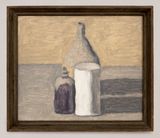
- Natura morta (1941) is one of a series of paintings exploring varying layouts of the same jug, vase and other vessels; muted tones in a matt light capture five objects in his Bologna studio. The painting sold in 2011 for £541, 250 at Christie’s in London.
- Morandi produced a rare variant of the Natura morta series in 1940—it achieved the artist’s record auction price in 2018, selling for $4,332,500 at Christie’s in New York City (it had been in the collection of Peggy and David Rockefeller).
- During the Second World War, in Grizzana, Morandi was inspired by his surroundings. 1942’s Landscape at Grizzana (currently on display in the Pitti Palace in Florence), he outlines the shapes of trees and hills in green tones, while using Cézanne-style cube shapes to depict a house.
Giorgio Morandi: Select Awards
- First Prize for Painting, 24th Venice Biennale (1948)
- Grand Prize for Engraving, second São Paulo Biennale (1953)
- Grand Prize for Painting, fourth São Paulo Biennale (1957)
- Rubens Prize (1962)
Giorgio Morandi: Select Posthumous Exhibitions
- Giorgio Morandi: Solo, Museum of Art Pudong, Shanghai (2026)
- Giorgio Morandi: Masterpieces from the Magnani-Rocca Foundation, David Zwirner, New York City (2025)
- Giorgio Morandi, David Zwirner, New York City (2015)
- Giorgio Morandi, Retrospective, Centre for Fine Arts, Brussels (2013) * Giorgio Morandi. Three Watercolours and Twelve Etchings, Fundación Juan March (2010) (and touring)
- Morandi: Master of Modern Still Life, The Phillips Collection, Washington DC (2009)
- Giorgio Morandi, 1890–1964, MoMA, New York City (2008)
- The Later Morandi: Still Lifes 1950–1964, Galleria dello Scudo, Veron (1997) (and touring)
Select Group Exhibitions
- Set in Stone, David Zwirner, New York City (2026)
- Whispers of the Soul, Villepin, Hong Kong (2023)
- Seen in the Mirror: Things from the Cartin Collection, David Zwirner, New York City (2021)
- Albers and Morandi: Never Finished, David Zwirner, New York City (2021)
- A Backward Glance: Giorgio Morandi and the Old Masters, Guggenheim Bilbao (2019)
Further Reading
- Artist profile page at David Zwirner
- Inside Morandi’s summer home from Upstate Diary (2022)
- Sidney Tillim writes about Giorgio Morandi in Artforum (1967)
Giorgio Morandi FAQs
What was Giorgio Morandi’s studio like?
The American scholar Jon Rewald visited Morandi’s studio and his description of the space is frequently quoted. “No skylight, no vast expanses; an ordinary room of a middle-class apartment lit by two ordinary windows. But the rest was extraordinary: on the floor, on the shelves, on a table, everywhere, boxes, bottles, vases, all kinds of containers in all kinds of shapes. They cluttered any available space, except for the two simple easels; they were either crowded together haphazardly, or else, here and there, assembled more loosely in balanced compositions... They must have been there for a long time; on the surfaces of the shelves or tables, as well as on the flat tops of boxes, cans, or similar receptacles, there was a thick layer of dust. It was a dense, grey, velvety dust, like a soft coat of felt, its colour and texture seemingly providing the unifying element for these tall bottles and deep bowls, old pitchers and coffee pots, quaint vases and tin boxes. It was a dust that was not the result of negligence and untidiness but of patience, a witness to complete peace. In the stillness of this humble retreat from all the excitement of an agitated world, these everyday objects led their own, still life.”
What techniques and styles did Giorgio Morandi use?
After 1922, Morandi developed what came to be known as his signature style: muted colours (earthy tones including pale brown, ochre, reds and blues) and broad brushstrokes depicting still lifes of everyday objects, rendered in a hazy quality with softened edges. His paintings were often small and rapidly produced.
What did Giorgio Morandi do during the Second World War?
Morandi’s work was not popular with the Fascists during the 1940s because it did not fit into the La Romanità theme. However, his work was included in the Ministry of Education’s contemporary art exhibition in 1941. During the war, his output was prolific: he created more than 130 artworks between 1940 and 1943. Returning from Grizzana to Bologna in 1944, a city under German occupation, he produced much less work.
Ocula

Recently Exhibited





Giorgio Morandi in Ocula Magazine





Explore and Follow Artists Shaping Contemporary Art
A respected voice in contemporary art discourse.
Focusing on ambitious storytelling and insightful art-world commentary. Ocula Magazine publishes in-depth interviews, critical essays and timely analysis on the artists, exhibitions and ideas driving the global art world.
Learn more about Ocula Magazine
Showcasing the best of the art world.
Ocula partners with galleries from around the world to highlight their artists, artworks and exhibitions. Gallery membership is by application and invitation, with each member vetted by an independent panel.
Learn more about Ocula Membership
Specialises in the sale of major artworks.
Led by a team with deep ties to the world’s leading auction houses, galleries and collectors. Ocula’s advisory team offers bespoke services to high-net-worth clients from around the world who are looking to acquire the best of contemporary and modern art.
Learn more about our team and services