






GLENN BROWN
b. 1966, United KingdomNominated for the Turner Prize in 2000, Glenn Brown is known for appropriating well-known images ranging from Renaissance paintings to Frank Auerbach and Salvador Dalí.
Artworks
Glenn Brown’s artworks merge the traditions of oil painting with a futuristic sensibility, producing unsettling reinterpretations of familiar images. Known for his extraordinarily detailed technique and flat, eerie surfaces, his work explores appropriation, memory, and transformation across painting, sculpture, and drawing. Brown’s practice meditates on the decay and mutation of images, highlighting how art is endlessly reproduced, distorted, and re-experienced across time.
Quoting the Old Masters
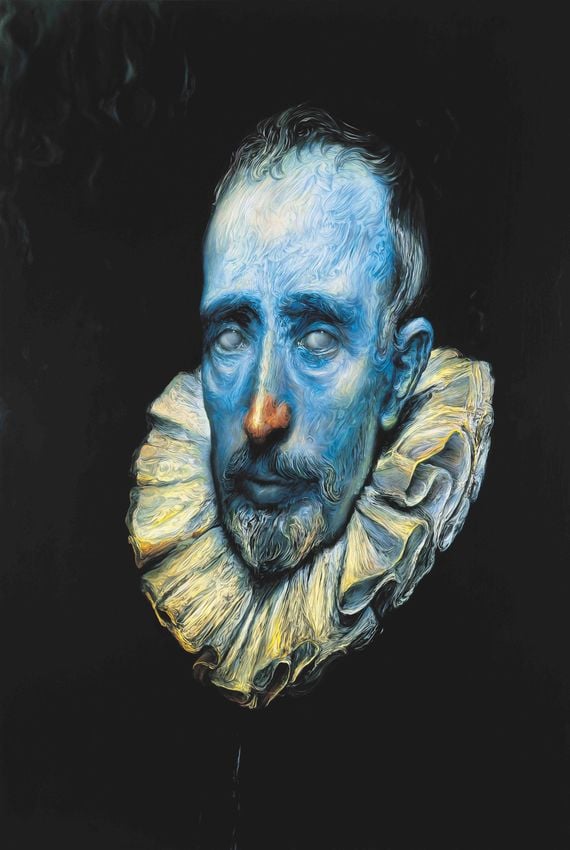
Brown first came to prominence in the 1990s with paintings that directly quoted other artists—Rembrandt, Auerbach, Dalí, and sci-fi illustrators—transforming their work into distorted, hyperreal versions. He manipulated these source images digitally, often exaggerating colour or elongating forms, before rendering them in oil with painstaking precision. Loves of Shepherds (1995), his controversial reworking of Tony Roberts’ sci-fi cover art, drew critical attention for its bold engagement with authorship and originality. These works do not simply copy—they dissect, flatten, and fictionalise historical artworks, collapsing centuries of art history into uncanny hybrids that question what it means to “own” an image in contemporary art.
Paint as Phantasm
A defining characteristic of Brown’s paintings is their deceptive surface. What appears in reproduction as thickly textured paint is, in person, hauntingly smooth. This illusion plays with the viewer’s expectations, creating a dissonance between the perceived and the real. Faces and figures seem to dissolve into swirling, decaying brushstrokes, as in Oscillate Wildly (2010), where a head appears to melt into abstraction. The grotesque beauty of these works lies in their refusal to settle into fixed meaning—each painting is a phantasmagoria of historical references, fleshy distortions, and visual tricks that seduce and repel simultaneously. Brown uses paint to evoke both material presence and spectral absence.
Sculptural Transformations
Since the mid-2000s, Brown has expanded his practice to include sculpture, treating three-dimensional forms with the same referential intensity as his paintings. Often casting from historical busts, he reshapes these figures by adding textured elements or painting their surfaces in swirling oil. Works like Layered Dismemberment (2015) resemble painted ghosts of antiquity, where the subject’s features are obscured by abstract, gestural matter. These hybrid forms explore the tension between permanence and mutation, suggesting that even the most canonical figures can be unmade and remade. Brown’s sculptures are often installed in salon-style arrangements, alongside his drawings and paintings, to foster dialogue between forms, epochs, and media.
Recent Developments
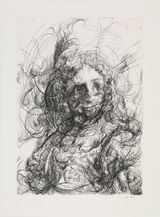
Brown’s opening of the Brown Collection in London in 2021 marked a new chapter in his practice. Housed in a converted mews building near his studio, the space presents rotating installations curated by the artist, combining his own works with items from his personal collection—antique drawings, historical sculptures, and rare books. These exhibitions collapse boundaries between public gallery, personal archive, and conceptual artwork. In this context, Brown’s drawings, which feature densely crosshatched lines and curling forms, become meditations on time, repetition, and death. The Brown Collection underscores his interest in how artworks inhabit time, acting as vessels of memory, decay, and resurrection.
Awards and Accolades
- Commander of the Order of the British Empire (CBE) (2019)
- Shortlisted for South Bank Show Award (2005)
- Shortlisted for Turner Prize (2000)
Exhibitions
Glenn Brown has been the subject of both solo exhibitions and group exhibitions at important institutions. A selection of important exhibitions are provided below.
Solo Exhibitions
- The Real Thing Part 1 and 2 (Retrospective), Sprengel Museum and Landesmuseum, Hanover (2023)
- Carte Blanche à Glenn Brown – FIAC Hors les Murs 2019, Musée national Eugène Delacroix, Paris (2019)
- Des Moines Art Center, Des Moines; Contemporary Arts Center, Cincinnati (2016)
- Suffer Well, Fondation Vincent van Gogh, Arles (2016)
- Tate Gallery, Liverpool. Travelled to: Fondazione Sandretto Re Rebaudengo, Turin; Ludwig Museum - Museum of Contemporary Art, Budapest (2009)
- Serpentine Gallery, London (2004)
Group Exhibitions
- Copistes, Centre Pompidou-Metz (2025)
- Contemporary Collecting: David Hockney to Cornelia Parker, British Museum, London (2024)
- NGV Triennial 2023, National Gallery of Victoria, Melbourne (2023)
- Reaching for the Stars. From Maurizio Cattelan to Lynette Yiadom-Boakye, Fondazione Palazzo Strozzi, Florence (2023)
- Les Choses (Things), Louvre Museum, Paris (2022)
- Arcimboldo Face to Face, Centre Pompidou-Metz, Metz (2021)
Website and Instagram
Glenn Brown’s website can be found here, and his Instagram here.
Critical Reception
Glenn Brown’s practice has been extensively featured in leading publications including The Art Newspaper, The Guardian, and The Telegraph.
Glenn Brown FAQs
What is Glenn Brown best known for?
Glenn Brown is best known for his richly detailed oil paintings that reimagine art historical and pop culture imagery through digital manipulation and painterly precision. His artworks are visually seductive yet grotesque, often featuring warped faces, swirling textures, and smooth, illusionistic surfaces. By referencing artists such as Rembrandt, Dalí, and sci-fi illustrators, Brown explores ideas of authorship, originality, and transformation. His work has become a hallmark of contemporary art’s obsession with image recycling and historical reinterpretation.
How does Glenn Brown make his paintings?
Brown’s creative process begins by selecting an existing artwork—often a painting by an Old Master or a 1970s science fiction book cover—and digitally manipulating it through distortion, layering, and exaggeration. He then painstakingly recreates the altered image in oil paint using fine brushes to achieve smooth, almost airbrushed finishes that contradict the expressive chaos of the forms depicted. This contradiction between digital flatness and painterly illusion is central to his practice, creating unsettling artworks that appear both classical and futuristic.
Why was Glenn Brown’s Turner Prize nomination controversial?
Brown’s 2000 Turner Prize nomination attracted controversy due to his use of Tony Roberts’ sci-fi artwork in Loves of Shepherds (1995), which some critics saw as plagiarism. Although Brown had radically altered the original image in scale, palette, and style, the work raised questions around appropriation, originality, and the boundaries of artistic authorship. The debate became a flashpoint in contemporary art, highlighting how image manipulation and remixing—common in music and digital culture—could unsettle traditional ideas of intellectual property in painting.
Ocula | 2025

Recently Exhibited








Explore and Follow Artists Shaping Contemporary Art
A respected voice in contemporary art discourse.
Focusing on ambitious storytelling and insightful art-world commentary. Ocula Magazine publishes in-depth interviews, critical essays and timely analysis on the artists, exhibitions and ideas driving the global art world.
Learn more about Ocula Magazine
Showcasing the best of the art world.
Ocula partners with galleries from around the world to highlight their artists, artworks and exhibitions. Gallery membership is by application and invitation, with each member vetted by an independent panel.
Learn more about Ocula Membership
Specialises in the sale of major artworks.
Led by a team with deep ties to the world’s leading auction houses, galleries and collectors. Ocula’s advisory team offers bespoke services to high-net-worth clients from around the world who are looking to acquire the best of contemporary and modern art.
Learn more about our team and services