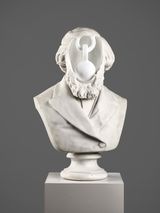
Jonathan Owen’s practice is concentrated in processes of reduction, erasure, reconstruction, and manipulation. Through labour-intensive techniques, including marble carving and delicate erasure with a standard rubber eraser, Owen transforms readymades and reactivates their materiality.
Early Works
Owen’s early practice examined ideas around masculinity through collage, painting, and drawing. Referencing found materials such as car manuals, martial arts guides, pornography, and men’s magazines, the artist manipulated images associated with male identity and culture in provocative subversions of gendered tropes.
Eraser Drawings
The artist is known for his ongoing ‘Eraser Drawings’ series, produced from as early as 2009. For these works, the artist uses an eraser to carefully alter found monochromatic photographs from old books, erasing specific elements and reshaping pigments to subtly restore the backgrounds in different configurations. The resulting ‘drawings’ bear subtle traces of their transformation, with their partial erasure not always immediately apparent. Reminiscent of Robert Rauschenberg‘s Erased de Kooning Drawing (1953), in which the American artist near-completely erased a drawing by his contemporary Willem de Kooning, Owen’s ‘Eraser Drawings’ similarly question ideas around authorship through enigmatic conceptual gestures.
In Eraser Drawing (Backstage) (2018), a ghostly trace of a figure can be spotted on a stage setting, while in Eraser Drawing (Michael Caine) (2020), the faint impression of hands presumably belonging to the actor Caine are just visible within a cluttered shop interior. Speaking to transience, absence, and memory, Owen’s analogue erasures complicate renewed readings of their images through selective decisions on what is revealed or obscured.
Sculptures
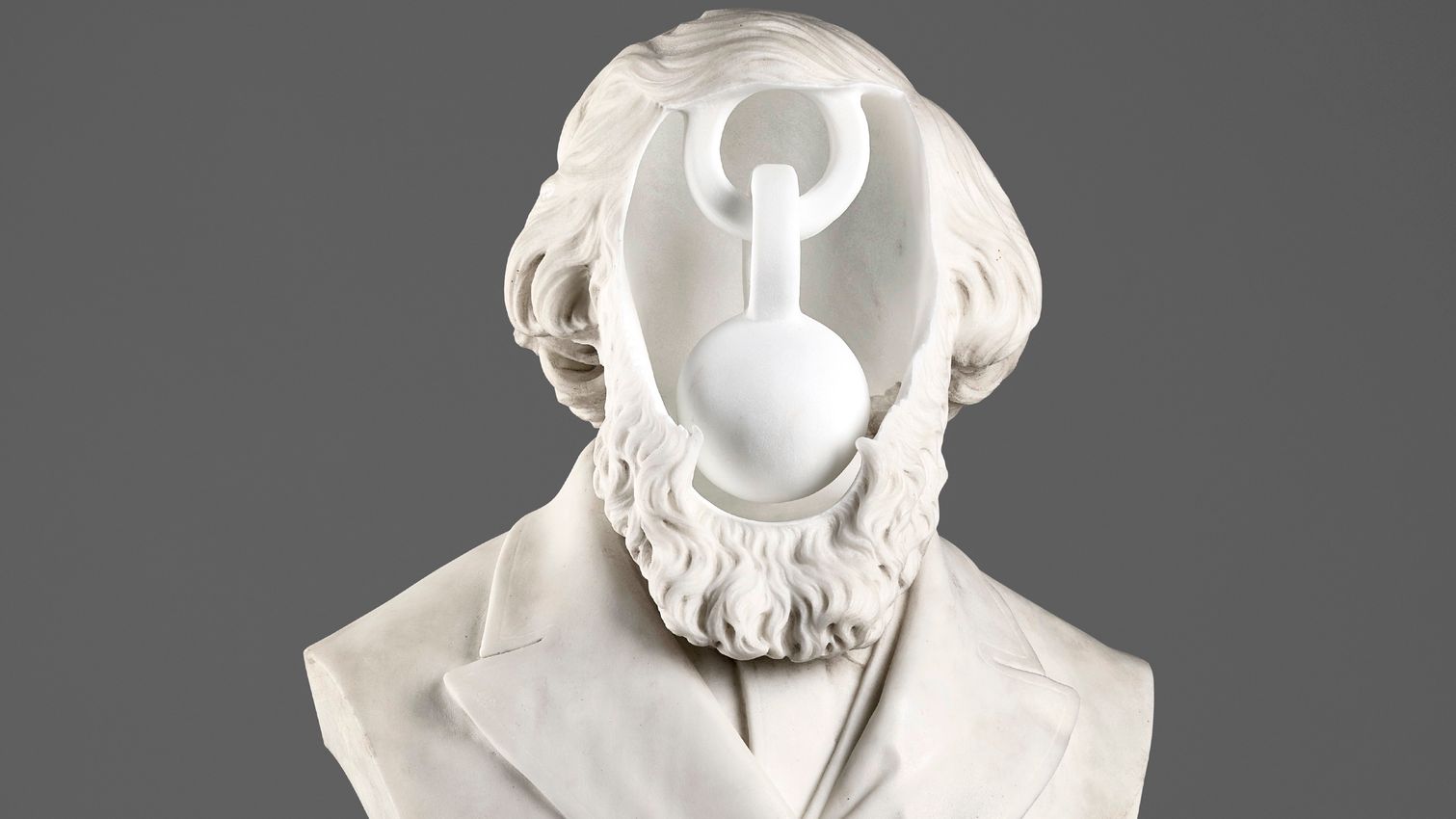
Though a similarly subtractive process, Owen reworks antique marble busts and statues, typically from the 18th or 19th century, carving out elements of the sculptures to reveal new abstracted forms and voids. He describes his manipulation of existing sculptures as a means ‘to subvert and puncture this familiar rhetoric, and so to reactivate the object through transformation rather than destruction, to make a new proposition.’
Mercury (2012) is a 19th-century marble statue of the Roman god, whose torso has been partially carved out by the artist into an abstract geometric form. For the 2016 Edinburgh Art Festival, Owen presented Untitled (2016), a simiarly reworked 19th-century life-sized statue of a nymph in white marble, for which the artist carved away parts of the nymph’s torso to reveal numerous interlocking chains.
Owen typically withholds information on the statues’ original artists and titles, conflating concepts such as appropriation and anachronism, while simultaneously destabilising the perceived permanence and grandiosity of historic sculptures.