





KAZU NAKAGAWA
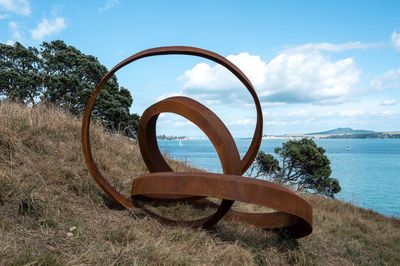
Noted for the creation of enigmatic worlds in miniature – in a variety of materials - while also for imbuing a large-scale public library with an almost mystical presence, interior and exterior, Kazu Nakagawa confounds ‘labeling’. Critics writing about his artworks write of ‘absence’; ‘matter and nothingness’; ‘ambiguously elegiac’; ‘materiality becomes an imprecise notion’. The ‘reality’ is that Nakagawa’s works embrace and conform to, if such a thing is possible, the Japanese concept of ‘ma’ – the space between, the distance between, the room between or around things.
Having exhibited extensively, survey exhibitions of Nakagawa’s work have been held at Te Tuhi and The Dowse Art Museum. He is represented in the Collections of The Dowse Art Museum and Christchurch Art Gallery, and has works in numerous private collections in Australia, UK, USA, New Zealand and the New Zealand Embassy in Japan.
Growing up in Tokyo, Nakagawa ‘felt’ his way towards art-making, much as he made the transition from Japan to New Zealand by container ship, so he could ‘feel the distance’ of the journey. Having studied Mathematics, Language, Engineering and Navigation in Tokyo, he then worked as a product designer for windsurfing manufacture in Tokyo and was later apprenticed for furniture making and graphic design as his focus shifted towards the arts. Nakagawa’s emigration to New Zealand in 1986 was followed with further development in furniture/design in Auckland and a move to Waiheke Island in 1988, where he still lives and works.
Nakagawa’s art practice is informed by his fundamental philosophical positions. His materiality (or often, seeming immateriality) is determined by the conceptual underpinning of each work – he will utilize as required: wood, metal, concrete, canvas, paint, graphite, paper, fabric; a recent work addressing notions of identity utilizes (approximately) 108,000 of his own thumbprints in ink on twenty 3-metre-lengths of cotton; the immateriality of his carved calligraphy on the Waiheke Library, delicately concealed or revealed by the changing play of
light, was achieved through many months ‘perching on the scaffold with chisel and hammer in the rain, sun and wind through winter.’
While Nakagawa’s work is often described as minimalist, or rooted in architecture and its precepts, the artist’s own words belie these ready classifications: ‘I fall into another half [of my brain] which always makes things blur, so boundaries have less meaning. An architecture becomes a piece of paper or a piece of paper becomes an architecture. Several months of carving becomes a ‘blink’ of brush stroke. A moment becomes endless. It is actually a process of simplifying what I see, and in this way it is utterly incommunicable unless putting in an art form.’
Nakagawa lives and works on Waiheke Island, New Zealand.
Text courtesy Trish Clark Gallery.


Explore and Follow Artists Shaping Contemporary Art
A respected voice in contemporary art discourse.
Focusing on ambitious storytelling and insightful art-world commentary. Ocula Magazine publishes in-depth interviews, critical essays and timely analysis on the artists, exhibitions and ideas driving the global art world.
Learn more about Ocula Magazine
Showcasing the best of the art world.
Ocula partners with galleries from around the world to highlight their artists, artworks and exhibitions. Gallery membership is by application and invitation, with each member vetted by an independent panel.
Learn more about Ocula Membership
Specialises in the sale of major artworks.
Led by a team with deep ties to the world’s leading auction houses, galleries and collectors. Ocula’s advisory team offers bespoke services to high-net-worth clients from around the world who are looking to acquire the best of contemporary and modern art.
Learn more about our team and services