Max Bill was an architect, painter, sculptor, industrial designer, and graphic designer. His graphic design work was met with acclaim for its innovative typography, while his industrial designs, which included furniture and timepieces, became icons of 20th-century design. The 1954 Ulm stool, produced by Bill in collaboration with Dutch designer Hans Gugelot, is an enduring piece of mid-century furniture celebrated for its sleek, minimal form and utilitarian versatility. Bill’s Junghans clock (1956–1957) and Junghans watch (1961) similarly became famous for their clarity, simplicity, and functionality.
Bill was a major proponent of Concrete Art, a term coined by Theo van Doesburg, and stated that its aim was to create ‘in a visible and tangible form things which did not previously exist—to represent abstract thoughts in a sensuous and tangible form’. Concrete Art championed art that was devoid of symbolism and without basis in observable reality. Bill began making sculptures in the early 1930s, and later works such as Konstruktion aus einem Kreisring (Construction from a ring) (1942) and Endless Loop (1953–1956) form visualisations of geometric and mathematical concepts, notably the Möbius strip.
Max Bill Paintings
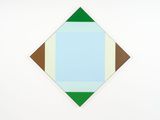
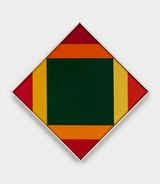
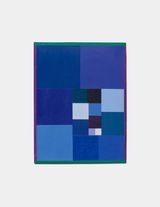
Bill’s paintings reflect his background in the Bauhaus movement. His works demonstrate a meticulous consideration of colour, balance, and proportion, with the surface carefully plotted to render shapes and planes in relation to the canvas. Expansion in Four Directions (1961–1962) features the distinct tilted square format also used extensively by Bill’s contemporary Piet Mondrian and sees tension generated in the pictorial space through an irregular demarcation of corners and layers. System mit vier gleichem farbquanten (System with Four Equal Colour Quanta) (1970) contains four variations of block colour combinations, neatly arranged in geometric order. Bill viewed the integration of mathematics and geometry with design and art as a way to rationalise the chaos of art and the natural world and to unify visual language.