





REENA SAINI KALLAT
b. 1973, IndiaMumbai-based artist, Reena Saini Kallat works with diverse media to deliberate conflict and co-existence. Anchored in archival research, Kallat’s artworks probe critically into history, collective memory, identity, and perception through careful considerations of material such as official records, state-constitutions, maps, and archaeological surveys.
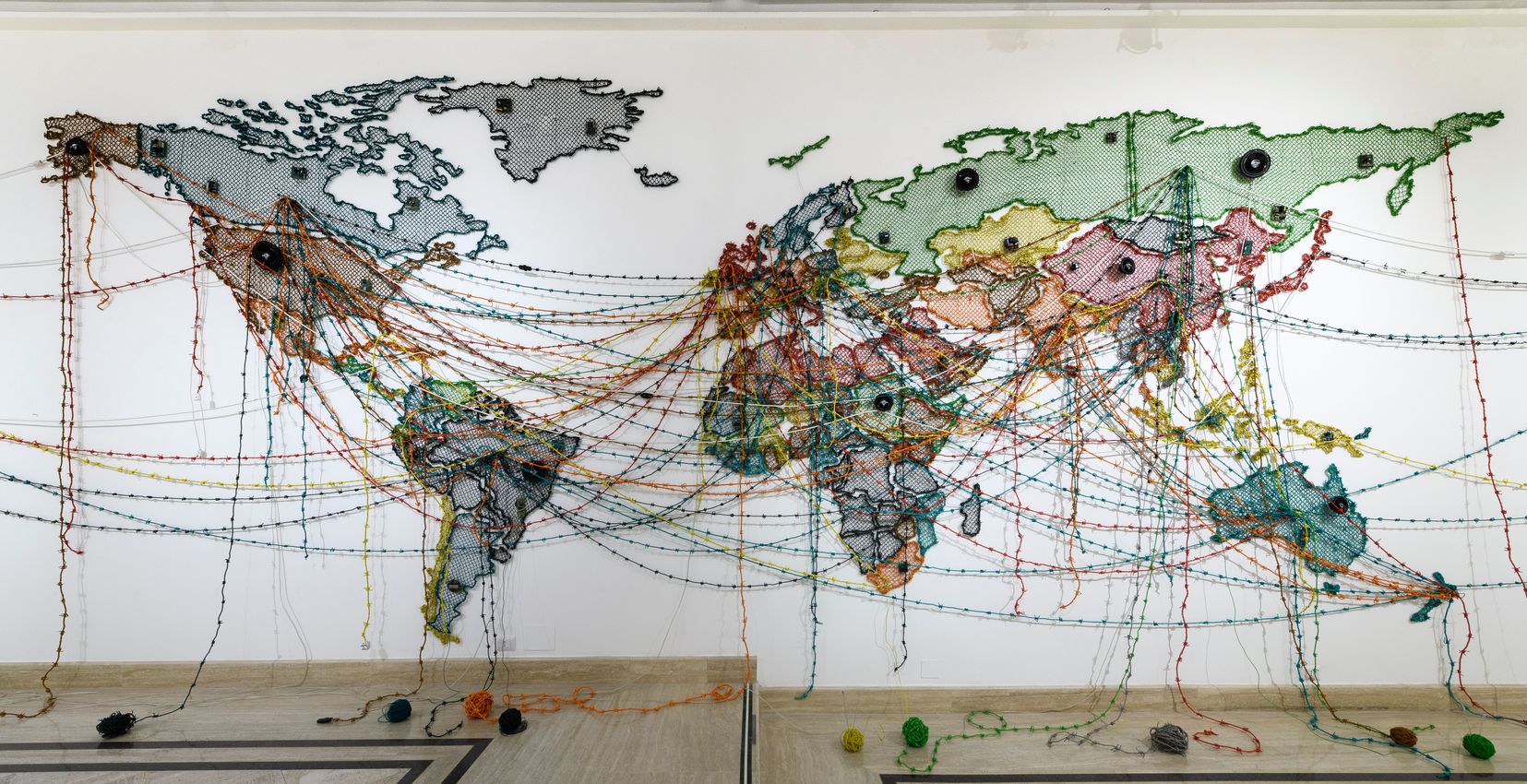
For Kallat, man-made borders shape perceptions of spaces, turning geographical terrain into political territory and subsequently creating psychological divides between communities. In Woven Chronicle (2011-2016), showcased at the Konsthall Goteburg, Vancouver Art Gallery, and MoMA, Kallat depicted a map tracing historical movements of migrants using electric cables. These wires symbolise carriers of information that bring the world closer, as well as barriers tearing regions apart, highlighting the irony of applauding a well-connected world.
To expose the arbitrariness of territorial-skirmishes, Kallat frequently draws attention to ecosystems and indigenous vegetation. In 2010, she participated in a River Biennial in Sydney, in which her work, 2 degrees was inspired by the Copenhagen Climate Change Conference. That year, River Indus overflowed across Indian and Pakistani provinces of Punjab, transgressing political boundaries. In 2013, Kallat began working on her Hyphenated Lives series, visualising hybridized birds, animals, trees, and flowers made from national symbols of politically-divided countries. These imaginary beings confront regional divides, proposing a reunification in the future. The series was displayed at Kallat’s 2017 exhibition Earth Families at the Manchester Museum, along with Cleft (2017) and Garden of Forking Paths (2017), where the hybrids inhabit the same landscape, emphasising our inherent inter-dependence. In her sound sculptures, Chorus I and II (2015-2019), modelled on acoustic devices built during the World Wars to track enemy aircrafts, national birds of ‘enemy-nations’ sing to each other to subvert premises of war. Kallat’s references to nature recall deeper time, highlighting the historical specificity of ostensibly eternal political constructs.
Kallat often references foundational legal texts that legitimise nations. The video, Synapse (2011) depicts the preamble to the Constitution of India on an eye chart, being read by patients in a clinic. Verso-Recto-Recto-Verso (2017-2019), a two-part hand-dyed bandhini scroll depicts paragraphs of India and Pakistan’s constitutions, printed in part-Braille, part Roman script. The video-installation, Blind Spots (2019), also features shared ideas from preambles to constitutions of conflict-ridden countries in the form of Snellen eye charts where the English text morphs into Braille. The inscrutability of these texts reveal how commonalities between conflict-areas are masked politically, generating a collective amnesia. Kallat reminds viewers to be critically aware of what is made obscure, to recognise the futility of political divides, and to challenge bureaucratic apparatus that manipulate perception.
Text courtesy Chemould Prescott Road






Explore and Follow Artists Shaping Contemporary Art
A respected voice in contemporary art discourse.
Focusing on ambitious storytelling and insightful art-world commentary. Ocula Magazine publishes in-depth interviews, critical essays and timely analysis on the artists, exhibitions and ideas driving the global art world.
Learn more about Ocula Magazine
Showcasing the best of the art world.
Ocula partners with galleries from around the world to highlight their artists, artworks and exhibitions. Gallery membership is by application and invitation, with each member vetted by an independent panel.
Learn more about Ocula Membership
Specialises in the sale of major artworks.
Led by a team with deep ties to the world’s leading auction houses, galleries and collectors. Ocula’s advisory team offers bespoke services to high-net-worth clients from around the world who are looking to acquire the best of contemporary and modern art.
Learn more about our team and services