






WAYNE THIEBAUD
b. 1920, United StatesWayne Thiebaud (1920—2021) was an American painter known for his impasto depictions of cakes, sweets, and suburban San Francisco. His iconic works simultaneously celebrated and critiqued American culture. While his focus on consumer culture frequently linked him to the Pop Art movement, Thiebaud’s work distinguished itself with thickly applied paint, vibrant hues, and nostalgia.
What was Wayne Thiebaud’s early life like?
Born in Mesa, Arizona, Wayne Thiebaud grew up in Long Beach, California. His early passion for art was nurtured through diverse creative roles, including an apprenticeship at Walt Disney Studios, where he contributed to animations of classic characters like Goofy and Pinocchio. He was a cartoonist and artist in the U.S. Army Air Forces during World War II.
After the war, Thiebaud pursued formal studies, earning both bachelor’s and master’s degrees at Sacramento State College (now California State University, Sacramento). He later became a professor of art at the University of California, Davis, mentoring future generations of artists while continuing to refine his practice.
What defined Wayne Thiebaud’s artistic style?
Thiebaud’s style is recognisable from his use of thick, textural paint, known as impasto, which gave his works a tangible, sculptural quality. His vibrant palette and attention to light and shadow afford his subjects a heightened sense of depth and perception.
Though often linked to Pop Art, Thiebaud’s work diverged from the criticality and detached irony of many other figureheads, like Koons or Warhol. Instead, Thiebaud’s paintings focus on subjects like desserts and diners with a nostalgic reverence. His fascination with geometry and perspective is especially evident in his later cityscapes, where steep, surreal angles and depths create a sense of disorientation.
What are some of Wayne Thiebaud’s most notable works?
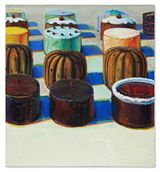
Cakes (1963) is one of the most beloved paintings produced in the United States and is often referenced, riffed on, and reproduced in gift-shop memorabilia. The painting of perfectly arranged cakes showcases Thiebaud’s signature impasto paint application, confectionary palette, and mastery of geometry. Similarly, Three Machines (1963) and Pies, Pies, Pies (1961) exemplify Thiebaud’s interest in the sculptural quality of everyday objects.
In a later work, River and Farms (1996), Thiebaud captured a rural landscape with winding rivers and geometric fields, showcasing a further engagement with perspective and abstraction.
Where did Wayne Thiebaud exhibit his art?
Thiebaud’s work was exhibited at major institutions across the United States and internationally. Highlights include:
- Wayne Thiebaud: A Paintings Retrospective, Whitney Museum of American Art, New York (28 June—23 September 2001)
- Wayne Thiebaud: A Celebration, 1920-2021, Crocker Art Museum, Sacramento (29 May—7 August 2022)
- Wayne Thiebaud: American Still Life, The Courtauld, London (10 Oct 2025—18 Jan 2026).
His work exists in the permanent collections of major art museums around the globe, such as, the San Francisco Museum of Modern Art, Tate Modern, the Whitney Museum of Modern Art, and the Museum of Contemporary Art, Los Angeles.
What is Wayne Thiebaud’s legacy in contemporary art?
Wayne Thiebaud was awarded the National Medal of Arts in 1994, and remains a beloved figure in American art history. Articles on Thiebaud’s life and work have appeared in numerous renowned publications, including Artforum,The New York Times, andThe New Yorker.
Hazel Ellis | Ocula | 2025




Explore Wayne Thiebaud's Exhibitions



Explore and Follow Artists Shaping Contemporary Art
A respected voice in contemporary art discourse.
Focusing on ambitious storytelling and insightful art-world commentary. Ocula Magazine publishes in-depth interviews, critical essays and timely analysis on the artists, exhibitions and ideas driving the global art world.
Learn more about Ocula Magazine
Showcasing the best of the art world.
Ocula partners with galleries from around the world to highlight their artists, artworks and exhibitions. Gallery membership is by application and invitation, with each member vetted by an independent panel.
Learn more about Ocula Membership
Specialises in the sale of major artworks.
Led by a team with deep ties to the world’s leading auction houses, galleries and collectors. Ocula’s advisory team offers bespoke services to high-net-worth clients from around the world who are looking to acquire the best of contemporary and modern art.
Learn more about our team and services