





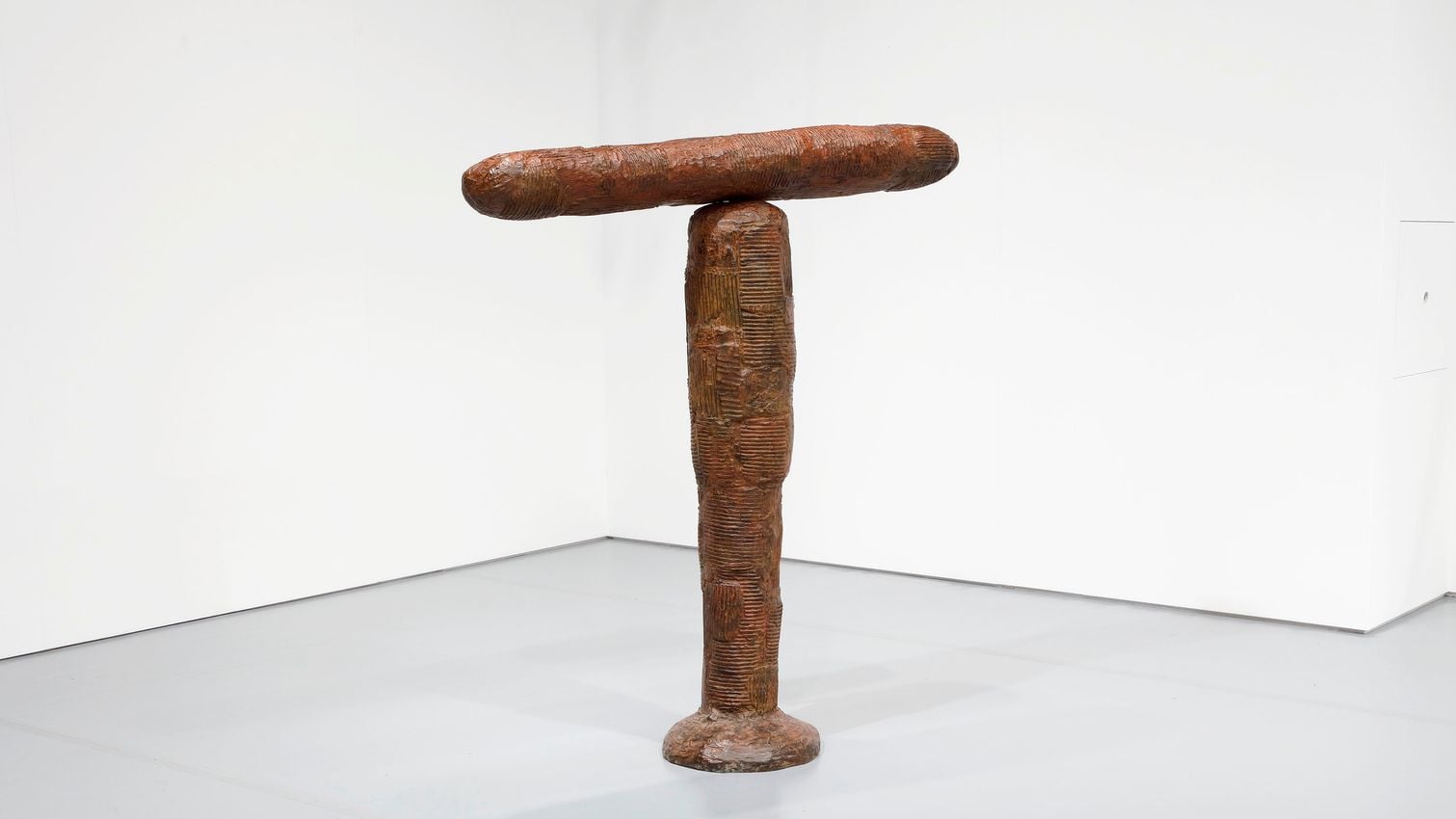
WILLIAM TURNBULL
1922-2012, United KingdomWilliam Turnbull was a Scottish artist whose timeless sculptures and paintings engage with ideas of balance and movement in the human body.
Early Years
Turnbull was born in Dundee, Scotland. After active service with the Royal Air Force during World War II, the artist began studying at the Slade School of Fine Art in 1946. There, he befriended sculptor Eduardo Paolozzi, with whom he would exhibit multiple times. In 1948, Turnbull went to live in Paris for two years, where he socialised with leading artists of the time, including Constantin Brancusi and Alberto Giacometti.
Upon his return to London in 1950, William Turnbull held his first solo exhibition at Hanover Gallery. In just two years’ time, he would garner international attention with his participation in New Aspects of British Sculpture, representing Britain alongside Paolozzi, Henry Moore, and Kenneth Armitage, among others, at the 26th Venice Biennale.
William Turnbull Artworks
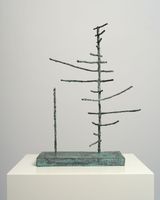
Throughout his practice, Turnbull drew inspiration from a range of sources that included ancient sculpture and cultures, aerial landscapes from his time in the RAF, Cubism, and Minimalism. The artist engaged with various materials over the course of his long career, focusing on bronze in the 1950s, then introducing steel, Perspex, and fibreglass to his work in the mid-1960s, while experimenting with stone and clay.
Independent Group
Turnbull is often associated with the Independent Group, which was established in 1952 at London’s Institute of Contemporary Arts and comprised artists, writers, and architects whose work incorporated elements of popular and commercial culture in reaction to dominant Modernist values in art.
In 1956, Turnbull exhibited with the Group—whose members included Richard Hamilton, Nigel Henderson, and Paolozzi—in the group show This is Tomorrow at Whitechapel Art Gallery, an exhibition that is now regarded as a precursor to the British Pop art movement.
The Horse
A recurring motif throughout Turnbull’s work, the horse traces back to a plaster sculpture he made while at the Slade School of Fine Art. Turnbull’s horse sculptures are typically characterised by two interlocking planes, one serving as the face with two holes punched through for the eyes and another arched to denote the neck.
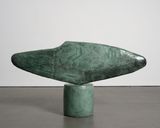
The forms of Turnbull’s horses underwent several changes as the artist explored different materials and styles. In Horse (1954), the bronze animal has a rough texture made by pressing ribbed paper into wet plaster, while the later Horse (1999) has smooth surfaces comprising both the face and the neck.
The Female Figure
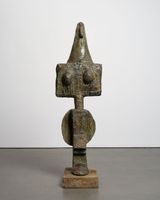
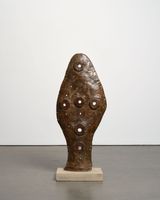
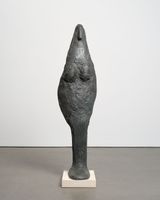
Turnbull’s concerns with figuration and shape can also be seen in his sculptures of the female figure. The early bronze sculpture War Goddess (1956) shows an upright figure, parts of her body divided into geometric shapes. Turnbull’s figures become increasingly abstract and minimalist in later works, as seen in the ‘Blade Venus’ series. Here, the female figure is reduced to a profile of an arrowhead with a slight curve, whose shape has been compared to those of Chinese knives and pens.
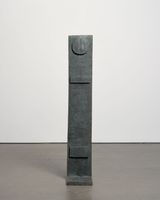
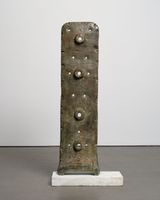
The column-like bodies of Turnbull’s figurative sculptures, such as the diamond-shaped Metamorphic Venus (1982) and elongated Venus (1984), also echo prehistoric sculptures that the artist was familiar with from his frequent visits to the British Museum and travels to Southeast Asia and Europe with his wife, the sculptor Kim Lim.
Painting
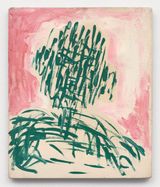
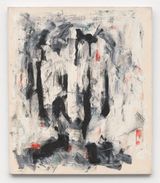
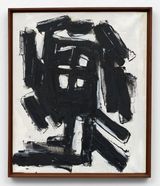
Like his sculptural practice, Turnbull’s paintings show the artist’s interests in different styles. Following a trip to New York in 1957, where he met Barnett Newman and Mark Rothko, Turnbull created vibrant Colour Field-inspired paintings. Other paintings, such as UNTITLED (WILLOWS 1) (1979) and UNTITLED (ABSTRACT FIGURES) (1988), feature more gestural and dynamic brushstrokes that suggest plant life or human bodies.
Exhibitions
William Turnbull exhibited widely in his lifetime, with major solo exhibitions including William Turnbull: Retrospective 1946–2003, Yorkshire Sculpture Park, Wakefield (2005); Serpentine Gallery, London (1995); and Tate, London (1973). His work continues to be shown internationally.
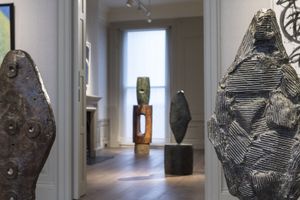
Turnbull’s estate has been represented by Offer Waterman since 2015. The London gallery has presented the solo exhibitions New Worlds, Words, Signs (2017) and Figures and Natural Forms (2021), as well as William Turnbull: Centenary Retrospective (2022).
Group exhibitions include Postwar Modern: New Art in Britain 1945–1965, Barbican Art Gallery, London (2022) and Dialectical Materialism: Aspects of British Sculpture since the 1960s, Karsten Schubert London (2019).
Website and Instagram
Turnbull and Kim Lim’s website can be found here, and the Instagram of Turnbull’s estate here.
Sherry Paik | Ocula | 2022


View William Turnbull's Artworks






















Explore and Follow Artists Shaping Contemporary Art
A respected voice in contemporary art discourse.
Focusing on ambitious storytelling and insightful art-world commentary. Ocula Magazine publishes in-depth interviews, critical essays and timely analysis on the artists, exhibitions and ideas driving the global art world.
Learn more about Ocula Magazine
Showcasing the best of the art world.
Ocula partners with galleries from around the world to highlight their artists, artworks and exhibitions. Gallery membership is by application and invitation, with each member vetted by an independent panel.
Learn more about Ocula Membership
Specialises in the sale of major artworks.
Led by a team with deep ties to the world’s leading auction houses, galleries and collectors. Ocula’s advisory team offers bespoke services to high-net-worth clients from around the world who are looking to acquire the best of contemporary and modern art.
Learn more about our team and services