






ZHAI LIANG
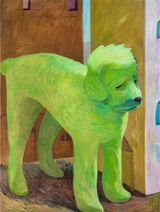
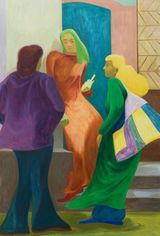
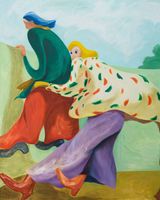
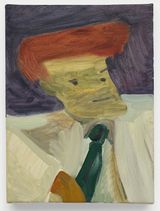
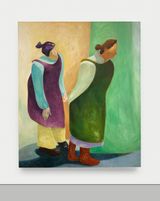
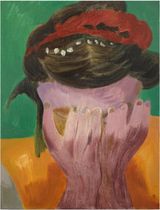
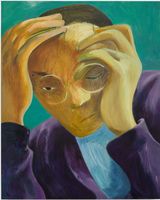
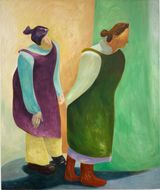
b. 1983, ChinaKnowledge serves as a nutrient for painting, flashing before us spontaneously, or acting as a suitable background that can incite the imagination of the artist. Whether it’s a story or a word: eventually they all take on this role of incentive. Within his bulky, diversified knowledge system, Zhai Liang takes a hopping/dipping approach to his selection of themes. Based on a previous painting he then further infers how a new piece should be done, which results in a visual logic. Hence, every work is brimming with freshness and life, reflecting the clumsiness and modesty of the artist with respect to any new painting. As for the works among themselves, some are large and some are small, but all of them share a similar orientation of interest. By means of gradual, substantial and personal experience of the artist himself, his paintings contribute to the forging of an unbridled visual system.
In the works of Zhai Liang, pictures merely serve as a preface or gateway: through traditionally made sketches, they are transformed again into the material/stuff out of which his paintings are made. Some of the works are even devoid of photo materials, and were directly created based on a pictorial logic. The artist renounces the restrictions imposed on his paintings by images (often overflowing with information and jumbled), thereby conferring a liberty onto the act of painting. He often takes lessons from “pre-modernist” artists such as Brueghel or Manet. The conciseness and simplicity of those painters have had a profound influence on him. Hence, Zhai Liang’s artworks are most concerned with the power of painting itself, the various styles at work within the painting, be it portraits, abstract painting, written script, etc. All of these essentially come down to the same thing, since they all operate according to the logic of painting itself. They all relate to the same question: “How can a world be fabricated from scratch?”
Zhai Liang (b. 1983, Shanxi Province, China) received his BFA from the Oil Painting Department of the Sichuan Fine Arts Institute (SFAI) in 2006, he graduated with a Master’s degree from the Oil Painting Department of the Central Academy of Fine Arts (CAFA) in 2009. Recent solo exhibitions include Imaginary Comedy, A Thousand Plateaus Art Space, Chengdu, China (2020); Writing Will Make Your Body Warm and Thumb Pain, Plate Space, Beijing, China (2019); Finding Hermits, WHITE SPACE BEIJING, Beijing, China (2018); Slow, A Thousand Plateaus Art Space, Chengdu, China (2017); Zhai Liang: Living Room, Fou Gallery, New York, US (2016); Notes, WHITE SPACE BEIJING, Beijing, China (2015). Recent group exhibitions include The Intertextuality of Art and Poetry, OCAT Shenzhen, Shenzhen, China (2019); Hack Space, K11 Art Foundation Pop-up Space, Hong Kong, China (2016); Luo Zhongli Scholarship 10th Anniversary Retrospective Exhibition, CAFA Art Museum, Beijing, China (2016); 1199 People: Collection from Long Museum, Long Museum, Shanghai, China(2014). Zhai Liang currently lives and works in Beijing, China.
Courtesy White Space

Recently Exhibited


Works Elsewhere










Explore and Follow Artists Shaping Contemporary Art
A respected voice in contemporary art discourse.
Focusing on ambitious storytelling and insightful art-world commentary. Ocula Magazine publishes in-depth interviews, critical essays and timely analysis on the artists, exhibitions and ideas driving the global art world.
Learn more about Ocula Magazine
Showcasing the best of the art world.
Ocula partners with galleries from around the world to highlight their artists, artworks and exhibitions. Gallery membership is by application and invitation, with each member vetted by an independent panel.
Learn more about Ocula Membership
Specialises in the sale of major artworks.
Led by a team with deep ties to the world’s leading auction houses, galleries and collectors. Ocula’s advisory team offers bespoke services to high-net-worth clients from around the world who are looking to acquire the best of contemporary and modern art.
Learn more about our team and services