



Press Release

The exhibition begins with the etymology of ‘hysteria,’ which comes from the ancient Greek word ‘hystera,’ meaning ‘uterus’. Unlike the contemporary understanding of hysteria as a form of extreme mental excitement or neurosis, historically, it was considered a women’s disorder. Ancient scholars and doctors attributed this condition to the female reproductive organ, diagnosing symptoms such as anger, gluttony, irritability, and various mental disorders as inherently female traits.

Hong grew up in a large family that lived together in a traditional Korean house known as a hanok. This house was built by her grandfather and housed four generations, including her mother, grandmother, and great-grandmother. In the early 1990s, her father, an architect, constructed a modern house for the family.

The artist recalls her childhood as composed of men doing construction work and women (mother, mother-in-law, and mother-in-law’s mother-in-law) cooking. Growing up in this environment, which spanned different generations and eras, Hong often imitated the men on the construction site and played with construction materials.

To this young artist, the cement pouring out of the concrete mixer truck resembled excrement being expelled from an anus. The men engaged in repetitive activities like erecting rebar, kneading the cement, and transporting construction materials, while the women performed the housework. The house’s architectural design did not accommodate domestic labor well, making it difficult for women to straighten their backs. This experience inspires the artist’s vision of wanting to ‘straighten the backs of the mothers,’ much like the rebar erected by the fathers.

Hong’s work is based on her childhood experiences of gender role segregation, her experiences as an Asian woman studying in Germany, her position as an artist, the distinctions between male and female as imposed by language (such as the use of articles in German), and the discomfort she finds in the observations (which she describes as ‘regrettable’). She uses the body and specific words as metaphorical vehicles to challenge and subvert their original meanings, deconstructing and reconstructing objects, language, materials, and methods typically associated with either gender.

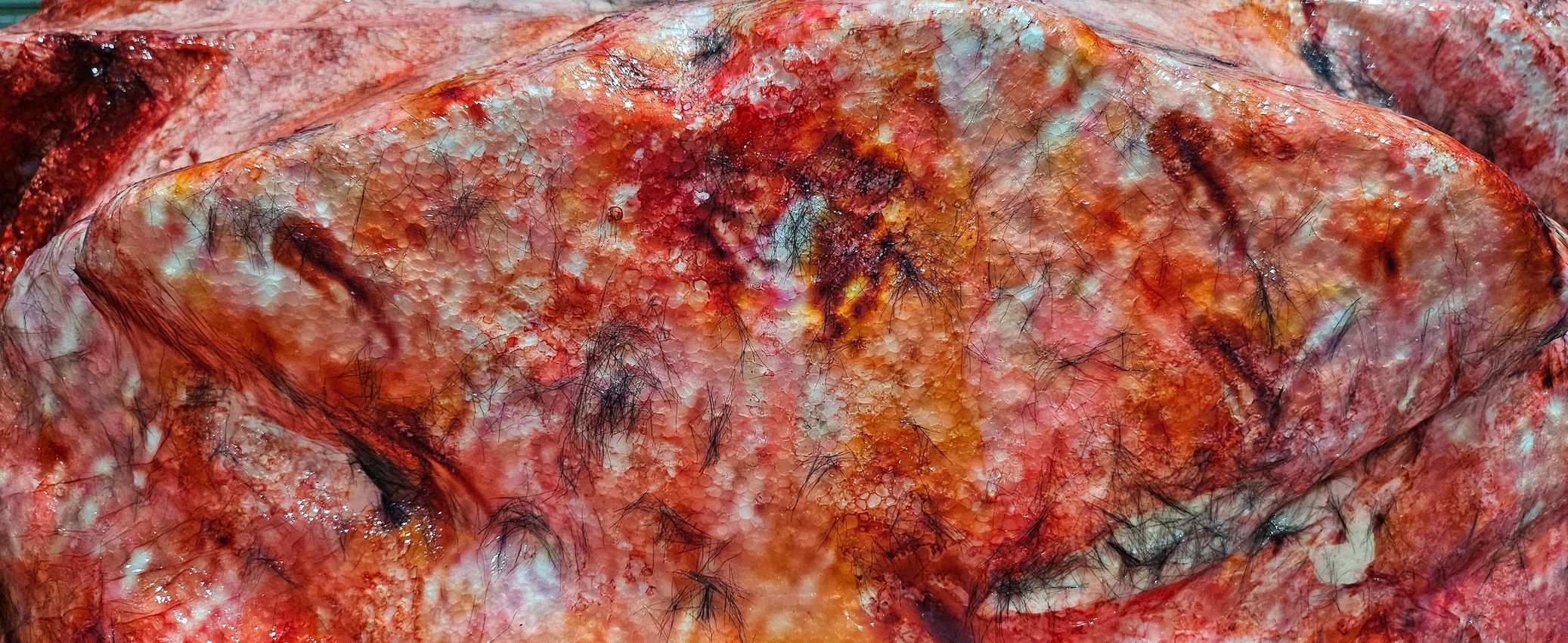
The exhibition features a set of ten sculptures made of construction materials. Expressions of hysteria, historically considered a female ailment, and the language women use to express disgust and unpleasant emotions are redesigned with materials from construction sites, which are predominantly male-dominated spaces. Structures that are intended to be ‘erected’ for human convenience are arranged in uncomfortable ways. The installed artworks have no titles; only the building materials used in their creation are listed. The red mass, resembling scratched mucous membranes or the inside of organs, is the product of patriarchy mixed with ‘expanded polystyrene, vinyl, ink, mortar cement, rebar, construction coatings (adhesives or waterproofing agents), pipe fittings, round steel pipes, galvanized iron sheets, wire mesh, pipe insulation’ which the artist observed in her childhood. Materials of men—a mass of aimless architectural shapes, loosely assembled ‘hemorrhoid chairs,’ and hardened, tangled structures—stand erect, deprived of their original utility.

The red installation, a sagging mass of red, speaks of women’s skin, defined by men as weak. The phrase in the exhibition title in Korean, ‘발작적, 너무나도 웃기는,’ which translates to ‘convulsive, hilarious,’ is a lexical play on the word ‘hysterical.’ Borrowing from the mechanisms of disorder, the exhibition aims to provide feedback rather than treatment. (The women) ‘don’t get diagnosed; they feed back everything of hysteria.’

Written by Sun Mi Lee, Curator of Alternative Space LOOP Translated by Jee Won Kim

Read More
About the Gallery

Established in 1999, Alternative Space LOOP is Korea’s first alternative space dedicated to experimental contemporary art. It is located in Hongdae, a district in Seoul famous for its art and independent music scenes throughout the late 1990s and 2000s.

View Gallery Profile
Address
20, Wausan-ro 29na-gil
Mapo-gu
Seoul
South Korea
Opening Hours
Monday – Sunday
10am – 7pm
(1)
Seoul 20, Wausan-ro 29na-gil, Mapo-gu
Alternative Space LOOP
20, Wausan-ro 29na-gil, Mapo-gu, Seoul, South Korea
+82 2 3141 1377
http://altspaceloop.com

Opening hours
Monday – Sunday
10am – 7pm
The art world in focus
