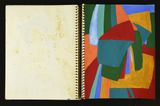
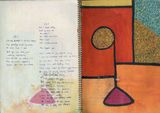
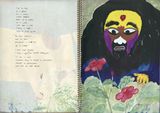
Form Colour Action explores sketchbooks and notebooks as sites of performance. The exhibition displays for the first time Lee Wen’s drawings, paintings, and notes dating from 1978 to 2014, as well as documentation of the pioneering artist’s performances. The selection helps us understand his contention that ‘drawing is the most basic time-based medium,’ and his development of performance art as tracings of daily routines of the human, the environment, and the cosmos.
The exhibition opens with a group of sketchbooks made between 1978 and 1989 that show Lee’s education in academic art—which he would reimagine, opening its vocabulary and techniques to a socially engaged practice. For him, image-making is integral to performance. This idea manifests most obviously in The Journey of a Yellow Man, which was developed from 1992 to 2001, and can be seen in the videos. The project evolved from a critique of Orientalism to a meditation on freedom, climate change, humility, and religious practices.
A group of sketchbooks and notebooks, from 1988 to 2002, shows how Lee uses lines and colour to convey emotions and action. A sketchbook from 1990 presents his early studies of representations of the human in the genres of portraiture and landscape. These studies inform Lee’s use of the body as vehicle and material in his performances. Another sketchbook from 1992 shows a drawing of the Hindu goddess Lakshmi sitting on a lotus flower, wherein the body and the landscape are part of a continuum. This merging of figure and ground would be crucial for Lee’s approach to performance art—his conception of the body’s movement as the lines of a drawing, and movement as an integration of the self into the world.
A facsimile reproduction of the pages of a 1978 sketchbook—comprised of drawings and gouache paintings of volumes and shapes—is spread along AAA Library’s west and north walls of windows. As one’s eyes move across the page, so the body moves down the line of windows. Another group of sketchbooks, from 1988 to 2014, can be seen on a monitor and in a vitrine along the windows. These studies in seriality remind us of Lee’s performances as multiples.
Lee Wen’s sketchbooks and notebooks offer a site to study his development of performance as an articulation of the self and its relation to the social and natural worlds. His training in drawing and painting gave him the tools to embody form and colour as action.
This exhibition is dedicated to the memory of Lee Wen.
Lee Wen (1957–2019) was a multidisciplinary artist who defined and shaped performance art in Asia. He had solo exhibitions at Singapore Art Museum, The Substation, and elsewhere. Group exhibitions included SunShower (2017), Secret Archipelago (2015), Singapore Biennale (2013), Asiatopia (2008 and 1998), Third Asia Pacific Triennial (1999), Sexta Bienal de La Habana (1997), and Gwangju Biennale (1995). Alongside his artistic practice, Lee was active in artist-run initiatives—in particular, the collective Black Market International, and the festivals Future of Imagination and Rooted in the Ephemeral Speak (R.I.T.E.S.).
Form Colour Action is curated by Chương-Đài Võ and Özge Ersoy, with the support of John Tain, Hazel Kwok, and Young One Cheung. This curatorial essay stems from a longer essay written by Chương-Đài Võ, which can be accessed through Asia Art Archive’s IDEAS journal. An earlier version of the essay was published as ‘Line Form Colour Action ‘in Afterall Journal, No. 46 (Autumn/Winter 2018): 14–25.
Sponsors: Eunei & Ron Lee; Yvonne Wang & Alex Turnbull; and The St. Regis Hong Kong

Lee Wen was a Singaporean multidisciplinary artist whose work concern social identity themes. Best known for his Yellow Man series of work, Lee was one of the pioneers of Performance art in Singapore. His work is based on what might be called a performance iconics, relying on the strategic deployment of visual and kinesthetic symbols and signs—motivated by a strong conviction of justice and idealism—with a persistence to stay true to the Self in a highly structured world. Lee Wen’s essays, texts, and investigations are an important reference, not only for Singaporean and Asian artists, but also for Performance art scholars and researchers worldwide. In 2003, Lee spearheaded the “Future of Imagination” international performance art event, seeing the value of having an annual gathering of international artists in Singapore, to share a continuing interest in the cultural constructs of identity in the global situation and current trends of contemporary art practice, through live performances and discussion forms.
Asia Art Archive (AAA) is an independent non-profit organisation in Sheung Wan, Hong Kong, dedicated to documenting and sharing the recent histories of art from across Asia within a global context.
Founded in 2000 by Claire Hsu, Johnson Chang, and Ronald Arculli, AAA has grown into one of the most comprehensive publicly accessible collections of research materials on contemporary art in the region. Its library and archive, housed on Hollywood Road and freely open to the public, anchor a wider platform of digital resources that reach researchers, artists, and educators worldwide.

A respected voice in contemporary art discourse.
Focusing on ambitious storytelling and insightful art-world commentary. Ocula Magazine publishes in-depth interviews, critical essays and timely analysis on the artists, exhibitions and ideas driving the global art world.
Learn more about Ocula Magazine
Showcasing the best of the art world.
Ocula partners with galleries from around the world to highlight their artists, artworks and exhibitions. Gallery membership is by application and invitation, with each member vetted by an independent panel.
Learn more about Ocula Membership

Specialises in the sale of major artworks.
Led by a team with deep ties to the world’s leading auction houses, galleries and collectors. Ocula’s advisory team offers bespoke services to high-net-worth clients from around the world who are looking to acquire the best of contemporary and modern art.
Learn more about our team and services