



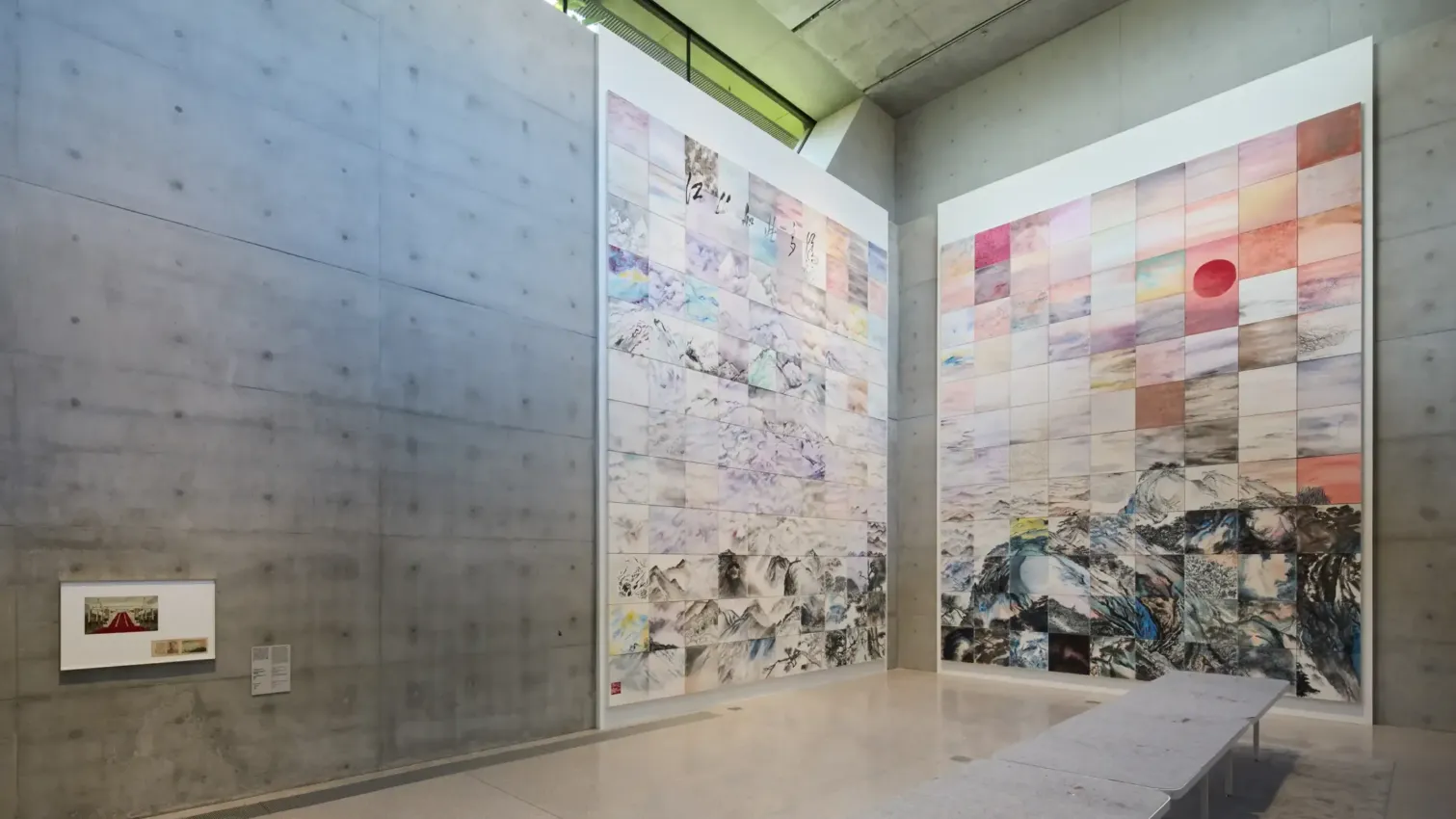
And Thus Is This Land is a participatory performance by Dai Guangyu, presented in conjunction with the Special Exhibition Canton Modern: Art and Visual Culture, 1900s–1970s. Dai invites professional artists and art students to collaborate on a recreation of This Land So Rich in Beauty (1959), a monumental landscape by Fu Baoshi (1904–1965) and Guan Shanyue (1912–2000), with each participant painting a segment of the artwork. The pieces will be made and assembled over one month in the Focus Gallery.
This Land So Rich in Beauty was inspired by Mao Zedong’s (1896–1976) poem Snow, which expressed a grand vision of the nation’s history and geography. The painting was unveiled in 1959 for the tenth anniversary of the People’s Republic of China. It hung in the Great Hall of the People in Beijing for over thirty years before being replaced by a replica in 1990.
The commission of Guangdong-born Guan Shanyue for This Land So Rich in Beauty reflected the rise of Cantonese art to national prominence. From conception to execution, the work was a collaborative challenge: Guan and Fu needed to reconcile their different painting styles and interpret Mao’s poem with feedback from high officials.
And Thus Is This Land extends this collaborative process into the present. It asks participants to engage with each other, the artist, the original painters, and the poem that sparked this chain of creative work. They will navigate the tension between copying and adaptation, arriving at a work that both resembles the original yet is also wholly new.
Dai Guangyu is a self-taught artist who grew up in a educated environment (with his father well versed in history and a student of calligraphy since the age of five). It is likely that Dai Guangyu would have followed a traditional career path had he not found himself a part of the New Wave Movement in 1985, which was a perfect fit for the development of his creative scope. He quickly became one of the leaders of the avant-garde scene in Sichuan. In the 90s, Dai Guangyu discovered performance, which employs the body as a key artistic medium, which he found most suitable for expressing himself artistically, being powerful in movement, incisive in meaning, radical and transient. It was during this time that he showed his penchant for ‘ink games’. In the north and in Beijing, during this period, performance raised the themes of suffering and the challenges of oneself in society, with the performance taking on what were often seen as masochistic forms.


A respected voice in contemporary art discourse.
Focusing on ambitious storytelling and insightful art-world commentary. Ocula Magazine publishes in-depth interviews, critical essays and timely analysis on the artists, exhibitions and ideas driving the global art world.
Learn more about Ocula Magazine
Showcasing the best of the art world.
Ocula partners with galleries from around the world to highlight their artists, artworks and exhibitions. Gallery membership is by application and invitation, with each member vetted by an independent panel.
Learn more about Ocula Membership

Specialises in the sale of major artworks.
Led by a team with deep ties to the world’s leading auction houses, galleries and collectors. Ocula’s advisory team offers bespoke services to high-net-worth clients from around the world who are looking to acquire the best of contemporary and modern art.
Learn more about our team and services