Press Release

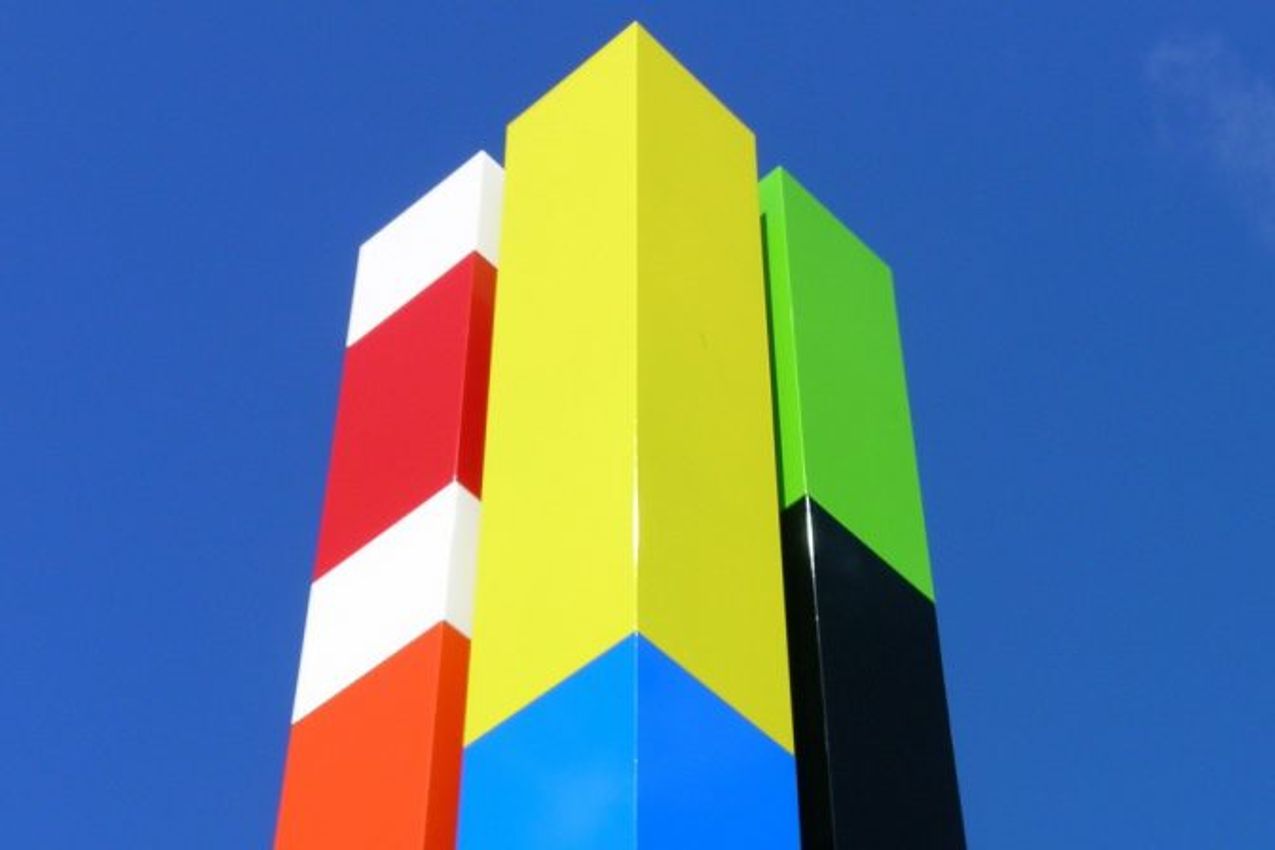
Atarangi II is a permanent sculpture by Tāmaki Makaurau Auckland artist Michael Parekōwhai, situated at the entrance to Te Tuhi. ‘Parekōwhai’s works are puzzling... they work as paradoxes, conundrums, machines for thinking through, talking points, conversation pieces. They engage and embody contradictions, drawing the viewer into a conceptual space where a variety of possible and often inconsistent readings can co-exist. Parekōwhai’s works both exemplify the difficulty of our situation and offer themselves as tools with which we might clarify it’. Curators Lara Strongman and Robert Leonard made the above comment in the 1994 catalogue for Kiss the Baby Goodbye, an exhibition by Michael Parekōwhai which, like Atarangi II, referenced children’s toys and educational tools. In this breakthrough exhibition at the Govett-Brewster Art Gallery in 1994, Parekōwhai scaled up chess pieces, pick-up sticks and building blocks to gigantic proportions, the sculptures becoming super-sized symbols of learning and socialisation. Atarangi II is a giant enlargement of a stack of Cuisenaire rods, an educational system originally used to teach young children relationships between numbers. This system was invented by Belgian teacher Georges Cuisenaire in the 1950s, and uses a visual language to describe mathematical equations, with each rod a different colour and length to represent a different unit value. New Zealand students of a certain era will have memories of Cuisenaire rods forming a staple part of the classroom equipment. More recently Cuisenaire rods have been used in the teaching of languages, including teaching te reo Māori, a method known as Te Ataarangi, developed by Dame Kāterina te Heikōkō Mataira DNZM and Te Kumeroa ‘Ngoingoi’ Pēwhairangi QSM. An immersion style of learning which stands in direct contrast to a grammar-based, academic approach to language, Te Ataarangi is considered one of the most significant programmes in the revitalisation of te reo Māori. Broken down into two words, Atarangi suggests new beginnings − ata meaning slow or deliberate but also morning or ‘the new start’, and rangi meaning sky or day. An epic beacon for Manukau situated in front of the contemporary art gallery and across the road from a shopping mall, Atarangi II suggests that art, language and culture could provide useful tools in the midst of rapid development.

About the Artist

Michael Parekowhai is an Auckland-based sculptor, photographer and installation artist of Māori (Ngā Ariki Kaiputahi, Ngāti Whakarongo) and Pakeha descent, highly regarded for his daring culturally thematic explorations, Pop (but conceptualist) accessibility, impeccable industrial finish and robust physical presence.

View Artist Profile

Also Exhibiting at Te Tuhi

About the Gallery
Te Tuhi is a nationally significant contemporary art gallery presenting exhibitions and projects by New Zealand and international artists. Te Tuhi works actively within the community of Auckland, providing a conduit for audience engagement and participation in the visual arts, underpinned by innovative exhibitions, education and associated programmes. In addition, Te Tuhi serves as a focal point for the community as an events venue and meeting place for our many users and community groups.

Te Tuhi was created in a partnership between the Fisher Gallery and the Pakuranga Community and Cultural Centre, the latter formally a Manukau City Council facility.

The Fisher Gallery had been created in the early 1980s by a dedicated and energetic group of local art lovers, who had decided that the area, only recently subdivided for residential use, needed an arts venue. The Fisher Gallery took its name from the Fisher family, who farmed the area prior to its suburbanisation and Iris Fisher, who was an original member of the Pakuranga Arts Society and the driving force behind the effort to build the new institution.

The name Te Tuhi was generously conferred on the institution by the Ngai Tai Iwi. The name refers to the legend of the ancestor Manawatere, a Maori voyager and explorer who arrived in the Hauraki Gulf prior to the arrival of the Tainui waka. Landing at the beach at Howick's Cockle Bay, he made his tuhi, or mark, on a pohutukawa tree located on the foreshore, using karamea, a red ochre. This was his sign to those who would follow, that this was the place he had chosen: Te Tuhi a Manawatere. The tree still stands today, although the tuhi has since disappeared.

Te Tuhi is administered by the Te Tuhi Contemporary Art Trust in conjunction with the Contemporary Art Foundation.
View Gallery Profile
Address
13 Reeves Road
Pakuranga
Auckland
New Zealand
Opening Hours
Open daily
9am − 5pm
Closed Public Holidays
(1)
Auckland 13 Reeves Road, Pakuranga
Te Tuhi
13 Reeves Road, Pakuranga, Auckland, New Zealand
+64 9 577 0138
http://www.tetuhi.art

Opening hours
Open daily
9am − 5pm
Closed Public Holidays
The art world in focus