



In 1969 Weiner issued a Declaration of Intent:
1. The artist may construct the work
2. The work may be fabricated
3. The work need not be built
(Each being equal and consistent with the intent of the artist, the decision as to condition rests with the receiver upon the occasion of receivership.)__
The receiver and the artist collaborate in the synthesis of the work, whether manifested or not. Weiner’s artworks can be made for a specific site but are not created as such. His materials and their formal presentation vary – installed on walls, floors, or windows of museums, galleries, homes and public spaces. Works appear on a multitude of surfaces, from matchbooks to manhole covers, pins and t-shirts, spoken on film or sung on a record. The same work can appear in different formats as to placement, colour, typeface, format, and scale and with texts, for example, painted, printed, stenciled, or in vinyl. Weiner’s work continues to disrupt our notion of art’s use, authorship, display, and material.
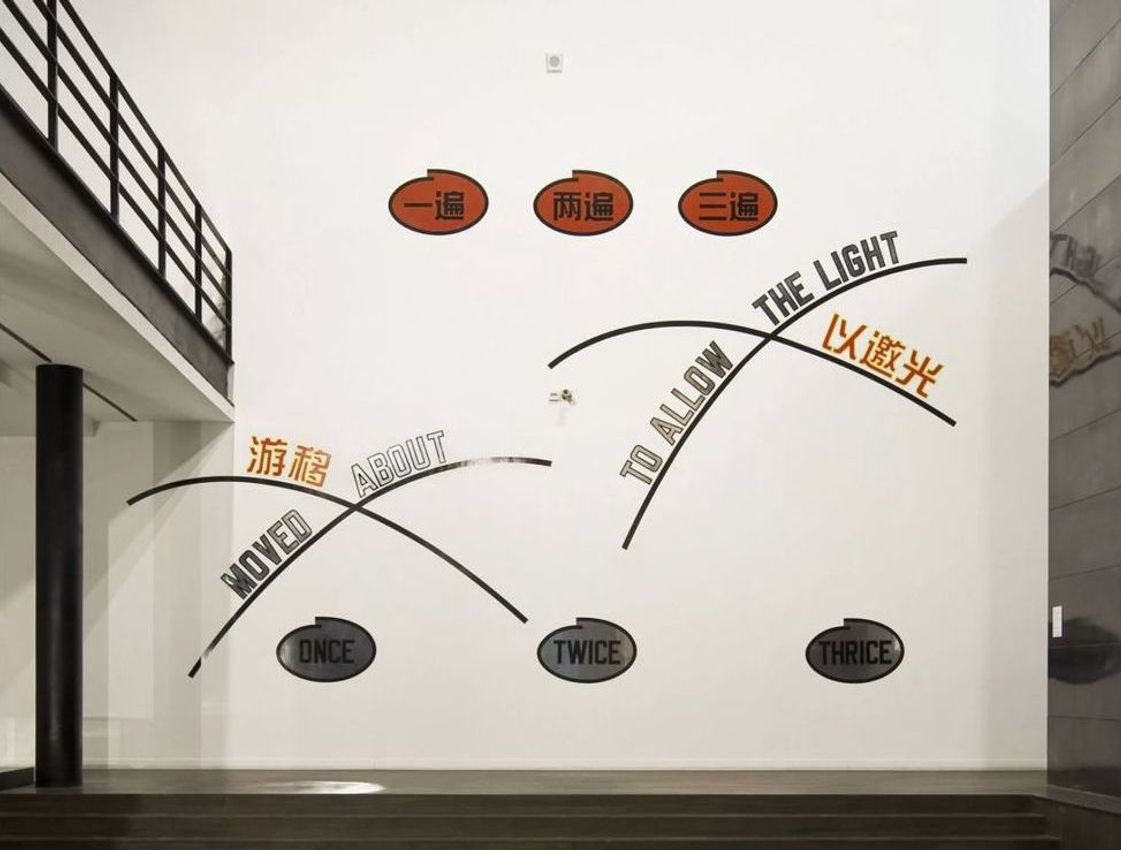
One of the key figures associated with the emergence and foundations of Conceptual Art during the 1960s, Lawrence Weiner is known for his text-based works that explore the nature of language, meaning, and communication. Considering language as a material object, Weiner helped to expand the ontological definition of art and explored the relationship between words and power, as Anne Rorimer has commented, ‘liberat[ing] the work of art from its traditional subjugation to uniqueness.’ In this survey exhibition, UCCA presents a selection of key works, chosen in collaboration with Lawrence Weiner Estate. Featuring text works dating from the 1970s through the 2010s, alongside archival materials, this exhibition marks Weiner’s first institutional presentation in China since his work TO ALLOW THE LIGHT was commissioned and presented in 2007 as part of UCCA’s inaugural series of exhibitions.
Contemporary American artist Lawrence Weiner is recognised as a pioneering figure of Conceptual art. Using language as a primary material, Weiner challenged the conventional notion of the artwork as a visible and tangible object. He also aimed to disrupt the authority of the artist by claiming that the realisation of an artwork lies with the viewer.


UCCA Center for Contemporary Art is China’s leading contemporary art institution. Committed to the belief that art can deepen lives and transcend boundaries, UCCA presents a wide range of exhibitions, public programs, and research initiatives to a public of more than one million visitors each year. UCCA Beijing sits at the heart of the 798 Art District, occupying 10,000 square meters of factory chambers built in 1957 and regenerated in 2019 by OMA. UCCA Dune, designed by Open Architecture, lies beneath the sand in the seaside enclave of Aranya in Beidaihe.

A respected voice in contemporary art discourse.
Focusing on ambitious storytelling and insightful art-world commentary. Ocula Magazine publishes in-depth interviews, critical essays and timely analysis on the artists, exhibitions and ideas driving the global art world.
Learn more about Ocula Magazine
Showcasing the best of the art world.
Ocula partners with galleries from around the world to highlight their artists, artworks and exhibitions. Gallery membership is by application and invitation, with each member vetted by an independent panel.
Learn more about Ocula Membership

Specialises in the sale of major artworks.
Led by a team with deep ties to the world’s leading auction houses, galleries and collectors. Ocula’s advisory team offers bespoke services to high-net-worth clients from around the world who are looking to acquire the best of contemporary and modern art.
Learn more about our team and services