





‘I Was Warned I Would be Blacklisted’: Alma Allen Speaks Out on Venice

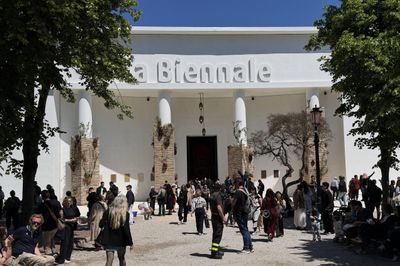
Allen was announced as the US pavilion artist in November last year, after a different artist and curator team’s project fell through. IMAGO/Manfred Segerer.

Alma Allen, the Mexico-based sculptor controversially selected to represent the United States at this year’s Venice Biennale, has this week pushed back against his critics, claiming that he has been bullied and blacklisted since taking up the project.
Allen was announced as the US pavilion artist in November last year, after a different artist and curator team’s project fell through following the departure of their institutional sponsor and alleged political interference. Allen’s appointment—and, since its opening last month, his Venice exhibition—have both been subject to heavy scrutiny.
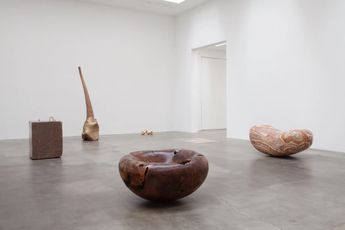
The 55-year-old artist makes ambiguous sculptures referencing organic lifeforms, usually hand-modelled on a small scale before being augmented in wood, bronze and stone. In Venice, these curvilinear, decorative and romantic forms contrasted with the classical symmetry of the pavilion’s Palladian architecture—at a glance offering two very different visions of contemporary America.
Allen has drawn criticism for choosing to represent the US under the Trump administration, especially after officials insisted that the show be used to “promote American values” and that funded programmes should not promote diversity, equity and inclusion initiatives that violate anti-discrimination laws.
“I believe in the viewer”
Speaking to Ocula via email, Allen said: “I don’t believe in American exceptionalism, but I do believe in the power of ambiguity and I know that viewers who understand my work won’t be put off by hateful things people said or need to view my work through the politics of the moment.”
The artist has avoided making overt political statements. “I leave my works untitled precisely because I believe in the viewer; I don’t want to lecture them or tell them what to believe. If I did title my works too many would be titled, ‘We are all going to die’,” he said.
Asked whether he could understand those who might not be able to overlook the political controversy surrounding the pavilion, he acknowledged: “I have not lived in the USA for many years. Maybe I’ve been away too long to understand how stressful the American experience has become.”
Allen’s latest comments follow a statement shared by the artist earlier this week. In an Instagram post on Monday, he alleged that his former galleries declined to support his participation in the biennale after being influenced to distance themselves from the US pavilion, resulting in the breakdown of their business relationship. He alleged that conversations with a third gallery, held with a view to them supporting the pavilion, fell apart for the same reason.
Speaking to Ocula, Allen named the galleries in question as Olney Gleason, Mendez Wood DM and Pace. All three declined to comment.
The artist also claimed that the alleged campaign against the pavilion later extended to efforts to smear his show, by influencing arts writers and curators not to take him seriously. “I was warned that I would be blacklisted,” Allen told Ocula. “But I was still surprised by how co-ordinated the bullying was.”
Resnicow: “It simply isn’t true”
In the Instagram post, the artist accused a public relations specialist, David Resnicow, of being behind these efforts—something Resnicow firmly denies.
“It’s baffling that Alma keeps perpetuating this narrative because it simply isn’t true,” Resnicow said in a statement. “I never told anyone not to work with him or spoke with anyone about funding for the pavilion.”
Allen has long asserted that he did not apply to represent the US in Venice and so did not take part in the open call through which the country’s artist is usually appointed. However, in Monday’s Instagram post, he further alleged that he was “one of five artists on a shortlist created by a committee of professionals”.
Allen claimed that the pool of artists selected by these officials also included Julie Mehretu, Barbara Chase-Riboud, William Eggleston and Kennedy Yanko. Chase-Riboud declined to comment, and representatives for the other three artists did not respond to Ocula’s requests.
These new details have revived questions about how the US pavilion was awarded. According to Allen, the committee of professionals involved in the selection process hailed from the National Endowment for the Arts (NEA), the independent federal body that traditionally appoints the committee that evaluates proposals for the biennale; The Bureau of Educational and Cultural Affairs (ECA), which issues the grants used to part-fund the exhibition; and Art in Embassies, which manages art collections in diplomatic spaces around the world. The latter two organisations are both branches of the US Department of State.
A representative for the NEA contradicted Allen’s account, telling Ocula that it was not involved in appointing the artist, and that it had agreed that the ECA would lead all aspects of the biennale selection process. “The NEA has valued its collaboration with the ECA on Venice Biennale, but this decision, driven by time constraints and staffing transitions at both agencies, allowed ECA to move forward and ensure a strong US presence at this prestigious international exhibition,” they said.
A spokesperson for the State Department told Ocula that a single grantee had been awarded $375,000 USD for the biennale “through an open grant competition”. The department did not respond to a request to clarify further the selection process, but said it was “proud to showcase American Excellence at the Venice Biennale through the artistic vision of Alma Allen” and that the artist “personifies the greatness of the American Dream”.
An unusual selection process
Asked why he felt the need to speak out now, Allen told Ocula he had “expected the curator to clarify the selection process much earlier”. The curator of the US pavilion, Jeffrey Uslip, did not respond to a request for comment.
The unusual selection process for this year’s pavilion has been roundly criticised by independent curator John Ravenal. The art historian told Ocula that his proposal for the US pavilion with artist Robert Lazzarini—and institutional sponsor the University of South Florida—had originally been selected (through the State Department’s usual independent process) in September last year.
However, their project unravelled after the university pulled out, citing the financial obligations and a compressed timeline. The pair were then left without an institutional sponsor—a requirement of the US pavilion application process, and a necessity to help pay for each year’s multi-million dollar exhibition.
Ravenal has alleged that US officials initially suggested a replacement partnership with the American Arts Conservancy (AAC), a little-known non-profit established just months earlier and staffed largely by business figures rather than art world professionals. However, after initial discussions, the curator said he was informed that the organisation had decided to instead sponsor another project.
“I thought: that doesn’t make any sense, because any other candidate who had applied would already have to have had an institutional sponsor,” Ravenal said.
In November last year, the State Department announced that Ravenal and Lazzarini would be replaced by Allen and curator Uslip. The AAC retained its role as the pavilion’s institutional sponsor.
“What was happening was that once the AAC understood they were being designated as the institutional commissioners, they usurped the whole thing. It was complete corruption and cronyism,” he said.
Ocula requested further clarification regarding the biennale selection process and the organisations involved from the AAC, ECA, the State Department and Art in Embassies, but had not received a response at the time of publication.







A respected voice in contemporary art discourse.
Focusing on ambitious storytelling and insightful art-world commentary. Ocula Magazine publishes in-depth interviews, critical essays and timely analysis on the artists, exhibitions and ideas driving the global art world.
Learn more about Ocula Magazine
Showcasing the best of the art world.
Ocula partners with galleries from around the world to highlight their artists, artworks and exhibitions. Gallery membership is by application and invitation, with each member vetted by an independent panel.
Learn more about Ocula Membership
Specialises in the sale of major artworks.
Led by a team with deep ties to the world’s leading auction houses, galleries and collectors. Ocula’s advisory team offers bespoke services to high-net-worth clients from around the world who are looking to acquire the best of contemporary and modern art.
Learn more about our team and services