





Exiled Belarusian Artists Challenge Censorship With Venice Collateral Show

Left to right: artist Sergey Grinevich, curators Daniella Kaliada and Natalia Kaliada and sound artist Olga Podgayskaya, 2026. Photo Francesco Barasciutti.

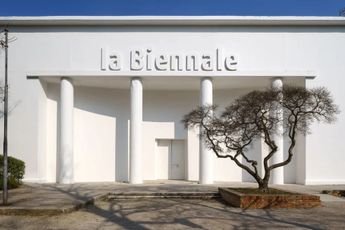
A group of exiled Belarusian artists will bring an immersive, multi-sensory exhibition to a Benedictine church during this year’s Venice Biennale, exploring how art is made, censored and experienced under authoritarian power.
Belarus, under the oppressive regime of president Alexander Lukashenko for more than 30 years, has not officially participated in the biennale since 2019. Still with no pavilion this year, from 9 May Belarus Free Theatre’s show will instead form part of the official collateral programme, which was announced in full today.
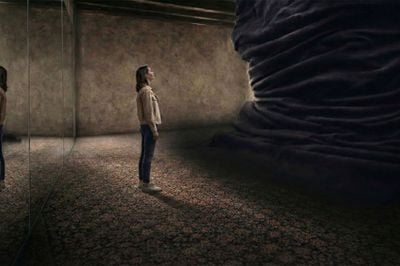
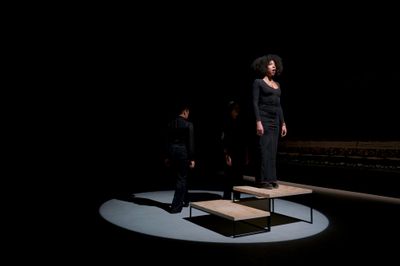
The exhibition, titled Official. Unofficial. Belarus., will continue a lineage of Belarusian artistic practices shaped by displacement and constant surveillance, and will invite visitors to encounter what it means when culture is forced to exist outside the state.
Natalia Kaliada, co-founding artistic director of Belarus Free Theatre, said: “Official. Unofficial. Belarus. signals that Belarusian independent culture—not the regime—holds cultural authority. We, a collective of Belarusian artists, all now in exile, come from a country of world-class artists, thinkers, and cultural innovators, and we are proud to show our homeland to the world through their lens, not as it is defined by the state.”
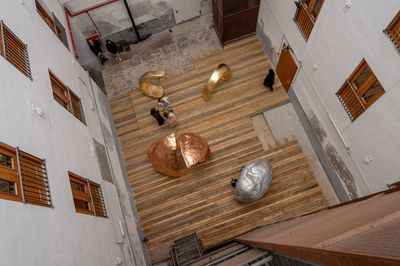
The exhibition will include a 2.5-metre sphere composed of books banned in Belarus, compressed within a crushed bulldozer claw, originally designed by the theatre’s co-founder Nicolai Khalezin. In the same space, a soundscape for the organ by Olga Podgayskaya will alternate between crescendo and reverberating silence.
Outside, an immersive sound installation of recorded testimonials by recently released Belarusian political prisoners will permeate a private cemetery, accompanied by a series of large-scale sculptures made from prison bars by artist and designer Vladimir Tsesler. Visitors will be invited to reflect on themes of deprivation and the enforced silence of authoritarian power, and to light candles and place them on the church’s altar, filling the space with a specially conceived scent of control and suppression.
“Together, we form an artistic constellation that is impossible to ignore, one that no state institution could ever assemble,” Kaliada said. “We hope that this moment will resonate far beyond this year as we look forward to a future where Belarusian culture will reclaim its rightful place on the world stage.”
The biennale’s full collateral programme is made up of 31 events. It includes a presentation of works by Lee Ufan at SMAC Venice by the Dia Art Foundation and an exhibition featuring 11 woman artists from Central Asia and the Middle East at ACP–Palazzo Franchetti, marking the relaunch of the Parasol unit foundation’s exhibitions programme.
The full list of participating countries has also been revealed, totalling 99 pavilions. The Republic of Guinea, the Republic of Equatorial Guinea, the Republic of Nauru, Qatar, the Republic of Sierra Leone, Federal Republic of Somalia, and the Socialist Republic of Viet Nam will all participate for the first time.




A respected voice in contemporary art discourse.
Focusing on ambitious storytelling and insightful art-world commentary. Ocula Magazine publishes in-depth interviews, critical essays and timely analysis on the artists, exhibitions and ideas driving the global art world.
Learn more about Ocula Magazine
Showcasing the best of the art world.
Ocula partners with galleries from around the world to highlight their artists, artworks and exhibitions. Gallery membership is by application and invitation, with each member vetted by an independent panel.
Learn more about Ocula Membership
Specialises in the sale of major artworks.
Led by a team with deep ties to the world’s leading auction houses, galleries and collectors. Ocula’s advisory team offers bespoke services to high-net-worth clients from around the world who are looking to acquire the best of contemporary and modern art.
Learn more about our team and services