





How Will Labour’s Election Win Impact Britain’s Arts Sector?
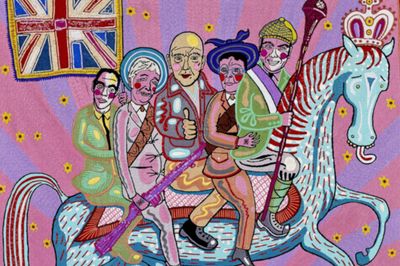
Grayson Perry, Britain is Best (2014) (detail). Embroidery, 120 x 100 cm (including frame). Courtesy the artist and Paragon, London.


Keir Starmer’s Labour Party won 412 of the 650 seats in Britain’s House of Commons in the U.K. general election held on Thursday 4 July. It was an emphatic rejection of Rishi Sunak’s Conservative Party, which won just 121 seats, and offers a clear mandate for reform.
In their plan for the arts, culture and creative industries, Labour promised to: support all of Britain’s arts and cultural organisations; create private finance models to attract more funding for the arts; launch a review of Arts Council England (whose funding for museums and galleries fell 36.7% in real terms from 2010 to 2023); support museums and galleries to make high-quality images available for free; bring art and artefacts to communities; and tackle scalping by capping ticket resale prices.
That fell short of more specific demands from leaders in the arts sector.
Tristram Hunt, director of the Victoria and Albert Museum, told The Art Newspaper he hoped to see ‘emergency financial support for regional museums facing bankruptcy’, easier flow of artists between the U.K. and Europe, the inclusion of gallery and museum maintenance in Green New Deal funding, and the option for cities to introduce a hotel tax to fund art and culture.
Axel Rüger, secretary and chief executive of the Royal Academy of Arts, asked that the Department for Education ‘ensure that art education is central to the school curriculum’. The English Baccalaureate (EBacc) measures students’ success in English, Maths, Science, geography or history, and a language, but does not include arts subjects.

Across the English Channel, France held their parliamentary election on Sunday.
Deadline cited concerns the far right National Rally (RN) party, led by Marine Le Pen and Jordan Bardella, would defund the country’s arts sector if they got into power.
Bardella hoped to scrap France Télévisions and Radio France to save €3 billion (U.S. $3.2 billion), a move that could threaten hundreds of thousands of jobs according to France’s independent producers’ union.
There were also fears RN would discontinue the Intermittence du Spectacle scheme, which ensures regular income for arts and entertainment workers on temporary contracts.
Despite polls predicting they’d win up to 230 seats in France’s 577-seat assembly, National Rally took 142, fewer than the left wing New Popular Front with 178, and President Emmanuel Macron’s centrist coalition, which secured 150 seats.
It’s not yet clear what the result means for the country’s arts and culture sector. With no clear majority, France faces a hung parliament. —[O]
Main image: Grayson Perry, Britain is Best (2014) (detail). Embroidery, 120 x 100 cm (including frame). Courtesy the artist and Paragon, London.





A respected voice in contemporary art discourse.
Focusing on ambitious storytelling and insightful art-world commentary. Ocula Magazine publishes in-depth interviews, critical essays and timely analysis on the artists, exhibitions and ideas driving the global art world.
Learn more about Ocula Magazine
Showcasing the best of the art world.
Ocula partners with galleries from around the world to highlight their artists, artworks and exhibitions. Gallery membership is by application and invitation, with each member vetted by an independent panel.
Learn more about Ocula Membership
Specialises in the sale of major artworks.
Led by a team with deep ties to the world’s leading auction houses, galleries and collectors. Ocula’s advisory team offers bespoke services to high-net-worth clients from around the world who are looking to acquire the best of contemporary and modern art.
Learn more about our team and services