





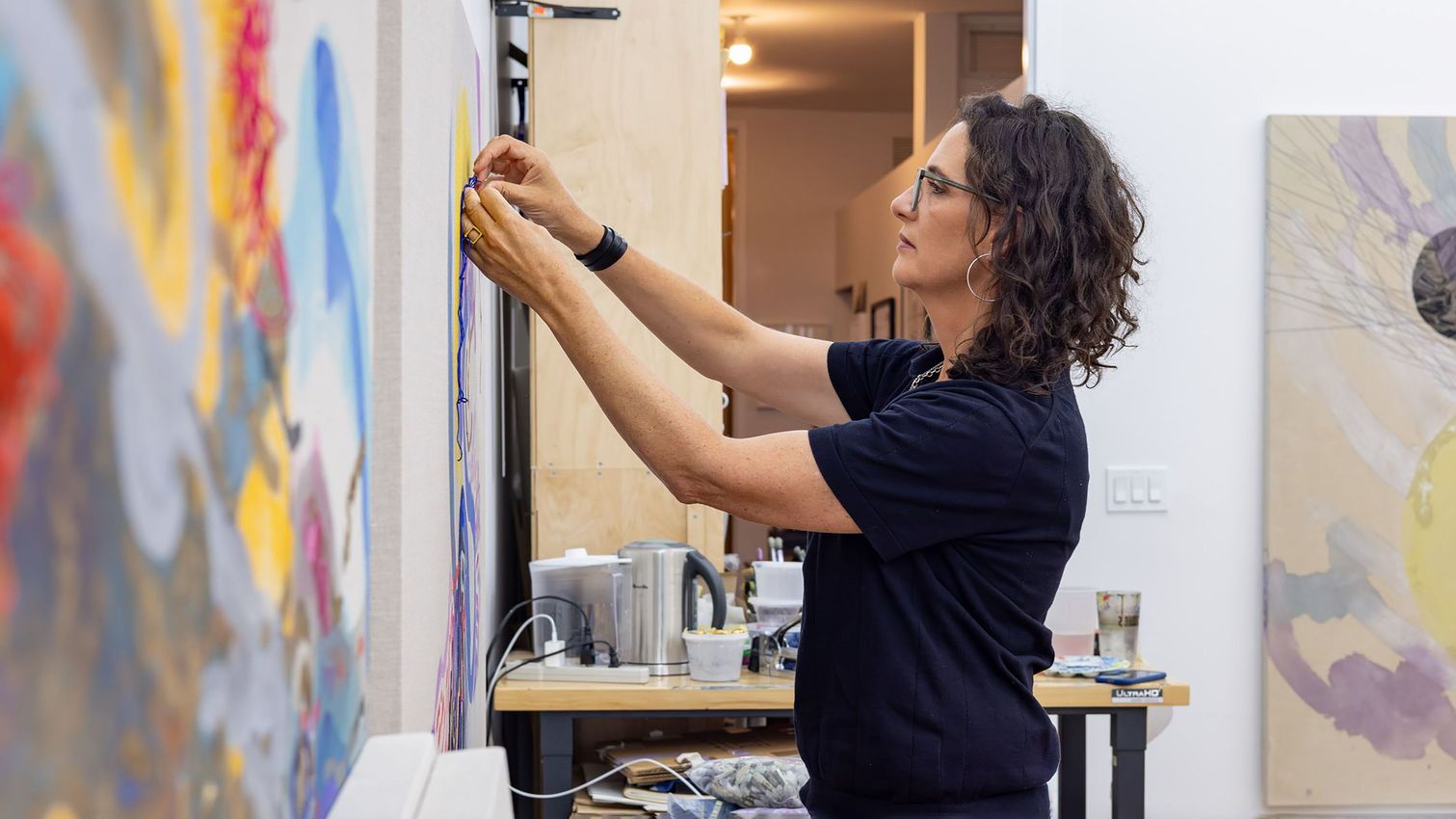
Jessica Rankin on Embracing the Unfamiliar
Jessica Rankin’s beguiling combinations of painting, needlework, and text teeter on the precipice between order and chaos. Save to My Ocula
Jessica Rankin‘s beguiling combinations of painting, needlework, and text teeter on the precipice between order and chaos.
When I speak with Rankin, it is over Zoom as she prepares for her current White Cube exhibition in Hong Kong. Rankin is easy to talk to, comfortable discussing her work, patient with questions, and generous with answers. She wears a casual patterned shirt, her hair loose, her face make-up free. Despite having lived away from her Australian homeland for over 20 years, she has not lost her accent—albeit it is now inflected with the rolling Rs that come from being a New Yorker. We talk about the Australian landscape, eclipses, and the influence of writers and artists, including her parents, particularly her mother, with whom Rankin’s latest series of paintings is especially in dialogue.
Rankin’s mother, poet and playwright Jennifer Rankin, died when she was eight. Her father, the artist David Rankin, later married author and poet Lily Brett. Rankin’s early textile ‘paintings’, completed on organdie, feature words and phrases in fluid lines that recall Surrealist wordplays and concrete poetry. She is as interested in the aesthetics of text as she is in the meaning of language.


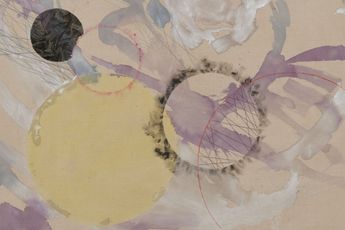
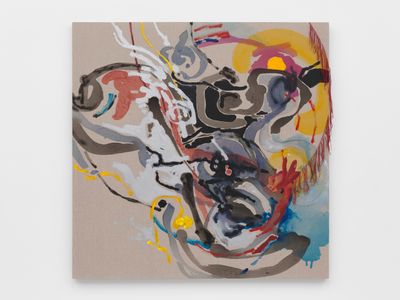
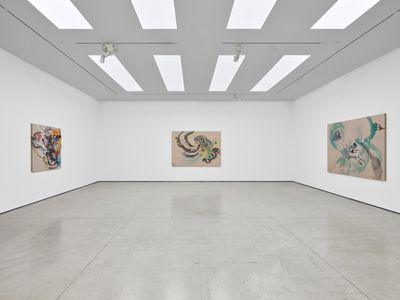
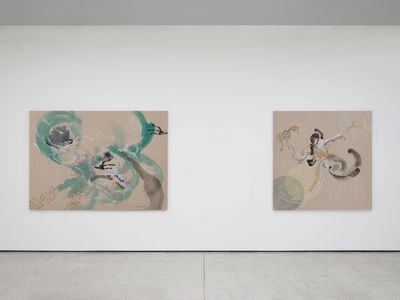
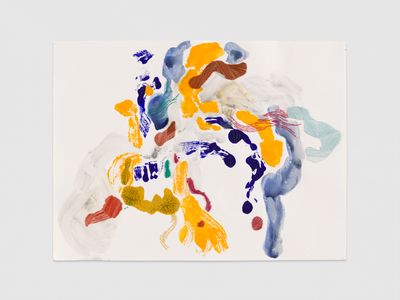
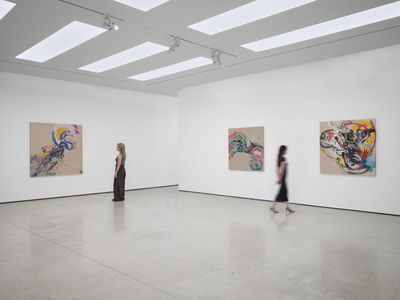
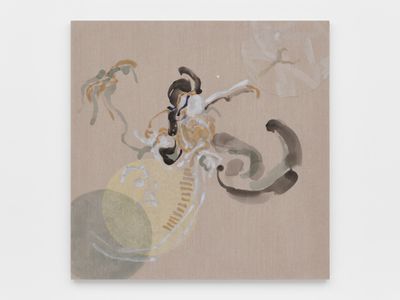
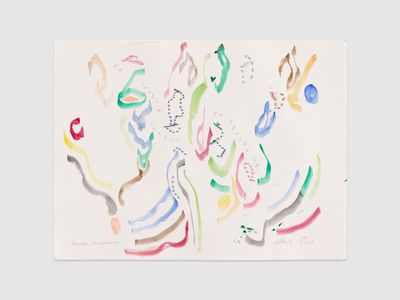
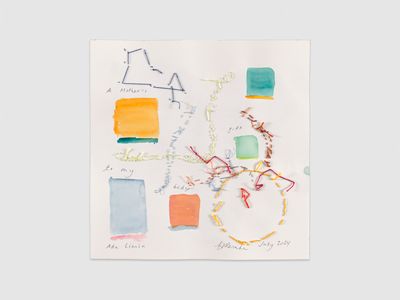
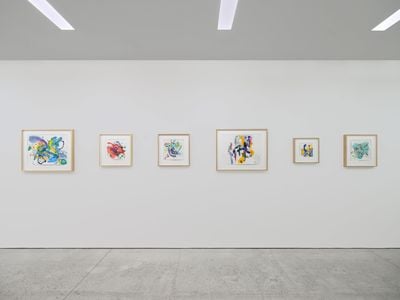
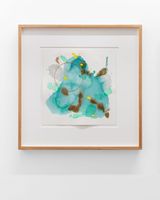
Entitled Sky Sound, the White Cube exhibition presents large-format, acrylic painted and embroidered linen works accompanied by a suite of watercolours. Gentle stains—reminiscent of Helen Frankenthaler‘s ‘Abstract Climates’ of the 1960s—coalesce into biomorphic forms while gestural strokes cartwheel and leave meteoric trails. The delicate washes—in faded pinks, purples, mint greens and sunshine yellows—reflect the fragility and translucency of Rankin’s earlier organdie works, contrasting with the darts of bolder, feverish colour.
These works are best experienced in person. A close inspection reveals Rankin has combined paint and barely visible stitches to create these fluid works. It isn’t easy to distinguish between painting and embroidery. Rankin appears to have taken the play of Roy Lichtenstein‘s Ben-Day dots a step further, queering the modernist canon by imbuing its masculine gestures with the mark of a traditionally feminine craft.
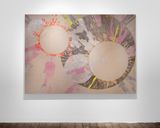
Having adopted John Cage‘s adage to ‘be unfamiliar with what [you are] doing’, Rankin took up painting in 2016 with a desire to push the medium’s abstract language to the limit by choosing gestures, colours, and ways of making that are hard to control or distinctly uncomfortable. In Fall out of the Sun, JR (2024), for instance, loose-hanging, fringe-like threads create shapes that arc, coil, and extend across the picture, echoing the drip of paint and blending with the composition of stitched and painted strokes that flood towards a centred yellow orb.
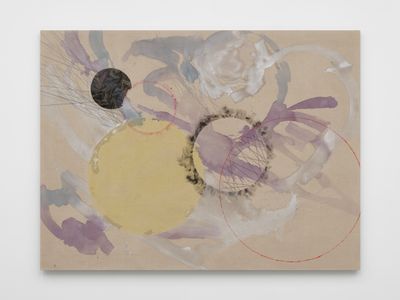
Circular forms appear throughout Rankin’s work, reflecting her interest in astronomy and cosmology. Sky Sound, JR (2024)—the first and largest piece Rankin painted for her show—is a pared-back composition of washed white, cream, yellow, and soft purple, interrupted by five perfectly outlined circles that evoke a celestial feeling. In our discussion, Rankin shares her astonishment at watching an eclipse in 2023 and seeing the circular shapes so prevalent in her work echoed back to her—a moment that reflected the uncanny experience of reading her mother’s poetry only to discover references to the same such shapes.
Writing fragments find textual form in words stitched in capital letters on the sides of canvases. They are a reminder that these paintings extend beyond their objecthood. Their creation is not the result of an isolated moment of inspiration but part of an ongoing conversation, directly and indirectly, with peers across time.
What follows are edited extracts from a discussion between Jessica Rankin and Anna Dickie on 6 August 2024.

AD: The catalogue for Julie Mehretu‘s current exhibition, Ensemble, at Palazzo Grassi in Venice, in which your work is also featured, includes the following quote from you, ‘We are in conversation either with our peers or our ancestors.’ Can we discuss how this quote relates to your work as an artist?
JR: If I could modify that quote slightly, it would be, ‘We are in conversation with our peers and our ancestors.’ When I discuss peers and ancestors, I mean it broadly. I’m talking about family, artistic peers, and ancestors.
I am interested in artists who are engaged with not only art but everything else in the world. I aspire to be that kind of artist. I want to be interested in everything. I prefer not to feel as if I am already familiar with everything. Adopting that mentality keeps you in a state of humility and learning. It allows you to grow and become a more interesting artist.
“Every artist and every writer understands that what they are doing is not something solitary; what they are doing is in a conversation, always.”
To be in conversation with someone, you must be curious about them and interested in learning from them or about them: what they were doing, what they do now, what powers them, what’s important to them. And that can only ever, I think, enrich your understanding of their work and of what you might try to achieve with your work.
I started teaching around 2016, a little before I started painting, and I often have linked the two beginnings. As a teacher, one of my jobs is to make people interrogate themselves. However, there are only so many times I can go into a student’s studio and ask, ‘Why aren’t you taking more risks?’ or ‘Why didn’t you pursue this?’ without turning those questions back on myself. Teaching helped to push my work into unfamiliar territory and gave me the jolt I needed.
AD: That brings us to another quote you referenced, John Cage’s saying, ‘I am trying to be unfamiliar with what I’m doing.’
JR: When I started painting in 2016, the whole thing felt chaotic and unimaginably free. I did not have 30 years of experience under my belt, like many of my peers, who seem to paint effortlessly. The whole thing was a challenge. It felt invigorating and terrifying. But then, a couple of years flew by, and I needed to foster a new challenge. I had to push my painting in a new direction.
Over the past two years, I have embraced a more intentional way of painting. I continue to bring in elements of chance and chaos, but I am also trying to go after certain kinds of thoughts or feelings and manifest them in paint.
I studied canonical historical artists, like Titian, but also my peers: people my age who have been painting for a lot longer than me or people I admire who are a generation above me. I wanted to look at their work and understand them. How or why did they do what they did? How did they create that effect? When I see an artist pushing into new territory, it feels exciting, and that’s something I want to continue doing with my work.
AD: I was interested to read about the reasons you started working in thread. Partly, it was to create your own identity as an artist, distinct from your father, a well-known abstract painter. Partly, it was related to your interest in feminist ideas. I also understand artists like Coco Fusco and David Hammons influenced you. I am curious to hear about these various influences.
JR: I didn’t study art or art history in Australia. I got my undergraduate degree in history, but the classes I was drawn to related to queer studies, feminist studies, and Indigenous history and politics. As I studied these subjects, I brought my interest in art to them. I realised I could self-educate myself around some of these histories through the work of artists like Hammons and Fusco, but there were a lot of other artists and movements that I came to through those studies that influenced me, too. These interests were then solidified when I went to graduate school in New York.
AD: Tell me about that time in New York and its impact on you as an artist.
JR: For several years, I worked as a waitress, hanging out and having a lot of fun. Then, I went to grad school, where I had good luck and came across several amazing feminist artists, including Emma Amos, Martha Rosler, and Joan Semmel. I don’t think my work was aesthetically influenced by these artists—possibly by Amos a little—but they all had a very sceptical approach to their chosen media, which I took on board. Amos was a painter who was part of the African American artists’ generation of the seventies and eighties, but then also moved inside a circle of feminist artists, openly critiquing her work and positions. Rosler was a photographer and videographer who was sceptical about the medium, and Semmel was a painter who was sceptical of the male gaze. What I got from them was an appreciation of this kind of scepticism. I want to embrace painting, but I also want to be sceptical of it and what I am doing with it.
“I always ask my students, ‘If your work goes out there into the world now, who do you want to see it?’”
I want to make paintings earnestly, but I want to poke holes in the idea of painting. I’ll make a splash with paint, but then I will echo its chance appearance in the deliberation of a stitched thread. From a distance, the marks do the same thing and behave in the same way. Then, you get very close and see they are completely different. I want to do something to the very best of my ability, working to understand the medium, embracing it and loving it, but remaining critical of it, its history and what it pretends to be.
AD: Critic and writer Bonny Cassidy observed that your mother’s poetry reflects how aware she was of painting. Your work reflects a deep awareness of literature. Can you discuss this exchange?
JR: Every artist and every writer understands that what they are doing is not something solitary; what they are doing is in a conversation, always. My father was a painter, and my mother was a poet, and they worked collaboratively. Neither went to art school. They were both self-educated in their art-making, and they were part of a community of other visual artists, including John Olsen. My mother watched them all paint, and she heard them all talk. My parents were also very inspired by historical communities of artists, poets, and scholars that they read about.
AD: Your mother’s poetry is very connected to nature, and so is your work.
JR: I spend a lot of my life observing nature and trying to capture it. I am constantly echoing what I’m looking at. My work usually draws from nature—a web of trees or roots or a view of the landscape from the air.
The Australian landscape has had a profound impact on me. When my ex-wife [Mehretu] and I were living in Australia, we did a drive and ended up camping at Uluru, where there are a lot of incredible rock surfaces. These experiences come into the language of how I make. In some ways, I think of myself as a landscape painter, but I also think that, as an Australian, the impact the geography has on you is inescapable. You grow up with this incredible sense of scale and an acute awareness of the environment—heat, drought, and fire season.
AD: Can you discuss further the conversation you are having with your mother through your recent work?
JR: I’ve been reading a lot of my mum’s poetry. She wrote a poem towards the very end of her life, which describes me, her daughter, essentially as a little girl on the beach. In the poem, I drew some symbols in the sand and drew a circle around them. Then, inside the circle, I put a stone and a stick and asked everyone in my family to choose one. The poem says that my brother chose a stick so he could catch fish, my mother chose the stone for endurance, and I chose the circle, saying, ‘because it’s mine. I made it myself. ‘It was uncanny to read that poem, not only because my mother described my future as a maker but because this show is full of circles—a shape that has frequently appeared in my work. Often, when I use them, they have a celestial or solar feeling, but now I see they all seem to echo back to that one poem.
Sky Sound, JR is the first painting I made for the show, almost two years ago, and many of the works that followed were made in response to it. We recently had the eclipse come through North America. In New York, we all stood on the roof and watched it; it was so exciting. I returned to my studio and thought, ‘Oh my God, I’ve been painting the eclipse for the last two years; I just did not know.’
When I realised, I had been painting the eclipse, I revisited my mum’s work. I started going through her manuscripts, and phrase after phrase after phrase fell into my lap all talking about moons, suns, orbs, circles, arcs. It felt like a moment of incredible fate that it all came together so clearly.
AD: It must have been wonderful to have this conversation across time with your mother.
JR: There is this idea that artists forge ahead on their own, making new kinds of work in isolation. But I think that my work exists in conversation with many artists. When I am teaching, I always ask my students, ‘If your work goes out there into the world now, who do you want to see it? Who do you want them to think about when they’re looking at it? Who are you in conversation with?’ —[O]
Main image: Jessica Rankin. Courtesy White Cube. Photo: © On White Wall.






A respected voice in contemporary art discourse.
Focusing on ambitious storytelling and insightful art-world commentary. Ocula Magazine publishes in-depth interviews, critical essays and timely analysis on the artists, exhibitions and ideas driving the global art world.
Learn more about Ocula Magazine
Showcasing the best of the art world.
Ocula partners with galleries from around the world to highlight their artists, artworks and exhibitions. Gallery membership is by application and invitation, with each member vetted by an independent panel.
Learn more about Ocula Membership
Specialises in the sale of major artworks.
Led by a team with deep ties to the world’s leading auction houses, galleries and collectors. Ocula’s advisory team offers bespoke services to high-net-worth clients from around the world who are looking to acquire the best of contemporary and modern art.
Learn more about our team and services