





Pio Abad: ‘I want to seduce people towards knowledge’
The Turner Prize nominee reflects on the closing of a chapter in his ten‑year project on the Marcos family loot and the lingering spectres of their regime. Save to My Ocula
Pio Abad is haunted by ghosts. The past ten years for the Manila-born artist have been marked by an ongoing pursuit to document the vestiges of the Marcos family’s autocratic regime in the Philippines.
Between 1965 and 1986, president Ferdinand Marcos Sr and his wife, Imelda, allegedly embezzled billions of dollars from the nation and amassed an inconceivable mountain of treasure including priceless works of art by Pablo Picasso, Francisco de Goya, Raphael, and Sandro Botticelli. Much of the ‘Marcos loot’ was later hidden or presumed destroyed to avoid evidencing the family’s corruption, and has not been seen again.
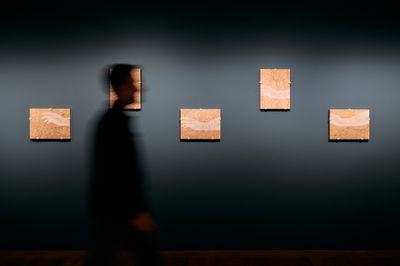
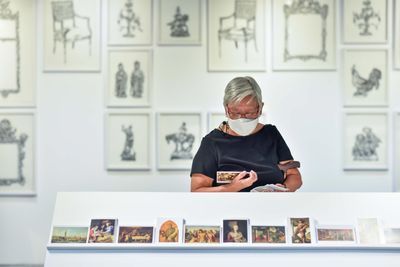
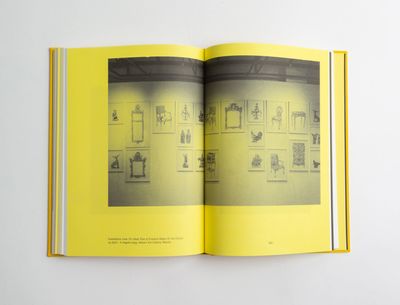
The first exhibition Abad produced for the Marcos project, Some Are Smarter than Others (2014), was titled after the landmark text by Ricardo Manapat (1991) that exposed the history of the Marcos regime and their loot. This year at the Ashmolean Museum in Oxford, Abad presents his Turner Prize-nominated exhibition, To Those Sitting in Darkness (10 February–8 September 2024), which comprises his own original works installed alongside replicas and originals of historic objects, artefacts, and artworks from the collection of the University of Oxford.
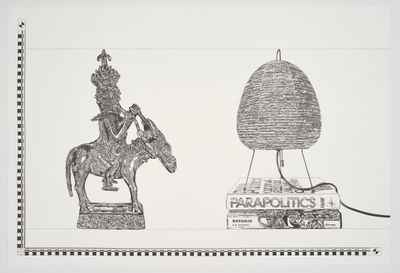
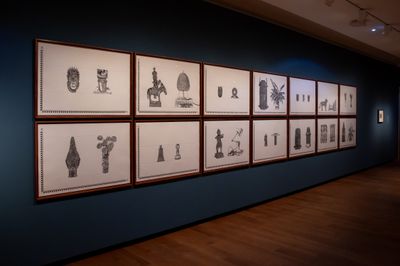
The title is a play on Mark Twain’s essay, ‘To the Person Sitting in Darkness’ (1901), in which the American writer casts a critical lens on imperialism and the colonisation of the Philippines. In a tongue-in-cheek gesture, Abad redirects the address to the so-called diasporic objects and images in the museum’s collection, animating and recontextualising them. In a series of black-and-white drawings (1897.76.36.18.6, 2023), Abad pairs the infamously pillaged Benin Bronzes with everyday contemporary objects.
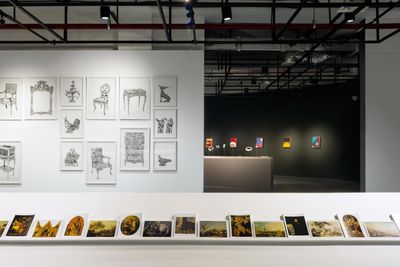
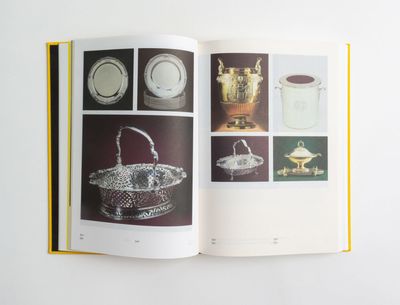
A key moment for Abad was his discovery of two Christie’s catalogues from 1991, when the auction house helped the Philippine revolutionary government to sell off the Marcos loot. The accompanying catalogues reproduce in lot images many of the objects that Abad’s works are modelled from: jewellery, Old Master paintings, the largest single collection of Regency-era silverware. These catalogue images are, in many cases, the only known record of the loot, raising questions about how we understand provenance and authenticity.


Speaking to a packed room at Gasworks, London, in June for the launch of his book, Fear of Freedom Makes Us See Ghosts (2024), which documents the decade-long project, Abad joked about how his fabricated ‘poor copies’ of the loot recurrently crop up in his research into the Marcoses, muddying the lines between history and fiction, archival record and artwork.
He described an instance in Lauren Greenfield’s 2019 documentary, The Kingmaker, which briefly showed a pair of paintings depicting Imelda Marcos as Maganda—the Eve of Philippine mythology—and Ferdinand as Malakas, the Adam counterpart. They were, in fact, Abad’s own paintings from 2014, leading to an uncanny realisation where ‘the documentary kind of failed for me.’
It’s a conundrum that echoes a famous line uttered by Imelda Marcos in The Kingmaker: ‘Perception is real, and the truth is not.’
The Marcos family’s persistent manipulation of reality eventually facilitated their restoration to power in 2022, with Ferdinand ‘Bongbong’ Marcos Jr elected president despite his father’s regime overseeing upwards of 100,000 human rights violations—according to Amnesty International figures—in its 20-year term and leaving the Philippines in a poverty and debt crisis.
Abad’s parents, Butch and Dina, were part of a group of young social-democratic activists who fought in the anti-dictatorship struggle and were involved in the years of agitation and activism that led to the revolution of 1986, as well as the rebuilding of Philippine democracy following the collapse of the Marcos regime.
Evolving political realities have permeated Abad’s project throughout its course in ways both expected and unexpected. His exhibition Fear of Freedom Makes Us See Ghosts—a title drawn from Paulo Freire’s Pedagogy of the Oppressed (1968), a formative text for his parents’ political group—opened at Ateneo Art Gallery, Manila, in April 2022, the month before Bongbong Marcos’ election. In the days following the election, thousands visited Abad’s exhibition.
‘The show became a way for people to examine their defeat in granular detail,’ Abad told the audience at Gasworks. ‘It became a site for grieving.’
The location of the gallery is, in fact, of remarkable significance to the artist, being on the grounds of the university where his parents were incarcerated in 1980.
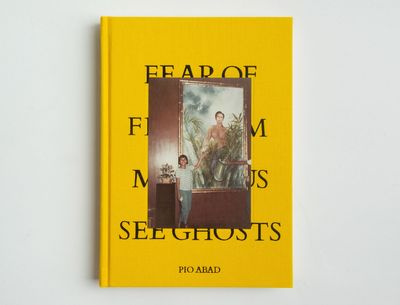
Abad’s new book marks a closure of sorts to this grief. Described as the most comprehensive visual account of the Marcos loot to date, Fear of Freedom Makes Us See Ghosts is equal parts monograph, historical document, and faux auction catalogue.
Its sunflower-yellow cover nods to the People Power Revolution of 1986: the use of yellow ribbons as a symbol of protest saw the uprising also called the Yellow Revolution, but in the fallout, the colour became associated with elitism and defeat.
‘I wanted to reclaim that colour,’ Abad said. ‘It’s the colour of a struggle that we were all part of.’
‘This project is an act of love, of paying tribute to my parents’ struggle and the entire community that they built ... They tried to do something impossible, which was to rebuild democracy in a country where corruption is systemic.’
The Marcoses still owe ten billion dollars to the Philippine government. But with Bongbong still in power, the chances of its recovery grow ever-slimmer.
MK: You have described your new book as a ten-year project that was timestamped with major events and losses, both personal and political. How does it feel to have the book out there now in the world?
PA: I’d describe the whole thing as a culmination, but also as a kind of exorcism, because the moment the project is crystallised into book form, you can put it away. Then, later, you can revisit it and go through it all again. It’s a strange record of a particular moment, when things larger than the project and larger than myself took place in politics, and life as we knew it was totally upended.
I don’t know how I feel, really. It’s not an end, but it puts a particular body of work to rest, in a way. As much as the book is a record of a history that has been forcefully made present, I see it also as a document for the future. While much of what led me to create the work was to do with grief—losing my mum, losing my country as I knew it—I did this project to imagine what accountability could look like in visual form. To be able to see it, and to have people be able to leaf through what accountability could look like—there’s something satisfying about that.
“Ultimately, the reason I make work, and the reason that the work takes the forms it does, is because I want to seduce people towards knowledge.
MK: As you said at Gasworks, it’s the most extensive visual record of the Marcos loot, so it exists as an important historical document in that way.
PA: That’s the thing: I’ve always seen it as an artistic project but it’s also very much a political document. A very beautiful political document, but a political document nonetheless.
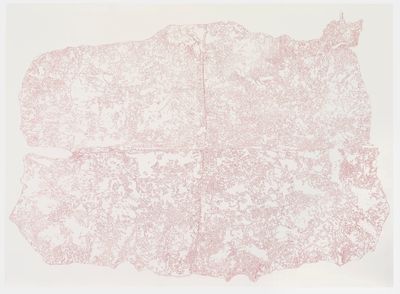
MK: You talked about the title coming from Freire’s Pedagogy of the Oppressed, and the significance of that book to your parents’ generation and their politics. How do Freire’s ideas inform your own practice?
PA: I think it’s the need to be transparent, and the role of the public in engaging with the work is important, too. The ten-year project is a tool for teaching and for learning, so I’d hope it can be used at some point further down the line as a visual aid for emancipation. That sounds very grand, which I don’t mean to, but if you’ve devoted a decade of your life to something you hope that there can be some use for it in the future. Ultimately, the reason I make work, and the reason that the work takes the forms it does, is because I want to seduce people towards knowledge, to gain as wide an audience as possible.
I think there are always two points to consider in that regard: one is to use beauty to that end; the other is to use a certain level of generosity in making the work and telling its story. That’s why the book is so important: not everyone can see the show, but a publication can be widely distributed. I see the book as an artwork in itself.
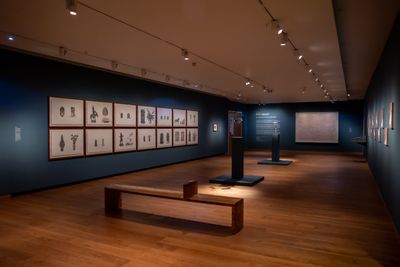
MK: The Ashmolean is an interesting setting for your project. How did the context impact the way you developed the show, and how do you think it’s understood by audiences in relation to what you said before about knowledge-sharing, generosity, and curiosity?
PA: It’s always been a dream to be able to operate within one of these ‘encyclopaedic museums’, and the Oxford show is almost the beginning of a new chapter: if the book is the closing of one, the Oxford project opens up my practice to different avenues, different contexts. I was invited by Lena Fritsch, who is the contemporary art curator at the Ashmolean, to look through the entire collection of Oxford University, which was a daunting task, and create a body of work that brings artefacts out of storage.
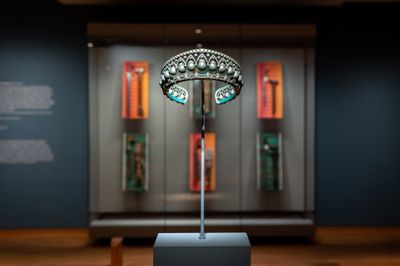
I approached the show like a call and response, choosing a selection of objects and making works in response to the histories and the people embedded within them. The title of the show, To Those Sitting in Darkness, is a reference to an essay Mark Twain wrote at the very beginning of the 20th century, which castigates the U.S. for colonising the Philippines. It’s a play on this quote from the Bible, ‘People who walked in darkness have seen a great light,’ with the light being the Empire. But I wanted to expand the remit of the essay title, so that it addressed those sitting in darkness, and I wanted to involve objects that have been either witnesses to or are residues of colonial histories.
Trawling through the Oxford University collection, everything is tinged with that history. So inevitably, for me, the Philippines became a starting point, because it’s always important to locate myself within that history before I start navigating anything, and that helps me to not be overwhelmed by what I’m excavating.
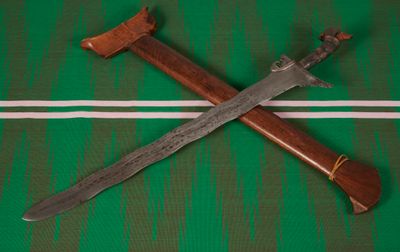
There’s also a sense of proportion, I think, of talking about all these vast narratives of colonialism, pillaging, conquest, and looting, but to then put them in relation to my own body, which hopefully would allow other people to access it through their own scale.
I’ve also written an exhibition text in the first person. There’s an element to it that serves as a memoir of sorts; it allows the viewer to access the entire project from my perspective, which is the only point of view I can offer, really.
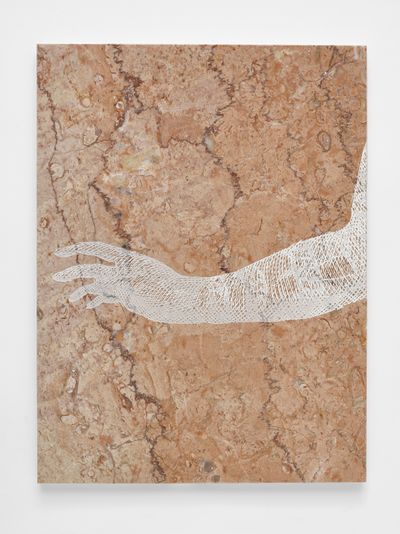
MK: What does it mean to you to be nominated for the Turner Prize for this show?
PA: When I moved to the U.K. in 2004, the Turner Prize was the biggest thing you could ever achieve as an artist, starting out at art school. The 21 year old in me is absolutely blown away. The 40 year old in me is blown away, too.
It’s also nice to be recognised. People forget, sometimes, that I live in London, because all of my projects exist elsewhere, or a lot of my work has focused on the Philippines, so my practice is often viewed through the lens of ‘nation’. For the judging panel to see this exhibition and recognise it as very much invested in the context and the narratives here, of the U.K., means a lot.
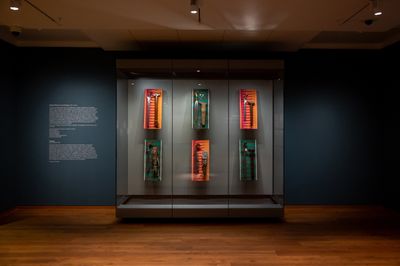
MK: You mention your practice being frequently viewed through the lens of ‘nation’. How do you feel about that?
PA: It’s funny because, on the one hand, obviously I make work about the Philippines—that’s my context. On the other, I would hope that the Philippines can be viewed not just as a nation with its own story, but as a microcosm for so many things happening in the world. Take Imelda Marcos: she’s perceived very much as this geopolitical figure, but I also see her as someone whose desires and excesses were shaped by a colonial imaginary. When I talk about histories of dispossession in the south of the Philippines, it’s a history of dispossession that relates to larger issues happening in the present.
“I would hope that the Philippines can be viewed not just as a nation with its own story, but as a microcosm for so many things happening in the world.
Or, when I talk about imagining accountability, it’s hard not to view that through the British general election, which is one of the few moments when this country can hold its leaders to account, and they’ve been so badly behaved for the last 14 years. So, although my works are unquestionably invested in a national story, I also want the viewer to be able to see that as part of a larger fabric of stories.
It’s all about context, like with the Ashmolean: to be able to experience the show as you navigate these artefacts from all over the world that are in the museum collection is really powerful. Right next to the gallery where my exhibition is installed is the display of the Ashmolean’s founding collection, which is one of the first cabinets of curiosities in the world that was made accessible to the public. To be in proximity to and in dialogue with these objects that carry that much historical weight is incredibly exciting. I’m curious to see how the work will change when the show moves to Tate Britain in September.
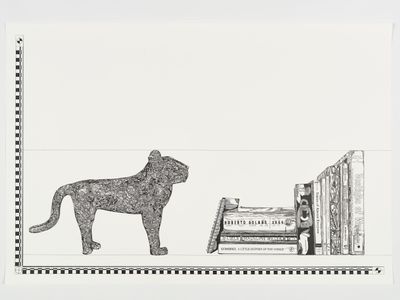
MK: Installing your show there will constitute another lifting or divorcing of context, another ‘poor copy’ in a sense.
PA: Exactly. I’m curious to see whether, when people enter the space in Tate Britain, the show will become a purely contemporary experience—not filtered through objects of civilisation or of conquest. So, that’s exciting for me, to have to think about the project existing on its own terms. But it will also exist in dialogue with the three other Turner Prize nominees, whose works likewise deal with histories of family within larger political contexts. That becomes another conversation to be part of, which is very exciting.
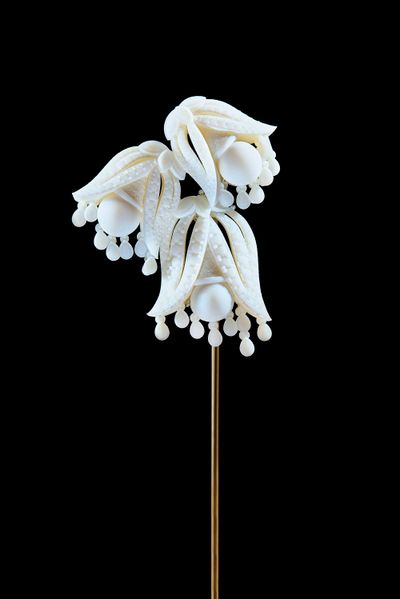
MK: I’m curious about the development of your collaborative practice with your partner, Frances Wadsworth Jones. Could you tell me about the origins of that working relationship and how it’s evolved?
PA: I think we’ve always shared a certain sensibility—Frances is a jewellery designer by profession—and there’s an element of elegant subversion in both our practices. So when it came to making work about the Marcos jewellery, it was amazing to have her talent immediately on board, and she was excited by the prospect.
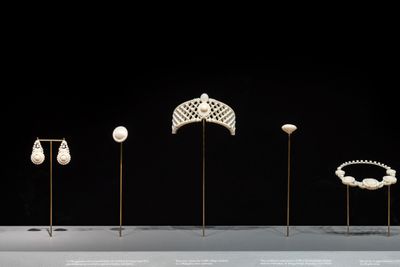
The collaboration developed organically but also as a consequence of politics and copyright because, just before Rodrigo Duterte’s administration took over in 2016, I got access to some images of the Marcos jewellery, which were technically still owned by the Philippine government. The initial plan was to use the photographs and to find a way of displaying them. Before Frances and I started collaborating, the Marcos project really was about reinterpreting photographic evidence. But because there was this unknown, frightening prospect of a punitive administration taking over, I wasn’t comfortable with appropriating government property.
“Jewellery is the ultimate, most intimate witness of all these public, political collapses . . . it’s literally worn before someone is deposed, beheaded, or exiled.
I was talking about the situation with Frances and she said: ‘Well, why don’t we just remake them?’ like it was the easiest thing in the world, despite the fact we only had one JPEG of the front angle of each piece of jewellery. A few months later, I was invited to take part in the 2019 Honolulu Biennial, and we realised it made sense to show this work, even though it was only in the very early stages of development, because this part of the Marcos jewellery collection was called the Hawaiʻi collection. It was the jewellery that Imelda tried to smuggle into Honolulu when they were granted exile by former U.S. President Ronald Reagan.
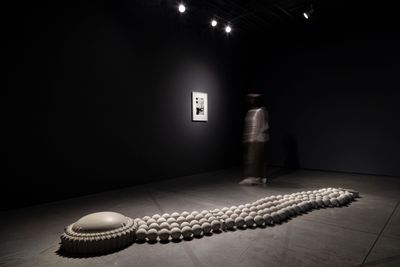
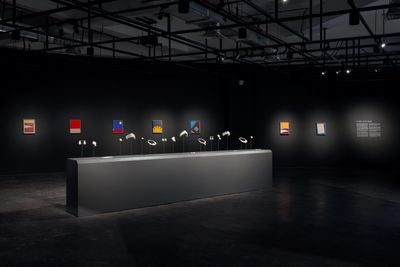
It’s really down to Frances’ skill that The Collection of Jane Ryan & William Saunders (2019) happened because she reconstructed each gem facet by facet. 3D printing was always going to be the conduit to realise them, but initially we couldn’t decide whether to cast them, or present them in colour. Then we thought: why don’t we just stick to the white plastic material that you normally use for 3D printing? And the jewels became these beautiful ghosts. When we showed them in Hawaiʻi for the first time in 2019, there was an element of return, an element of haunting.
Since then, we’ve been collaborating on a few other projects. We did a show at KADIST as part of my residency there in 2019, and then we did the Kochi-Muziris Biennale in 2022, and now there’s a bronze tiara, For the Sphinx (2023), in the Ashmolean.

I think this fascination with jewellery will be an enduring one, because there’s something about its history in relation to the body. I think jewellery is the ultimate, most intimate witness of all these public, political collapses because it’s literally worn before someone is deposed, beheaded, or exiled.
So, I hope Frances will be willing to keep working together. It’s been a long collaboration, and we’re also expecting our first child, which will have to be the best thing we’ve ever made—not 3D-printed, not drawn. And the most expensive project ever [laughs]. Having a kid is a beautiful new beginning. It puts everything else into perspective. —[O]
Pio Abad: To Those Sitting in Darkness is on view at the Ashmolean Museum in Oxford until 8 September 2024. The Turner Prize 2024 exhibition opens at Tate Britain, London, from 25 September 2024 through 16 February 2025.
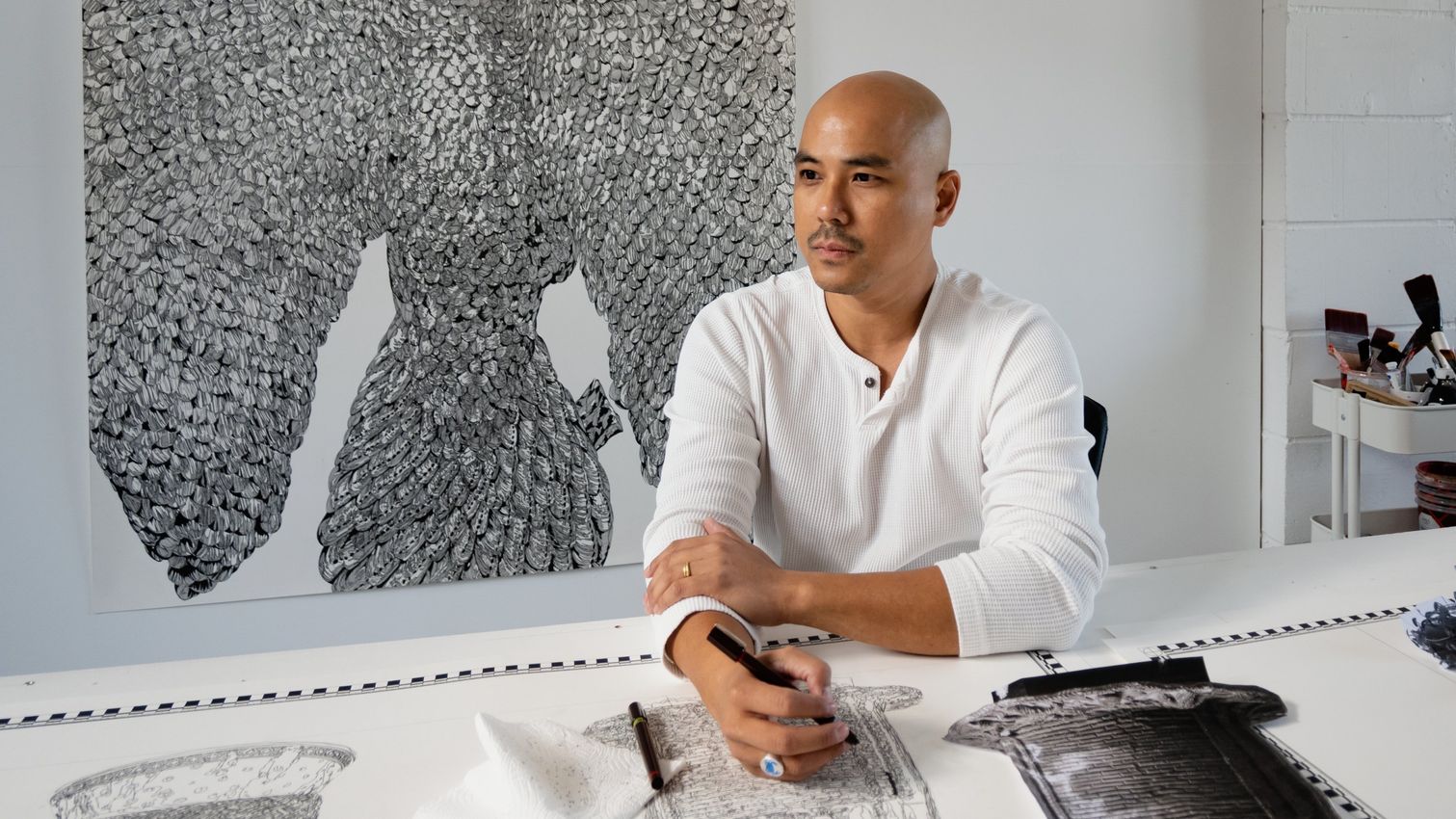
Main image: Pio Abad. Photo: Frances Wadsworth Jones.




A respected voice in contemporary art discourse.
Focusing on ambitious storytelling and insightful art-world commentary. Ocula Magazine publishes in-depth interviews, critical essays and timely analysis on the artists, exhibitions and ideas driving the global art world.
Learn more about Ocula Magazine
Showcasing the best of the art world.
Ocula partners with galleries from around the world to highlight their artists, artworks and exhibitions. Gallery membership is by application and invitation, with each member vetted by an independent panel.
Learn more about Ocula Membership
Specialises in the sale of major artworks.
Led by a team with deep ties to the world’s leading auction houses, galleries and collectors. Ocula’s advisory team offers bespoke services to high-net-worth clients from around the world who are looking to acquire the best of contemporary and modern art.
Learn more about our team and services