





Tasneem Sarkez: ‘Adverts Were My Entry Point into Signifiers of Arab Culture’
The artist discusses ways the cultural aesthetics of her Libyan heritage inform her singular ‘kitsch’ take on a shared global commercial visual language. Save to My Ocula
The first time I met Libyan-American artist Tasneem Sarkez, on a cold January evening last year at the opening of her first solo exhibition in London, White Knuckle at Rose Easton, she confessed that she aspires to own the Mercedes-branded platform pleaser heels depicted in her 2024 painting G-Class Dancing With the Shah (2024).
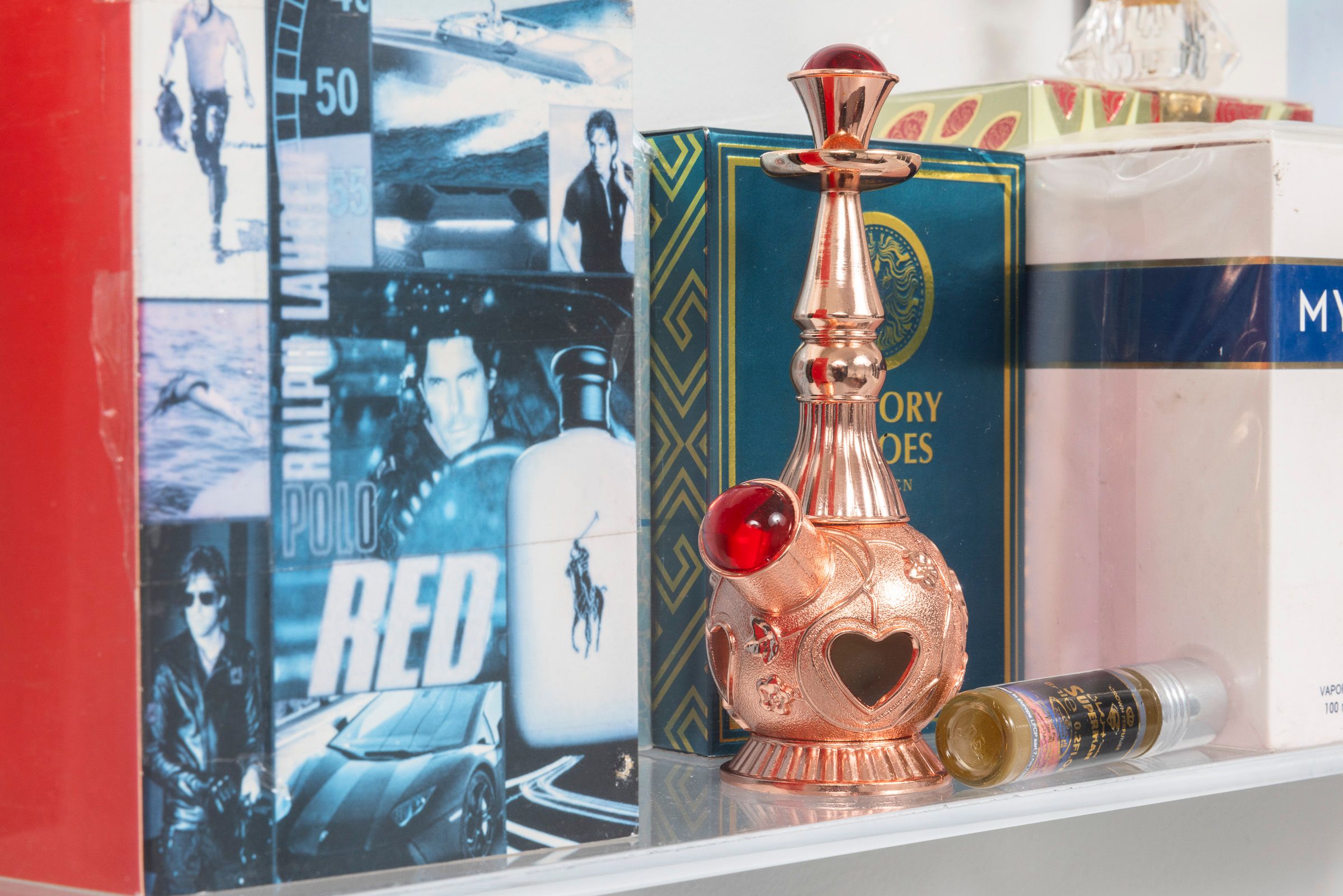
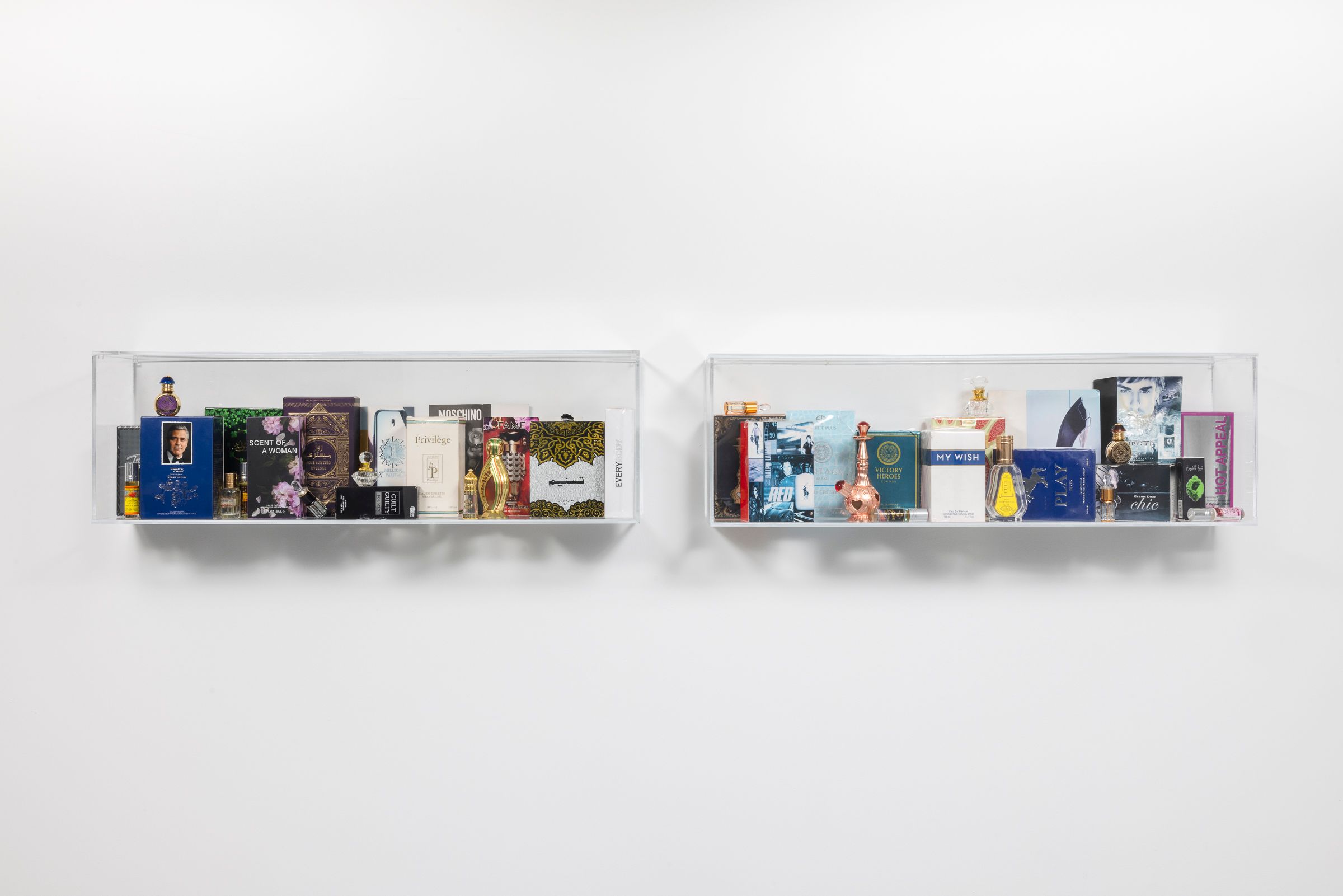
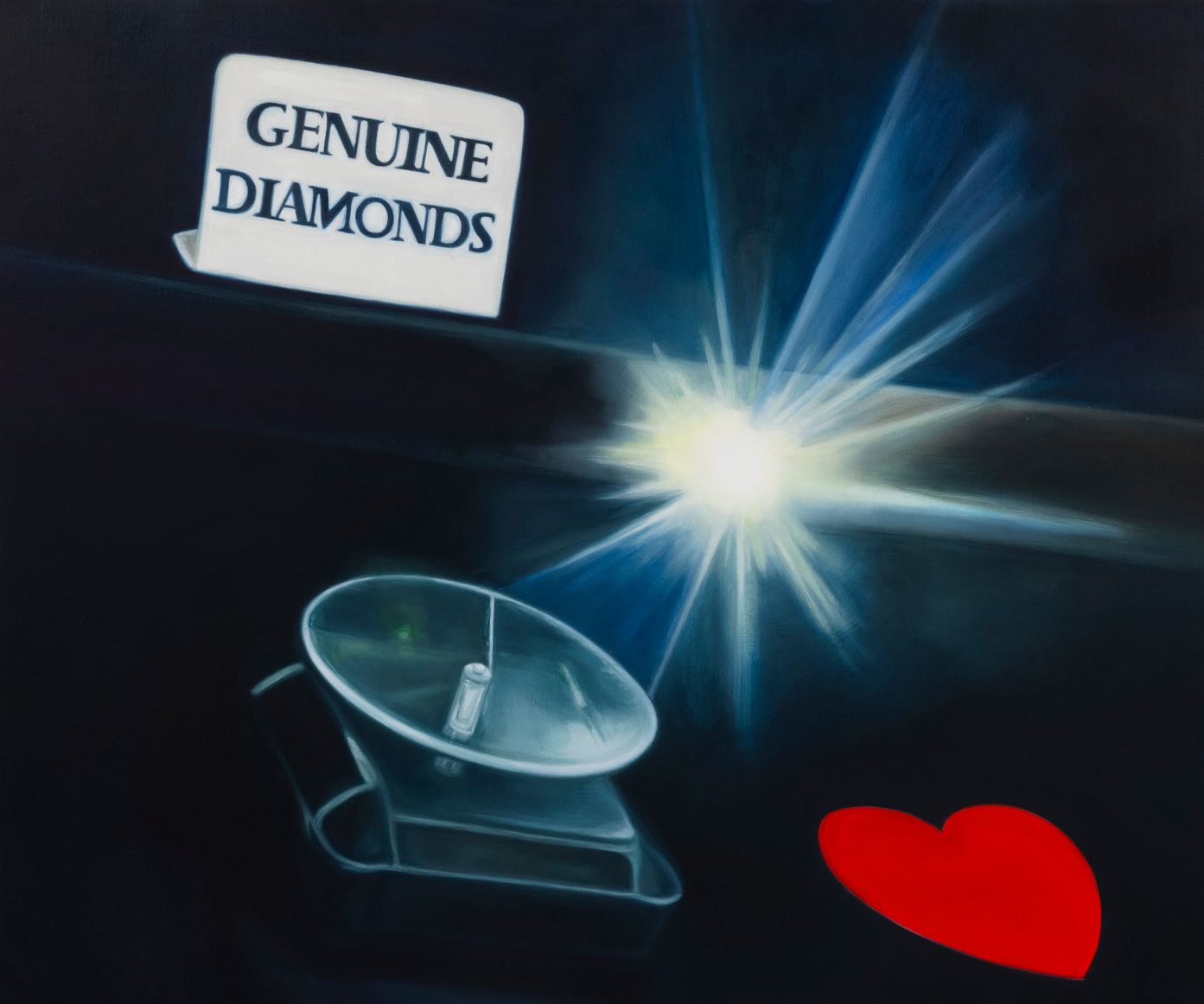
Sarkez, who grew up in Portland, Oregon, and relocated to New York in 2020, describes her creative practice as ‘Arab kitsch’, in reference to a body of work built on the aesthetics—gold bars, vibrant red roses, camo print, clouds of vape smoke, flashy cars and images of Muammar Gaddafi’s army of glam women (Amazonians) placed upon ‘skin-whitening’ soap bars—of Arab merchandising found in the dollar stores, delis and on the perfume shelves of New York. In installation Moral Odor (2025), a collection of knock-off perfume bottles is grouped together in a wall-mounted acrylic box, an ode to celebrity-sponsored aspirations of desire, featuring such names as ‘Rose Mystery Intense’, ‘Scent of a Woman’, and actor George Clooney’s own-brand perfume ‘Whatever It Takes’. She is interested in the so-called authenticity that comes with dated advertisements from the pre-digital age, which she refers to as ‘images approaching death’.
By using a brushwork technique she calls ‘blurring’ on her oil-painted canvases, Sarkez references the oft-seen ‘blur’ in-built into phone apps utilising the front-facing camera, in which appearances are distorted in real time to smooth skin blemishes and other perceived imperfections. The almost luminous quality of the ‘blur’ in her work refers too to the effervescent light emanating from a shisha pipe, an object depicted shaped as an AK-47 assault rifle in Hi Jolly (2025). These subjects are humorous, with reverence afforded to them via the culturally elevated medium of oil painting, explored in her show “Just For You” in 2025 at Romance, Pittsburgh.
While we spoke over Zoom, Sarkez periodically showed me images from her camera roll. Shop awnings, windows filled with posters, cars covered with vinyl stickers. She’d formatted them into her Notes app—highlighting in yellow the aspect of the image that appealed to her—all for future reference in the studio. Sarkez is a flâneuse taking stock of what most people ignore: the un-homogenised advertisement where stock imagery can meet kitschy personal taste, and the cultural cross-pollination of what she calls ‘Arab Americana’ is achieved.
LET: Is there a moment in your life that shaped your practice today?
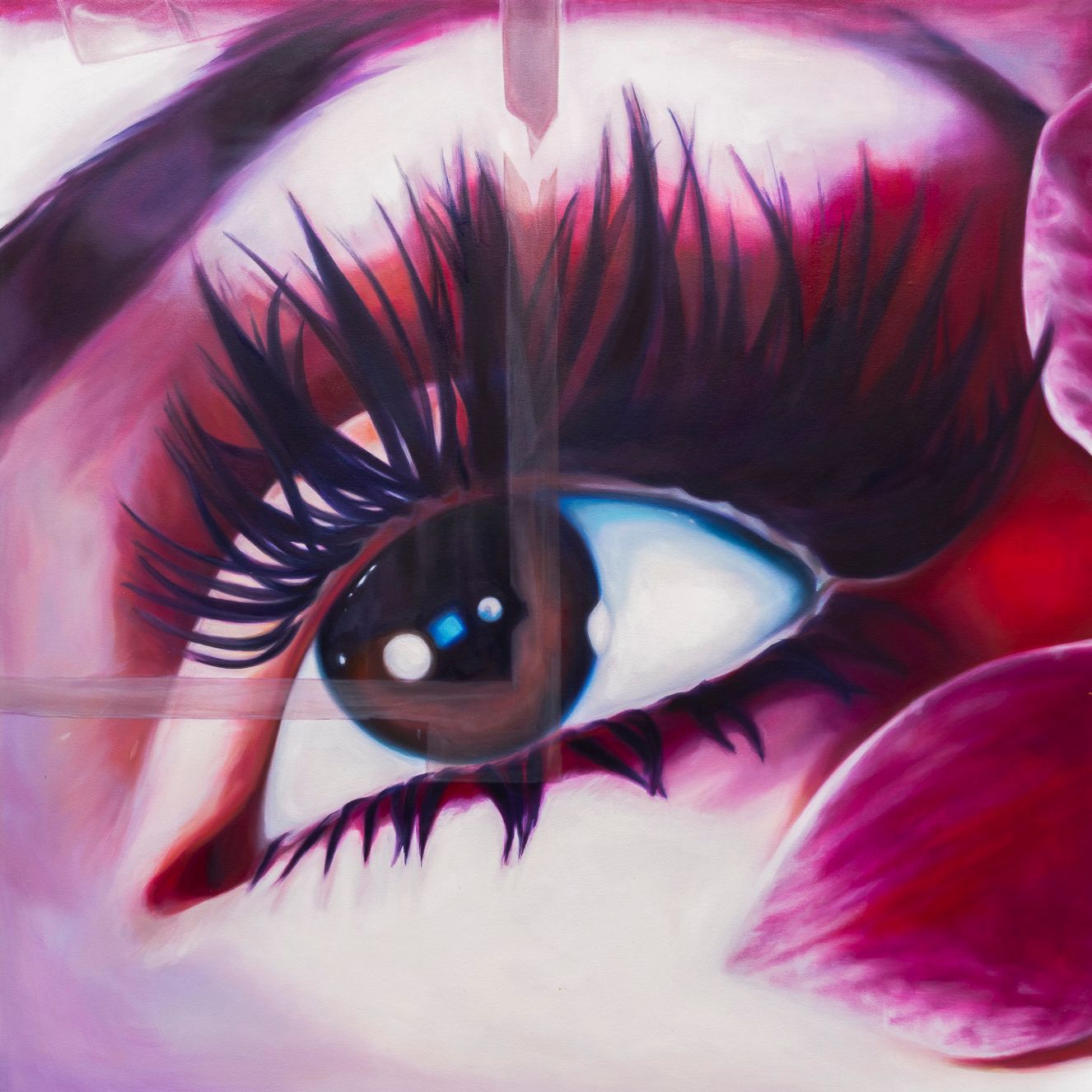
TS: When I was 16 and on holiday in Morocco, I had an epiphany while I was roller-skating down the street. I became obsessed with movement and the way speed changes form. This relates to my later obsession with the aesthetic of ‘Arab drift’: a dreamlike fantasy, whereby a woman’s eyes are superimposed over a flash car rolling in the dust. My high school yearbook quote was the line from M.I.A.’s music video for Bad Girls (2012), ‘Suki suki’; it means ‘Drive, drive’ in Arabic.
LET: Is there a particular exhibition that marked a turning point in your approach to painting?
TS: The first thing that comes to mind is Ed Ruscha’s 2023 solo show at MoMA, NOW THEN. It made me think about the role of language in art. Ruscha’s deadpan American humour has shaped my approach to the written word within my practice. For example, my uncle in Libya will wear a shirt that says ‘I LOVE SUNDAYS’ in English. He doesn’t know what it means. It’s lost in translation; that alienation is the same as the feeling conveyed in Ruscha’s canvases.
LET: I often hear the term ‘Arab kitsch’ in relation to your work, but ‘American’ and ‘deadpan’ less so. What do these words mean to you?
TS: I would relate the word ‘deadpan’ to kitsch. The scenes and objects I gravitate towards are deadpan. These are images of objects approaching death: washed-out, sun-bleached advertisements in the windows of storefronts. That was Ruscha’s interpretation of Americana: bleak landscapes and empty words. In my own work, I wanted to approach this through the Arab American context—through settings like dollar stores, delis, or perfume stores.
LET: What is it about these spaces that you’re drawn to?
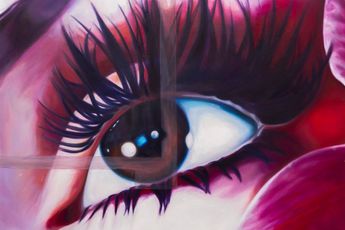
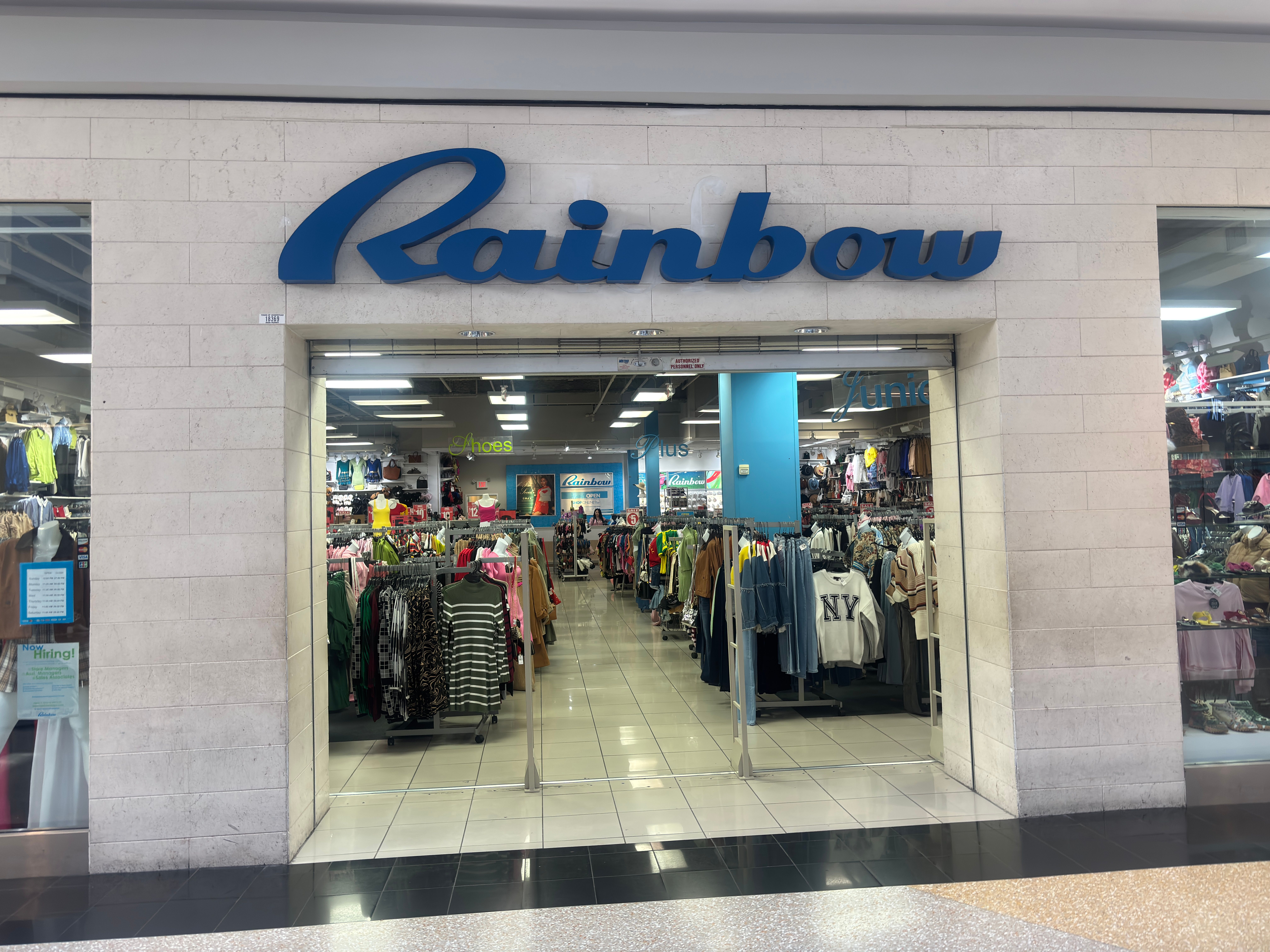
TS: My love for the marketplace is related to my upbringing in Portland. It’s such a white city with very little racial diversity. Outside of my home, the only source of any kind of contemporary Arab aesthetic I encountered growing up was at the grocery store. Commercial advertisements were my entry point into signifiers of Arab culture: motifs of the gold-plated bar, the rose, the drift car, the heavy kohl around a woman’s eyes.
LET: Tell me about a time you lifted source material from the street.
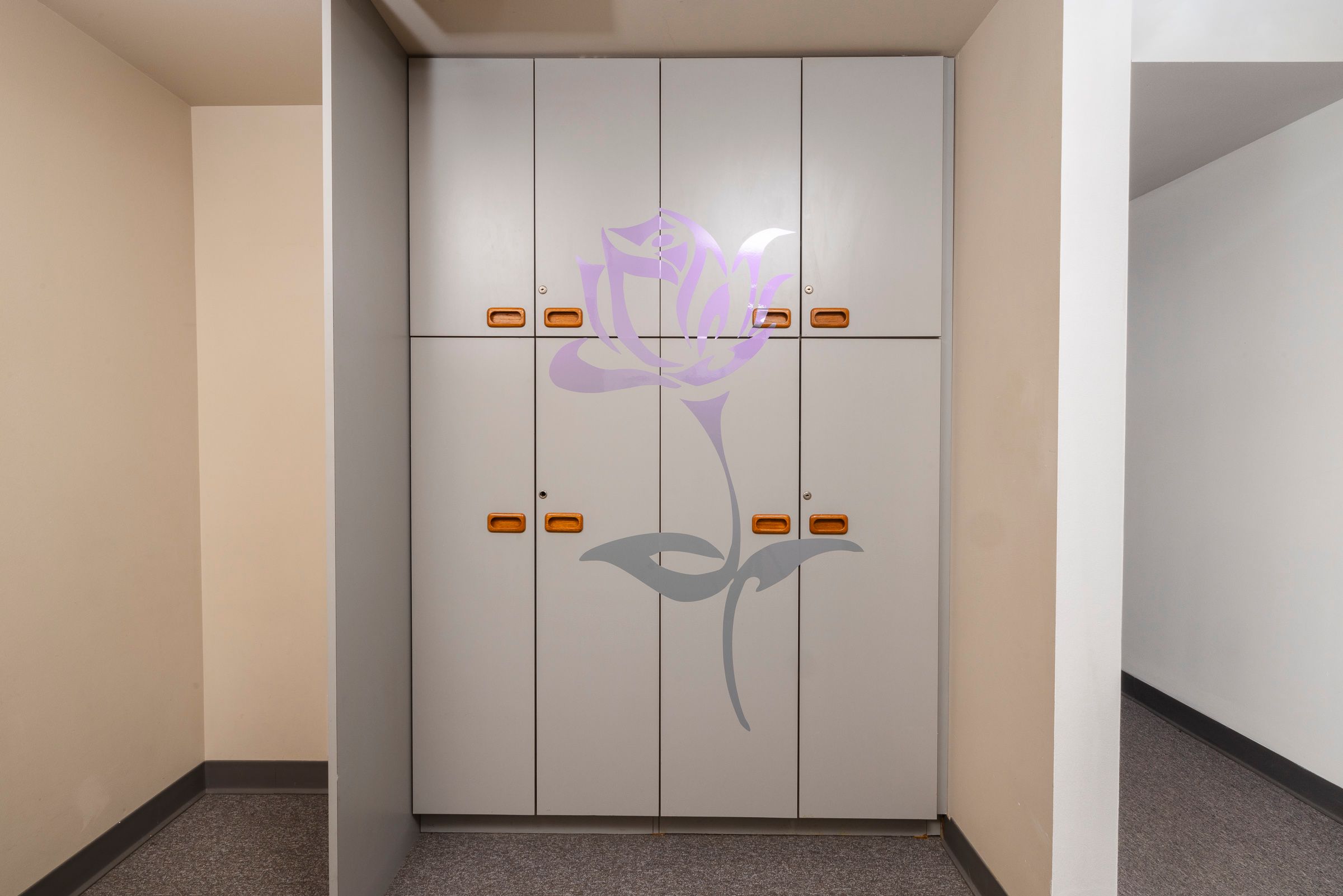
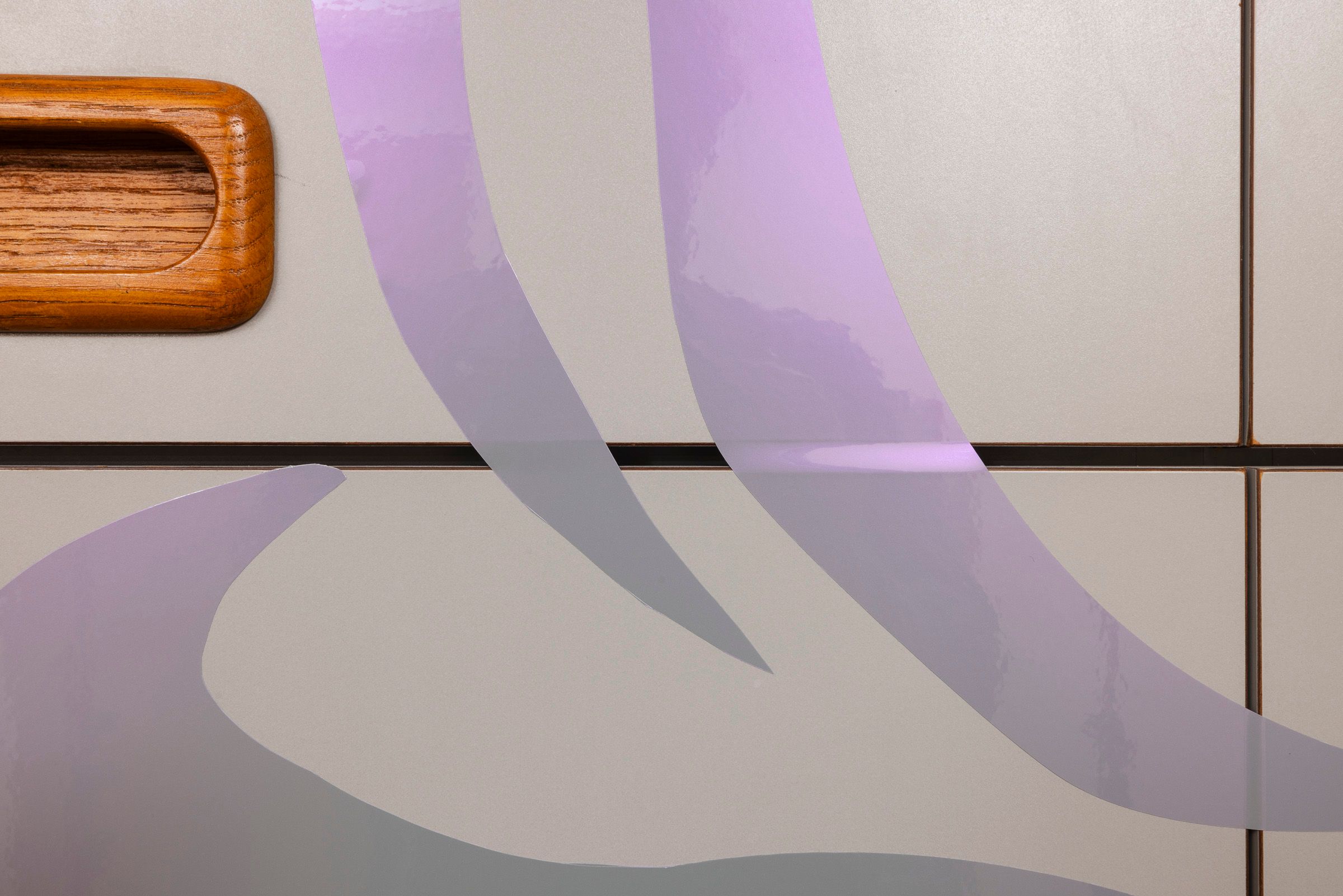
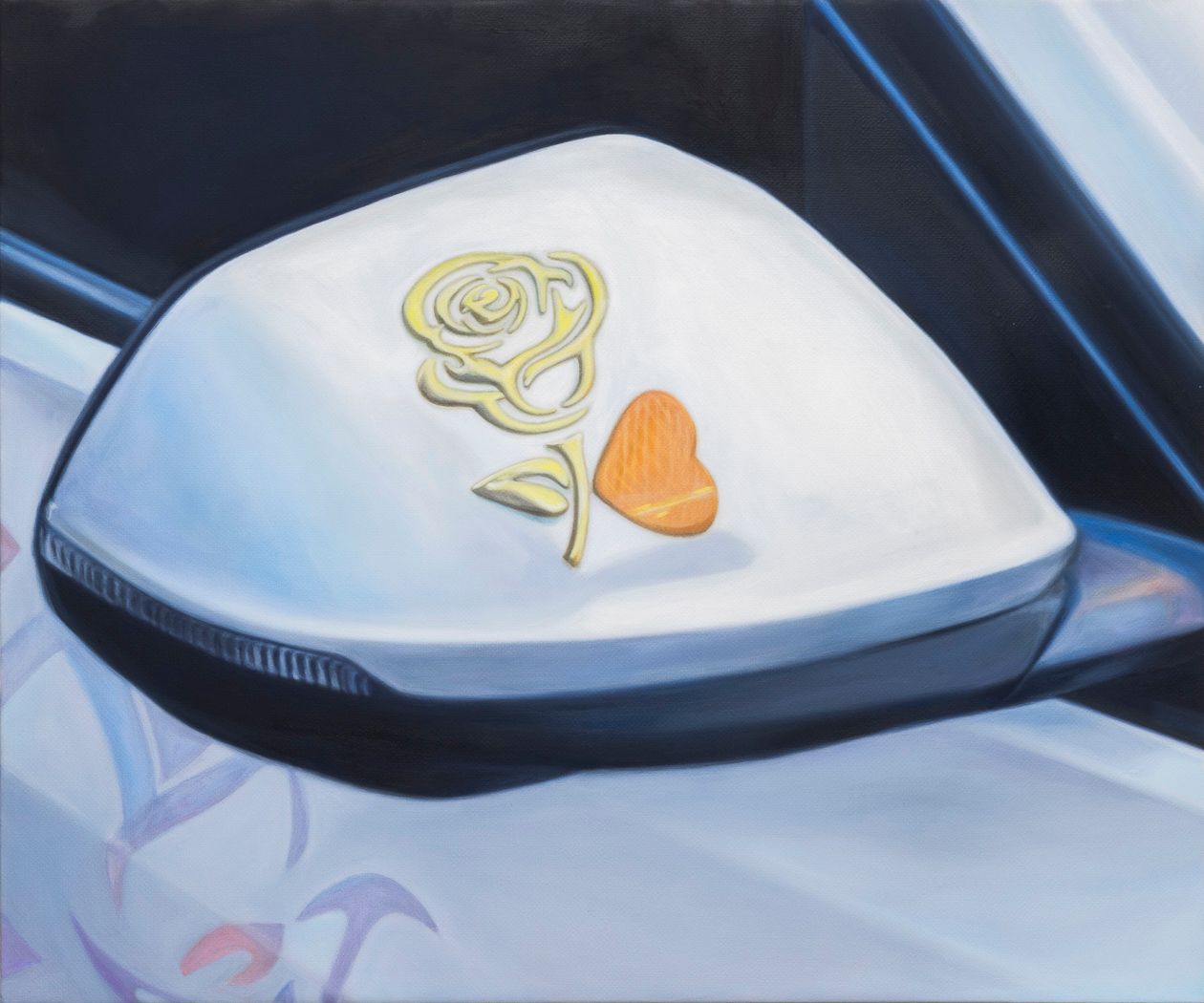
TS: For my show in Pittsburgh last year, I had a sticker made from car vinyl and pasted on to school lockers for [the] installation Ascending Rose (2025). The shade I chose is called ’Candy Paint’, and it has an iridescent purple sheen. I’m obsessed with decals and transfers; so many artists that I love have worked with them—Laurence Weiner, Nora Turato, Puppies Puppies.
The image source for the work is a car I found in Chinatown. It was the perfect car, covered with daintily placed roses, butterflies, hearts. Usually car decals are placed really predictably: symmetrically on the bumper or door. This car was soft and the decals felt one with the vehicle. All of this is related to my obsession with speed and movement and ways in which we personify the representation of it.
LET: Which fiction book would you say has impacted your practice?
TS: The Alchemist (1988) by Paulo Coelho. It’s about a boy navigating a journey through the desert. The way that Coelho writes about the concept of a ‘personal legend’ and takes notice of omens introduced me at a young age to the idea of what it means to listen to your intuition about signs. It’s that feeling of chance when encountering an object, or the moment. I’m constantly taking pictures of things that feel like a sign to me and often work from these in my practice.
LET: What about non-fiction?
TS: Either Simulacra and Simulations (1981) by Jean Baudrillard, The Power of Words (1937) by French political activist Simone Weil. My professor also recommended Weil’s Gravity and Grace (1947) to me during a conversation about the Arab Spring. There is one quote, specifically, from Gravity and Grace, that has stayed with me: ‘To find extraordinary difficulty in doing an ordinary action is a favour which calls for gratitude. We must not ask for the removal of such a difficulty. We must beg for grace to make good use of it.’
LET: What are you visualising for your upcoming three-month residency in Tunisia at Selma Feriani Gallery?
TS: A trip to Libya last year knitted together my understanding of Arab Americana and Arab aesthetics. It was the first time I had been back since 2012, and here I was able to contextualise the aesthetics I’m drawn to. It’s a global visual language: it explains how smoke shops that serve diasporic Arab communities in Coney Island in New York, Edgware Road in London, and downtown Tripoli in Libya all have this shared visual language.
During my residency, I’m going to draw upon my recent time in Libya, using that same appraisal and lens, to capture Tunisia. I’ve already asked the gallerist to help me find some Tunisian drifters. I’m obsessed with Arab drift culture: drifting is the practice of often using a stolen vehicle to whip at high speeds in urban environments. Arab drifting is an anthropological extension of that movement; characterised by speed and fluidity, it turns the road into a playground of fun, protest, bliss… blurring the hierarchical structures of gender, capital and mobility. It’s politically embedded into the geography and power dynamics of a culture in which roads hold both state power and imperial influence.
LET: The way you speak about the architecture of the smoke shop is very evocative. Would you ever try to create an immersive installation?
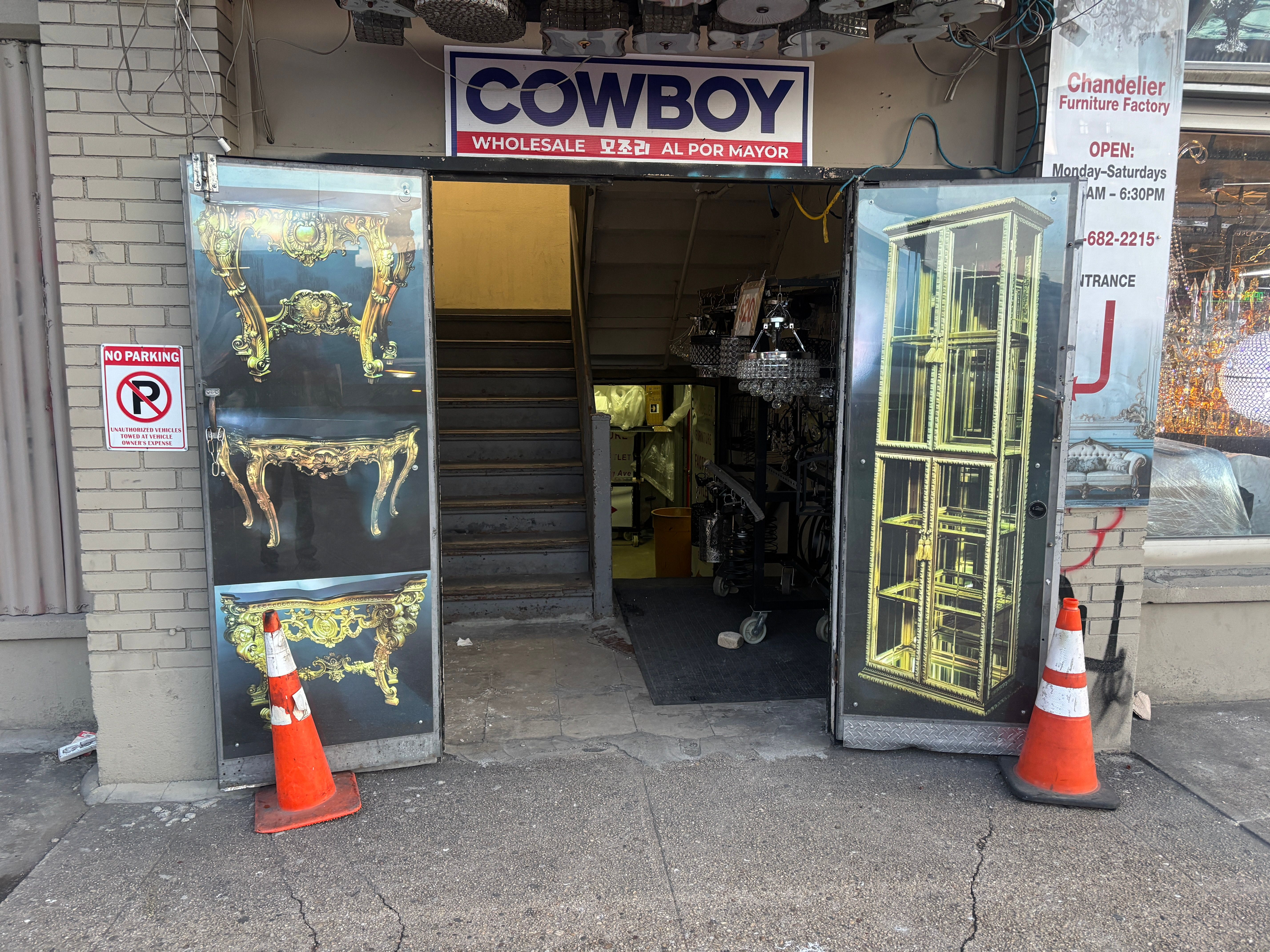
TS: It’s funny you say that. There is this storefront I saw recently at a wholesale chandelier shop in New York City, named ‘Cowboy’, where the doors were covered in images of ornate, rococo chandeliers. It spoke to me as an installation. If I had all the budget in the world, I would reproduce a similar awning. —[O]
Palette Cleanser is a weekly interview series with the artists you need to watch, as selected by our editors.
Main image: Tasneem Sarkez, Paradise City (2025) (detail). Oil on canvas. 50.8 x 60.96 cm. Courtesy Romance Gallery, Pittsburgh. Photo: Chris Uhren.








A respected voice in contemporary art discourse.
Focusing on ambitious storytelling and insightful art-world commentary. Ocula Magazine publishes in-depth interviews, critical essays and timely analysis on the artists, exhibitions and ideas driving the global art world.
Learn more about Ocula Magazine
Showcasing the best of the art world.
Ocula partners with galleries from around the world to highlight their artists, artworks and exhibitions. Gallery membership is by application and invitation, with each member vetted by an independent panel.
Learn more about Ocula Membership
Specialises in the sale of major artworks.
Led by a team with deep ties to the world’s leading auction houses, galleries and collectors. Ocula’s advisory team offers bespoke services to high-net-worth clients from around the world who are looking to acquire the best of contemporary and modern art.
Learn more about our team and services