





Dr. Wang Chunchen
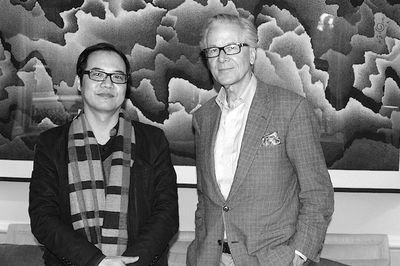
Dr. Wang Chunchen, Head of the Department of Curatorial Research at the Central Academy of Fine Arts (CAFA), is one of China’s most distinguished curators, art critics and historians. He is internationally recognised for his immensely broad view of Chinese contemporary art and culture and his acute awareness of Western art and its interaction with the Chinese contemporary art world. Chunchen curated the Chinese Pavilion of the 55th Venice Biennale in 2013 and also holds the position of Adjunct Curator for the Eli and Edythe Broad Museum in the United States. Most recently, he was invited to visit the Tate Research Centre: Asia-Pacific in London for a month long fellowship. Before he left, he sat down with Michael Goedhuis, who himself has had a long and close relationship with Chinese art, particularly Chinese contemporary ink, to discuss what some experts have referred to as the real “cultural revolution” under way in China at the moment. Insisting on the importance of history in understanding China today, in this interview Chunchen also speaks about national identity in the arts, and the next generation of Chinese artists and collectors.
Michael Goedhuis: China has undergone an extraordinary and relatively recent evolution in its culture.
Wang Chunchen: We have to go back 100 years, or maybe even 200 years, if we want to describe why China has changed.
I know China … but sometimes I am unsure what it is that I know. I have this doubt because when we look back to an ancient civilisation, we need a kind of real physical testimony to its existence. When we visit the British Museum, the Metropolitan Museum of Art, or any other relevant and major institution we of course can see a lot of ancient objects—ceramics, bronze, or even silk paintings—and these things can tell us that they represent ancient Chinese civilisation. In my recent trips outside of China, I found a lot of paintings that referenced Chinese history, but in China you don’t often see real authentic works in museums. A lot of the works are in warehouses, inventories, and not available to the public.
Growing up in China, I was told that China has an ancient civilisation, a long history and so on and so on, but in reality, if we look at how we are served today in China, you cannot see a lot of physical evidence in the form of works—they are not immediately available to the average person to see. So did China have this history?
MG: But an understanding of China’s history is essential to an understanding of contemporary art today?
WC: Yes.
We often say that things in China completely changed because of globalisation and international trade. We are told that China was invaded by foreign powers, and maybe it is true. The Chinese people thought that China was the centre of the world, and they had everything here so other nations should come to China, and pay homage.
When the first train was introduced to the Chinese Emperor for the royal family, they were scared. “How can we use that? If we built that train, maybe some kind of chemical or beast might come and destroy our feng shui, destroy our legacy,” and so on and so on. So they were scared by these kinds of mechanical inventions. These ideas were not understood according to the Chinese traditions. But little, by little, China changed. And when they found that Chinese education and culture or learning could not produce the development desired, they thought maybe our knowledge of the world is not real. That is why the first group of Chinese literati scholars started to study the Western system of education.
At that time, they thought: ‘we should learn from the Western countries or cultures to help China defeat the West’. But they just learned how to make the machines, how to use the technology, the new guns, and the new rifles. They didn’t touch upon the systems of ideas: the legal system, philosophy or religions. They didn’t care about it.
After the last Qing dynasty was overthrown, the new Republic of China was set-up by Dr. Sun Yat-sen. Politically many, many new parties were set-up, including the Communist Party, Kuomintang Party, and also other kinds of small political parties.
Then the civil war began in 1927, which lasted until 1950 and saw the victory of the Communist party. If we do not know this general history or background of China, we cannot touch a lot of critical points.
MG: And at this stage young Chinese artists left China, and had an impact?
At that time, in art for example, the young Chinese, including the revolutionaries, like Kang Youwei, travelled to Europe, and visited some museums in Germany, maybe in France. Kang was shocked by what he saw—describing it as so vivid, so realistic—he perceived China as not having the same skills. Chinese literati painters were perceived as backwards: they were just painting the landscape, and flowers, bamboos, with a free stroke—not portraying the real world. Because of this, he said we should destroy our revolutionary Chinese art, and we should learn the Western realistic techniques. They wanted to bring this kind of painting to China. They thought if we can use realistic paintings to tell people, what is wrong, what is right, use it as propaganda, use it as a kind of promotion of new ideas for the new China.
Even during the civil war, both sides used art, including painting, because they felt they needed a kind of motivation, a new spirit.
MG: Realism was of course used aesthetically and culturally, but also politically, especially by Mao, can you escort us through the Mao period briefly?
WC: Yes. After 1949, realism was the main style for artists to learn, to make, and to use. That is why when you visit China, and you look at the works made after 1949, a lot of works focus on that kind of style, even today. Even for today’s students who learn in the university, in the college of arts, they still make works based on a realist style.
MG: Including at CAFA?
WC: Including at CAFA. For example, if you want to take the entrance examination, they test your three skills; whites on colors, whites on plastic, and life drawing. The work must be realistic: you cannot make abstract art, and you cannot make expressionist art—you must follow that model exactly.
After 1979 when Deng Xiaoping tried to reform China with new policies, we saw a lot of especially the European modernist art introduced into China. Previously, in the 1950’s, maybe around maybe 1957 or 1958, some articles and books were introduced and even translated and even though the style was not so new to the Western world, it was the first time young Chinese artists had seen Impressionist art, for example. There was a lot of debate, argument, and criticism of Impressionist art. It was considered by many not to be art.
MG: But you are also seeing in 1979 Jackson Pollock abstract expressionism and surrealism and other modernist movements introduced into China too?
WC: Modernist art movements were introduced into China, in the 80’s. Also Western modern philosophy such as Nietzsche, Freud, Sartre—during that period so many books on these subjects were introduced, even books on existentialism, such as Sartre’s, Being and Nothingness. I bought that book and I tried to read it. People, including young artists, were eager to read about these subjects, they desired new knowledge. When the translations were published they tried to buy them, and to circulate the books among themselves, even read them over night.
MG: This is what was happening in the early 80’s and then what happened?
WC: I should say, before this period, the central focus of art in China was Socialist and Realist art.
Even traditional culture and painting was not a focus. During the 1950s there was a lot of debate about the continuation of the traditional Chinese painting style. It was a political issue: traditional art was considered by many to be feudalist art. But some people fought to retain the tradition, and in the 1950’s, there are several name changes to accommodate this. For example, today at CAFA, we call the relevant department, the Department of Traditional Chinese ink Painting, but in the 1950s that name was changed to ‘Department of Color Ink Painting’. It was changed because by referencing ‘color’ it suggested something new.
MG: Is there a lot of furious debate today about these different movements?
WC: We often say that the 80s were open years—new doors were opening to the other side of the world. We were seeing so much new knowledge. People felt fresh, and excited.
But during this time, and as a result of this knowledge, a lot of critics or writers criticised Chinese civilisation again. People were reading about Western countries and they were surprised that there was so much development. For example, in China, common families didn’t have cars or telephones. Even bicycles, and even watches, were scarce. People were shocked by the material prosperity in the West and they tried to look for the reason for this disparity. Some people felt it was linked to the 19th century and this was the main explanation for China’s being so backward. Some people felt it was because, while there had been modernisation in terms of industry and military, China had not modernised administratively or politically. That is why, one Chinese critic (Wei Jingsheng), advocated for what he called the fifth modernisation—democracy, and the modernisation of democracy. As a result he was put into prison by Deng Xiaoping, but 20 years later he was released and now he lives in America—a very famous person.
People, and especially art students were thirsty for new knowledge. They used realistic techniques, abstract methods of expression, expressionism, everything—even performance. Rauschenberg visited Beijing in 1985 and this was a very influential moment.
MG: Can you just touch on what was going on in the 90’s, where there was a certain amount of work that was being done almost to titillate a Western audience—often with political subject-matter? And then bring us up to the last ten or fifteen years, where there has been an even greater opening, intellectually.
WC: By the 90s, the Chinese artists had absorbed almost everything about the Western modern art—they knew all styles and concepts. But there were two categories. On the official side, the focus was still on realism, and this is true, even today they do not encourage modernism. Even contemporary art is very complicated. They never say: “We should promote contemporary art as an official art,”
MG: Because that could be too challenging?
WC: It is challenging and people do not understand it.
MG: Ai Weiwei is a good example.
WC: Yes, he is a good example. There are very complicated issues, not just in relation to art, but to many different struggles, or conflicts.
Sometimes people associate contemporary art with a kind of challenge—and that is why they do not care for it. But for the young generation of artists, sometimes if they are young, if they are open enough, they like this new innovation and creativity because they like to look for something special, or different—different from before, different from the official side. That is the main phenomena if we look at general Chinese contemporary art.MG: So what do you think is happening today? What is going exactly today, in your view?
WC: Today, people have a clearer idea of how to approach art. For myself, and for others, we think if you want to keep traditions just make the work as traditional as possible. If you want to do contemporary and very inventive art, just do it and forget where the methodology or underlying concepts are from. Use any kind of objects and material to create your own expression. For example, a lot of artists use sculpture, including materials, such as furniture (not only Ai Weiwei, but also other artists). They use these materials to make an installation. You know, installation according to the Chinese education is not art. According to the official theories, it is not art.
MG: Is there one dominant trend in your view?
WC: No, there is not a dominant trend.
MG: How would you define the difference—if there is really a difference—between young artists in China and in the West?
WC: Actually, for the newest generation of young artists, there is not much of a difference. Sometimes you could not distinguish whether this is made by a Chinese, or a British or American artist.
MG: What interests me in relation to ink art, is that there are, (just as Picasso had looked at, and also Cezanne) — the lessons of the old masters, such as Raphael. Ink artists are also aware of the past in ways in which some other artists are not, is that not true?
WC: Of course. Ink art or painting is strongly linked to Chinese philosophy and to a Chinese understanding of the world.
On the one side, I know it is OK for it to look very modern, even super modern, even if the work is made of Chinese material, Chinese ink. We must not restrict ink painting to just using brush or to making it as they did in ancient time. No, we can go beyond that, and innovate based on the ink material; it is OK to do that.
However, on the other side, how can we continue to judge this art, to determine which artist makes good art? According to traditional Chinese philosophy the artist must be very quiet, calm, very deep in thought, very controlled, and very subtle, harmonious.
On the one side, if we want to be modern we must do it in a modern way, but the modern way is not to destroy everything. For the sake of Chinese culture and history, we must keep something. Even if it is too late, we must try to get it back.
I want to take Xu Bing as an example; he is a balanced person. Xu Bing made his works based on Chinese culture, language, and philosophy. He is not the only artist to do so.
MG: Do you think that China’s next generation is going to want to collect art like people in the West collect art?
WC: That is another thing we want to do: to promote a new concept for collecting art, not just for investment or speculation. We want people to focus more on collecting art as a kind of enjoyment and for the purpose of building a collection, and as a kind of cultural undertaking.
MG: Is that happening amongst your generation?
WC: Yes. I know people that just buy art works for enjoyment, for the purpose of building a collection. Of course they do hope that what they buy is not too expensive and of course, they hope that maybe some day later, it becomes very expensive. For myself, I like to be universally open to art, and on the other hand I try to use art as a means to learn something about my own culture.—[O]
A respected voice in contemporary art discourse.
Focusing on ambitious storytelling and insightful art-world commentary. Ocula Magazine publishes in-depth interviews, critical essays and timely analysis on the artists, exhibitions and ideas driving the global art world.
Learn more about Ocula Magazine
Showcasing the best of the art world.
Ocula partners with galleries from around the world to highlight their artists, artworks and exhibitions. Gallery membership is by application and invitation, with each member vetted by an independent panel.
Learn more about Ocula Membership
Specialises in the sale of major artworks.
Led by a team with deep ties to the world’s leading auction houses, galleries and collectors. Ocula’s advisory team offers bespoke services to high-net-worth clients from around the world who are looking to acquire the best of contemporary and modern art.
Learn more about our team and services