





Sound and Voice Animate the Landscape of Sharjah Biennial 16
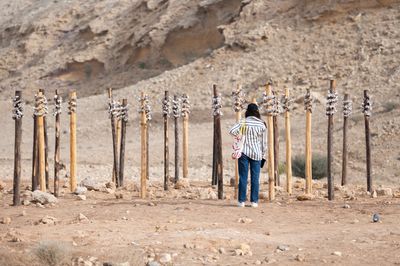
Megan Cope, Kinyingarra Guwinyanba (2024). Assisted by Creative Australia. Courtesy the artist and Milani Gallery, Meeanjin/Brisbane. Exhibition view: Sharjah Biennial 16: to carry, Buhais Geological Park, Sharjah (6 February–15 June 2025). Photo: Motaz Mawid.
Shapeshifting between exhibition, broadcast platform, archive, farm, workshop, and gathering space, Sharjah Biennial’s sprawling 16th edition offers some of its most affecting moments in the form of sound.
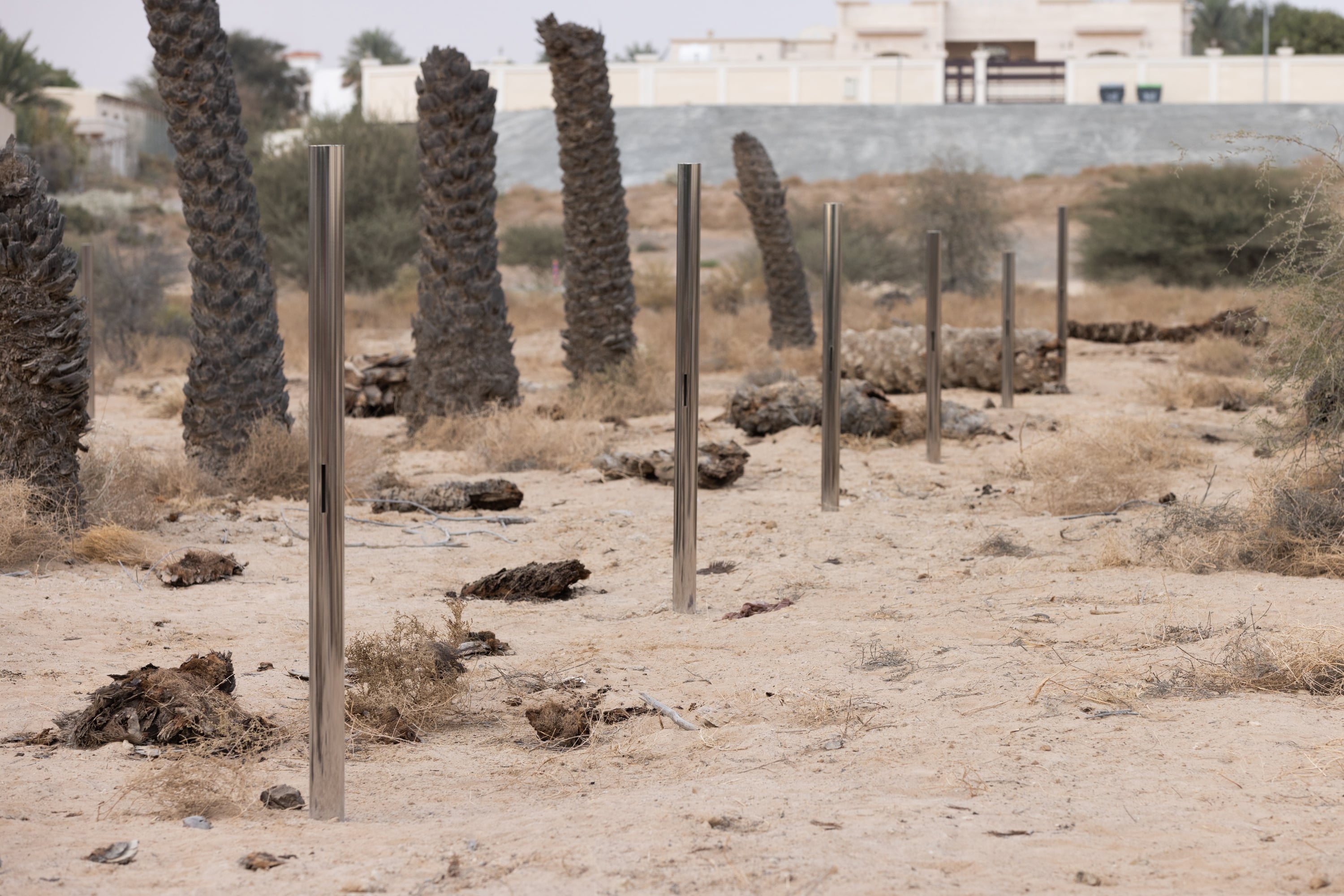
Aqueous, rippling sounds echo through the Al Dhaid desert, where wilting palm trees with missing crowns stand like monuments. The reverberating compositions, by sound artists Hauptmeier | Recker, emanate from metal rod speakers standing sentinel alongside the trunks. Titled Palms of Speculative Memories (2025), the work forms part of Sharjah Biennial’s ‘Farm Project’, which comprises six sound installations that engage with the living forms and historical irrigation systems of the desert. Here, Hauptmeier | Recker’s reflective sounding poles merge with the sterile landscape while reimagining a parallel ecosystem under the roots.
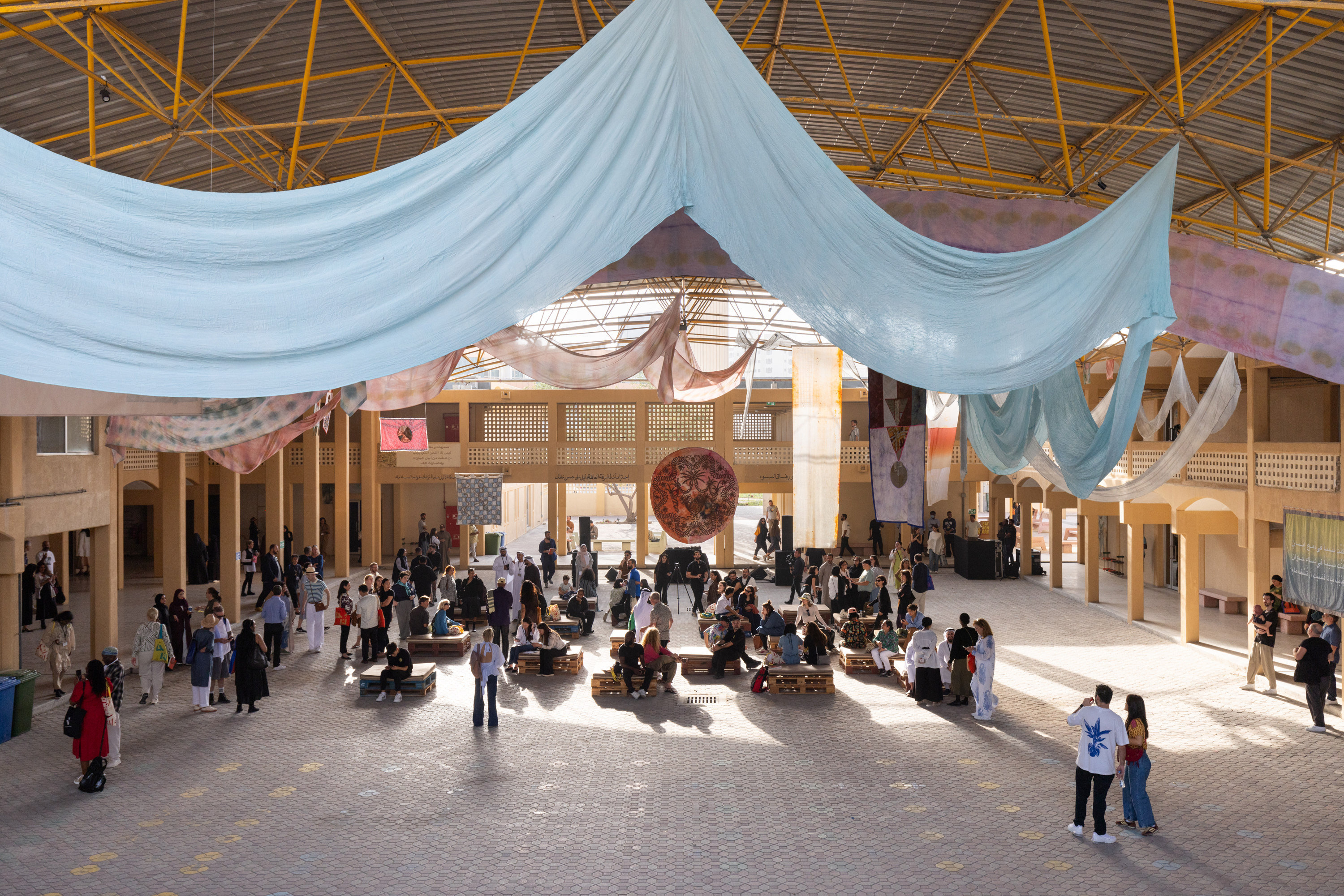
Featuring more than 200 newly commissioned artworks, Sharjah Biennial’s 16th edition, titled to carry, gathers an international, all-women curatorial team—Natasha Ginwala, Amal Khalaf, Zeynep Öz, Alia Swastika, and Megan Tamati-Quennell—who work independently and collaboratively to interweave distinct themes, from collective power and collapsing ecosystems to fiction and sonic remembrance, in a rich field where histories intersect and voices converge. In total, nearly 200 artists respond to the region’s complex geographies across 17 different venues spanning coastal areas to desert landscapes, cultural institutions to former marketplaces.
A one-hour drive from Dhaid leads to the beach in Al Hamriyah, where the Old Al Diwan Al Amiri (the ruler’s court) houses Luke Willis Thompson‘s film installation, Whakamoemoeā (2024). In this powerful work, a Māori woman delivers a commanding manifesto heralding Aotearoa New Zealand’s transition to an Indigenous state. The celebration of herstory and ancestral legacy resonates throughout every venue in Sharjah, often manifesting through deeply personal lenses recorded in individual and collective memory.
In Al Dhaid, an oasis town in central Sharjah, an old clinic—one of Sharjah’s earliest modern medical facilities—has been repurposed into an exhibition space comprising over a dozen rooms. One of these rooms hosts Sevil Tunaboylu’s Remainder (2024), a selection of paintings and minimalist sculptures that mine the artist’s everyday life while examining her family’s migration history via an archaeological approach. Through carefully orchestrated arrangements of broken barrier poles, wires, wilting plants, and lizards guiding individuals as they navigate migration routes—the artist traces the foundations of her personal narrative.
Also at Al Dhaid, Ximena Garrido-Lecca‘s Redes de conversion (Conversion Networks, 2021) presents a series of insulated copper wires linking solar panels to LED screens. Drawing on traditional Andean weaving patterns, the work elevates weaving’s legacy as women’s labour while introducing new energy conversion processes that echo early computing’s roots in the production of patterned cloth.
At Bait Al Serkal, formerly the city’s earliest hospital, Rajni Perera presents a sculpture of a pregnant, bird-headed being grasping an umbilical cord-like rope that descends into a well. This site-specific work, gatekeeper (2024–2025), appears amid Perera’s paintings and installations featuring mythical female creatures drawn from South and Southeast Asian tales, asserting the body’s agency to guard, defy, and generate.
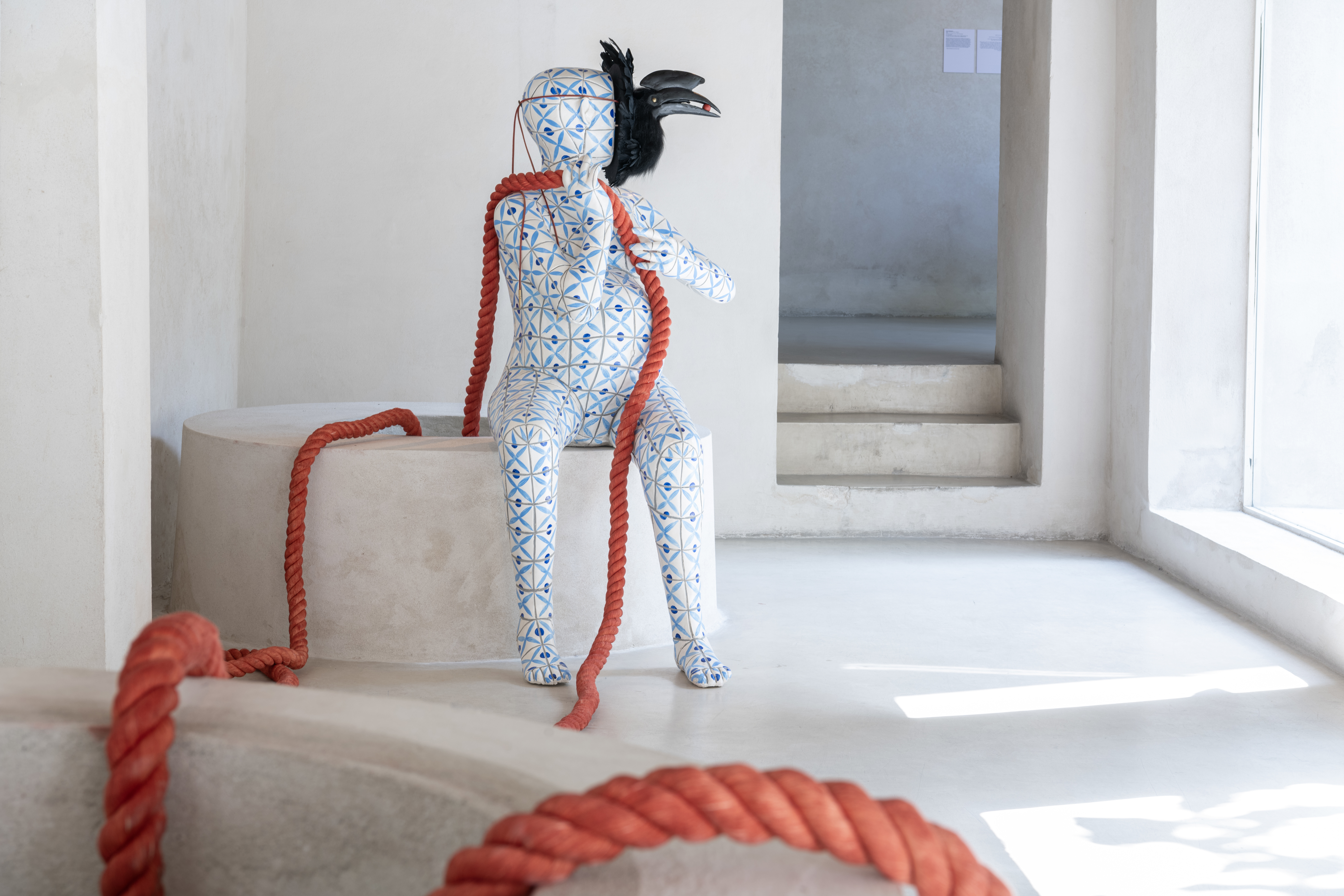
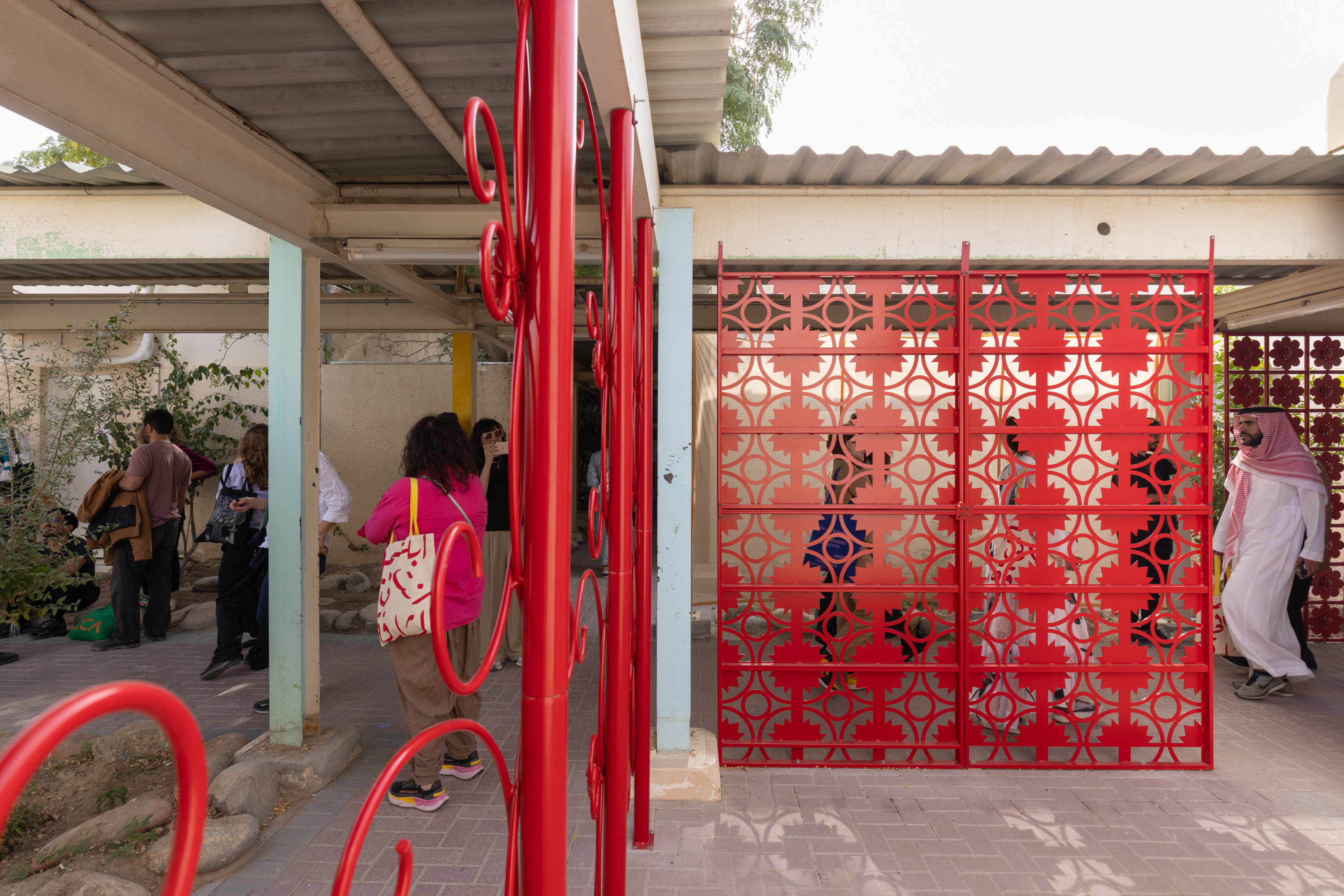
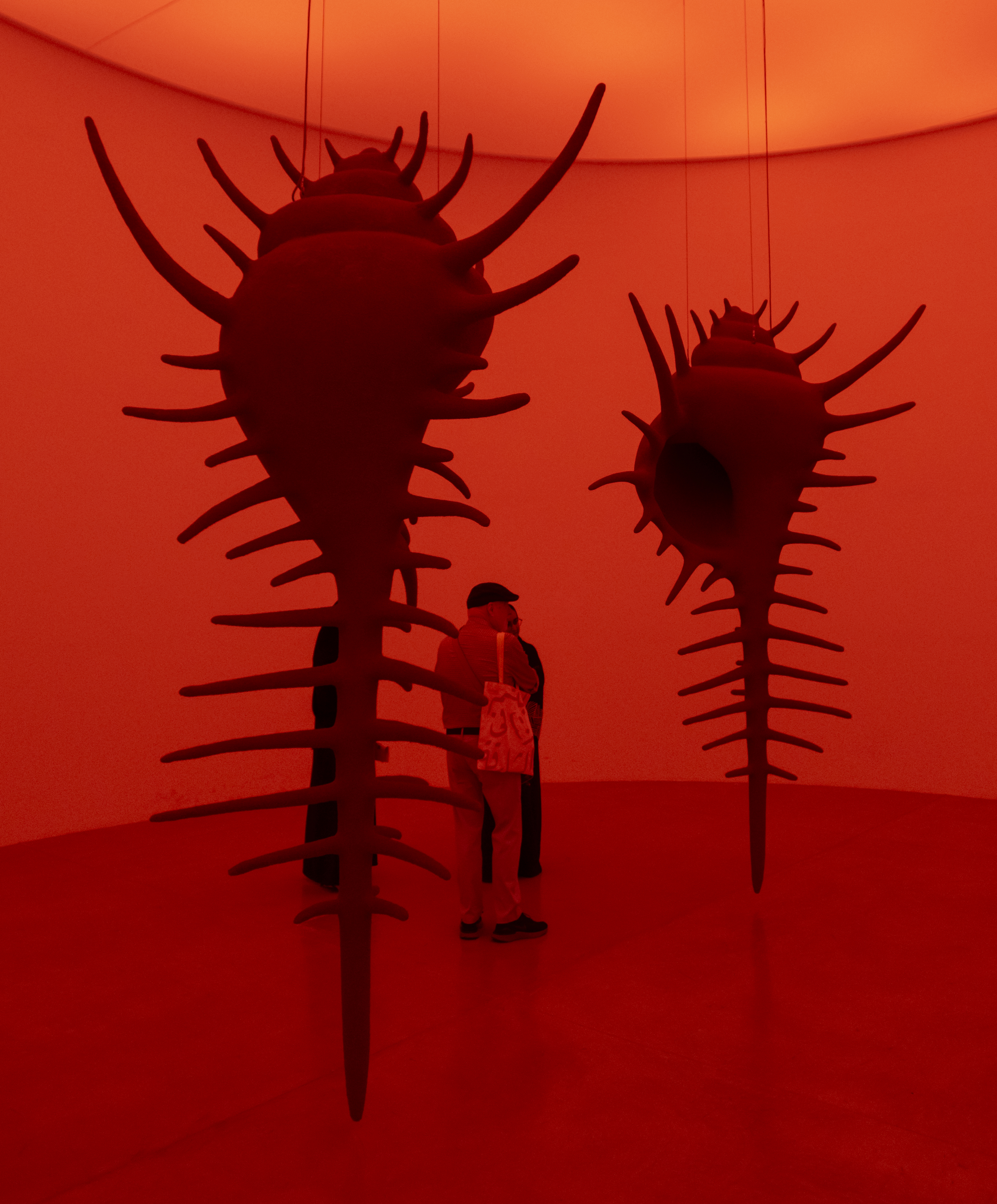
These works by artists like Garrido-Lecca and Perera are connected to specific places, embodying the biennial’s core mission: to make visible underrepresented regions and people. This is echoed in the decentralised presentation of art across the city, along the coast and in the desert. In the Heart of Sharjah—the heritage neighbourhood with restored beige-coral walls typical of the region—Al Mureijah Square presents 28 artists in a labyrinthine layout that leads viewers through traditional courtyards, outdoor sculptures, remnants of ancient wall, and six galleries of varying sizes and structures. Gallery 5 provides an immersive meditation on environmental and economic realities shared by the Gulf and Southeast Asia. A red-lit spiral structure houses Monira Al Qadiri‘s sculpture Gastromancer (2023): a pair of murex shells giving voice to gender transformation narratives in the ocean, inspired by the damage to marine life caused by tributyltin—a biocide historically used to paint ship rudders as an anti-fouling agent.
While Gastromancer emerges from Al Qadiri’s experience of oil-boom transformations, Stephanie Comilang‘s two-channel video installation Search for Life II (2025) probes pearl-industry histories in the Philippines and Southern China. The work’s haunting imagery, projected onto a monumental pearl curtain, weaves together narratives of pearl divers, Spanish colonial shipping routes, K-pop performances, and Chinese livestream sales to connect historical seafaring practices with contemporary global maritime networks.
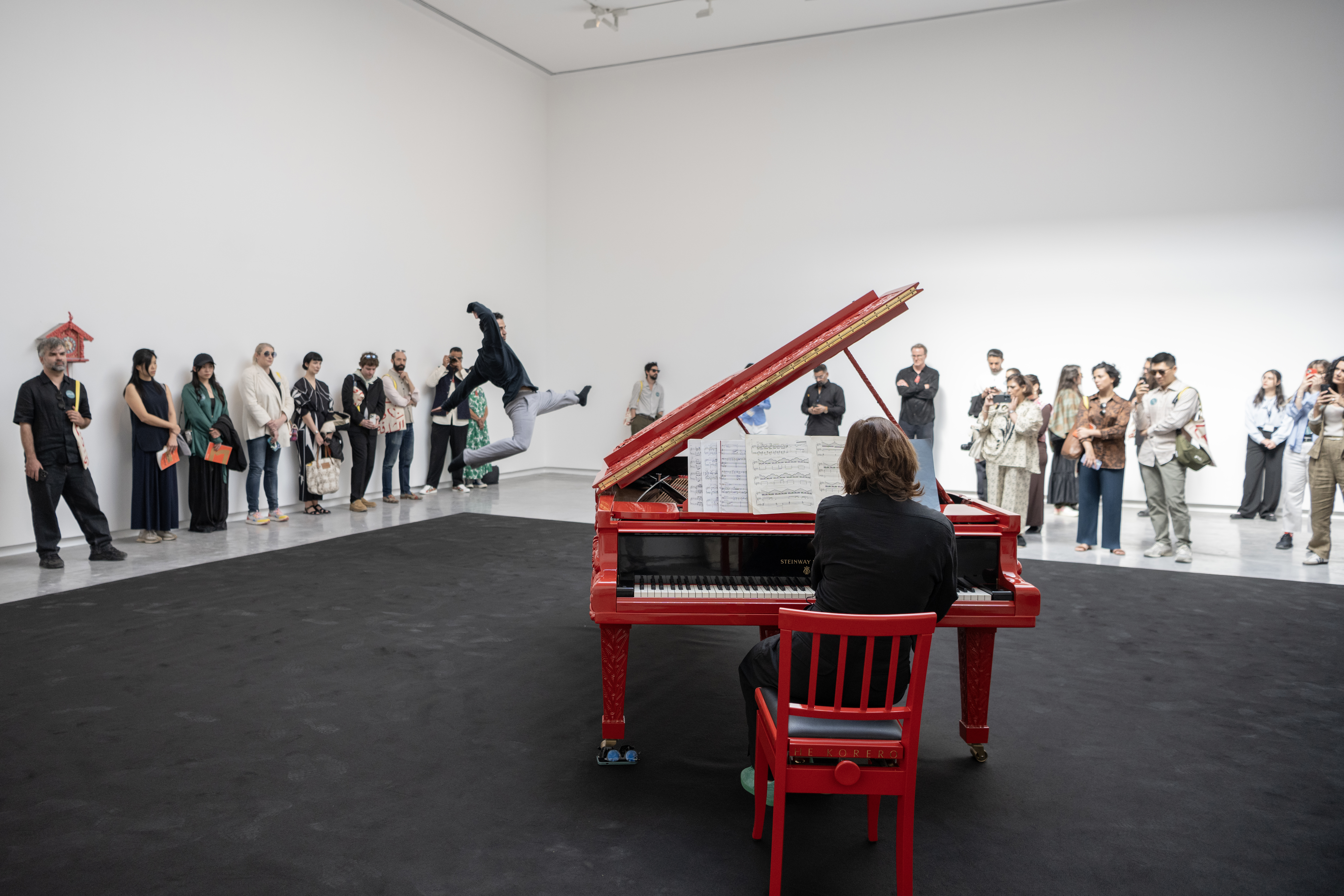
to carry shapeshifts between broadcast platform, archive, farm, workshop, and gathering space. Among the layers of multimedia and cross-disciplinary practices, it is the sonic works that deliver the biennial’s most affecting moments. Highlights include an intimate listening room at Bait Al Serkal, which houses an archive—including soundtracks and instruments—of indigenous East African music, and Indonesian artist Rully Shabara’s arresting a cappella performance on the Arts Square, exploring the human voice as a catalyst in public spheres. At Al Mureijah Square, Michael Parekōwhai‘s He Kōrero Pūrākau mo te Awanui o Te Motu: Story of a New Zealand River (2011), a red piano carved with Māori patterns, was played by various musicians who performed or improvised. The work embodies the success of Sharjah Biennial 16’s polyphonic structure: spaces where local realities find their counterpoints in art, where all are invited to host and be hosted, to carry forward not just inherited histories, but the embrace of emergent futures. —[O]
Main image: Megan Cope, Kinyingarra Guwinyanba (2024). Assisted by Creative Australia. Courtesy the artist and Milani Gallery, Meeanjin/Brisbane. Exhibition view: Sharjah Biennial 16: to carry, Buhais Geological Park, Sharjah (6 February–15 June 2025). Photo: Motaz Mawid.





A respected voice in contemporary art discourse.
Focusing on ambitious storytelling and insightful art-world commentary. Ocula Magazine publishes in-depth interviews, critical essays and timely analysis on the artists, exhibitions and ideas driving the global art world.
Learn more about Ocula Magazine
Showcasing the best of the art world.
Ocula partners with galleries from around the world to highlight their artists, artworks and exhibitions. Gallery membership is by application and invitation, with each member vetted by an independent panel.
Learn more about Ocula Membership
Specialises in the sale of major artworks.
Led by a team with deep ties to the world’s leading auction houses, galleries and collectors. Ocula’s advisory team offers bespoke services to high-net-worth clients from around the world who are looking to acquire the best of contemporary and modern art.
Learn more about our team and services