





Good Grief
Following the death of its curator Koyo Kouoh, In Minor Keys could have felt rudderless, but the Arsenale side of the exhibition creatively intertwines threads of perception, posthumous continuity and the elevation of African artists and viewpoints. Save to My OculaBoth the Arsenale and the Central Pavilion in the Giardini open with works by Issa Samb, the late Senegalese artist and co-founder of Dakar’s revolutionary art collective Laboratoire Agit’Art, though in sharply contrasting registers. In the Central Pavilion, a reconstruction of Samb’s courtyard studio, filled with clothes and found objects including masks and dolls, looks at the texture of a life spent accumulating and gathering. The space, which served as a place for meeting and talking as well as making, introduces the sense of comradeship underpinning the late Koyo Kouoh’s curatorial spirit. Samb was something of a mentor to Kouoh; she once described his courtyard as a “total artwork”.
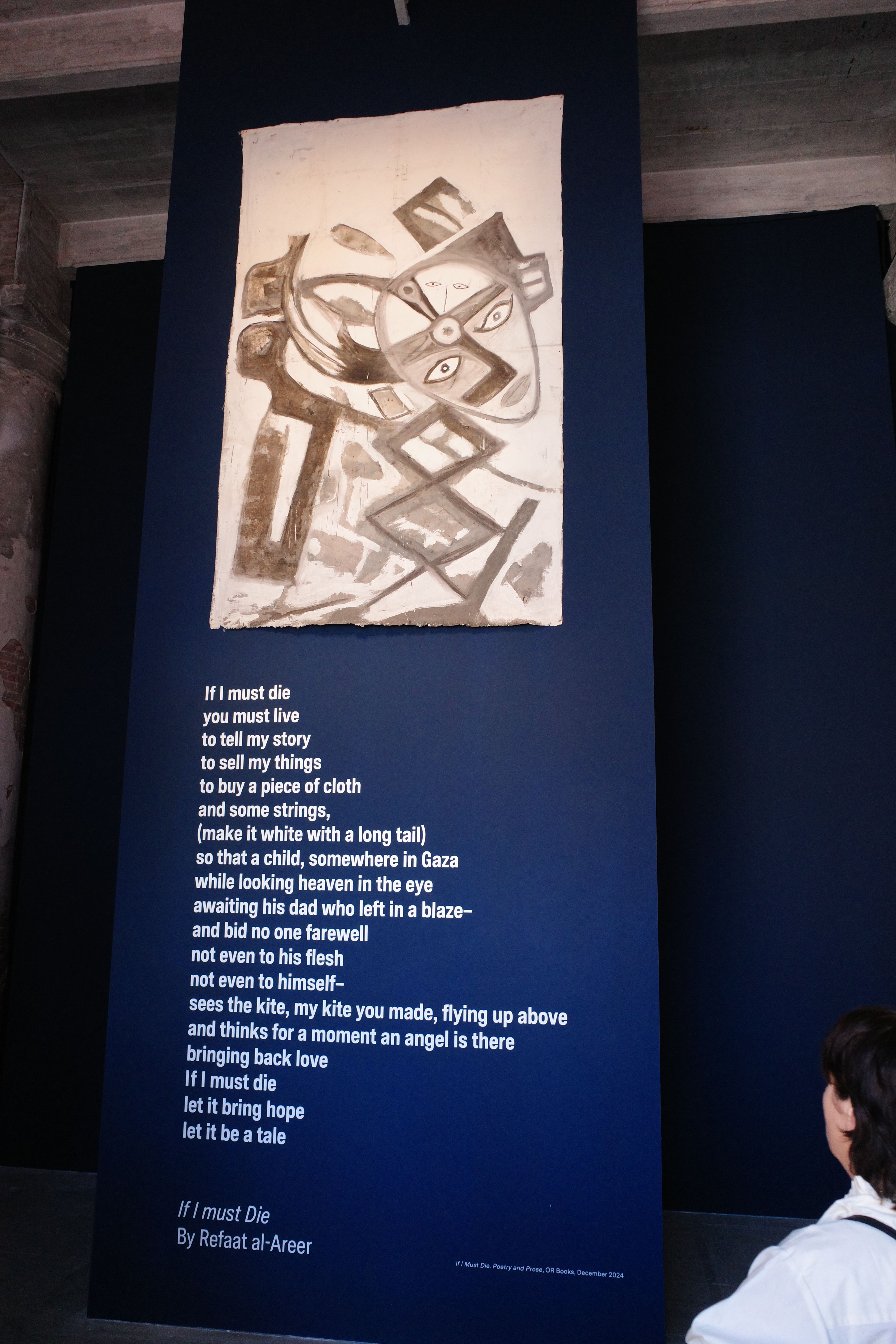
The Arsenale begins with a solitary painting resembling a spectral mask or threshold figure, which the wall text describes as an expression of Samb’s understanding of existence beyond the divide between life and death, a sensibility that was echoed in his habit of repeatedly destroying and remaking his own works. That atmosphere of posthumous continuity is further underscored by the inclusion, beneath the painting, of the late Palestinian poet Refaat Alareer’s If I Must Die (2023), a poem mourning loss while insisting on the fact that life must continue after loss. The pairing collapses private grief, Kouoh’s own passing, and the ongoing catastrophe in Palestine into a shared spectral presence that has haunted Venice during its opening week.
This is one of the lingering notes across in the Arsenale. The raw corrugated-cardboard cross-sections used as partition walls further reinforce this atmosphere: warm, provisional, rhythmic and evocative of “the earth-toned spaces” of the art centre Kouoh founded in Dakar, RAW Material Company. Emerging from the long hallways of the Arsenale and standing before Nairobi-based artist Kaloki Nyamai’s epic figurations, standing inside Kader Attia’s kaleidoscopic chamber, or beneath the long halls crowned by Akinbode Akinbiyi’s photographs, hanging like suspended prints fresh from production, traces of daily life are brought to the fore, while also alluding to the afterlives of people who lived under colonial rule.
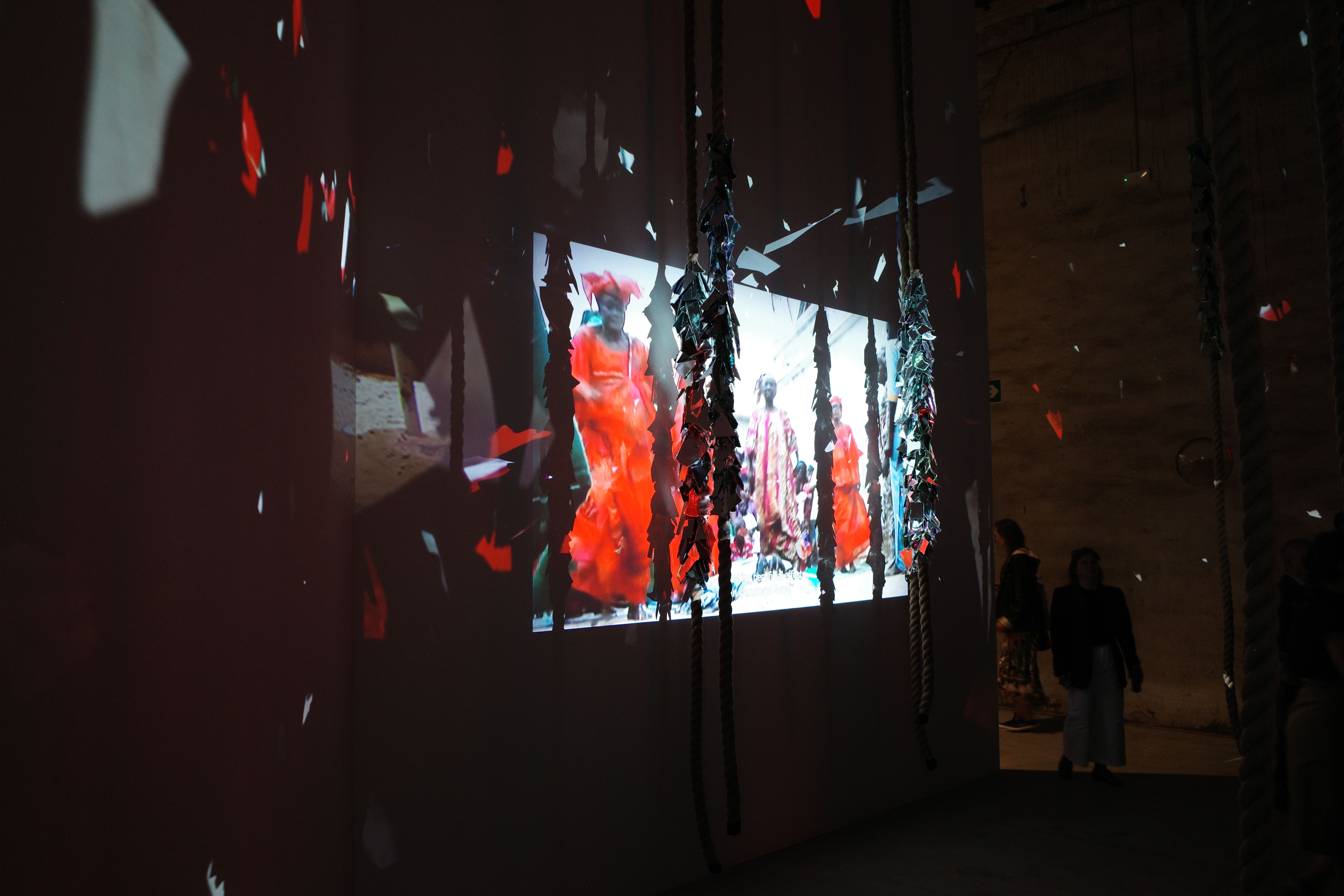
I found myself thinking about how craft operates across much of the Global South as infrastructure: something that enables society to function. In this way, Kouoh’s curation is a marked departure from the recurring framing of craft and ancestral spirituality as holding ethnographic rather than artistic value, a perspective that still dominates the bienniale circuit. A celebration of another sensibility seen in the Global South emerges later in the exhibition. Barbadian artist Annalee Davis is showing a huge wall-mounted herbarium filled with plants grown in her garden, and Carolina Caycedo’s giant hanging seed-like sculptures explore gardening, seed-keeping and food sovereignty less as subjects for ecological discourse than as structures of continuity and autonomy still embedded in everyday life.
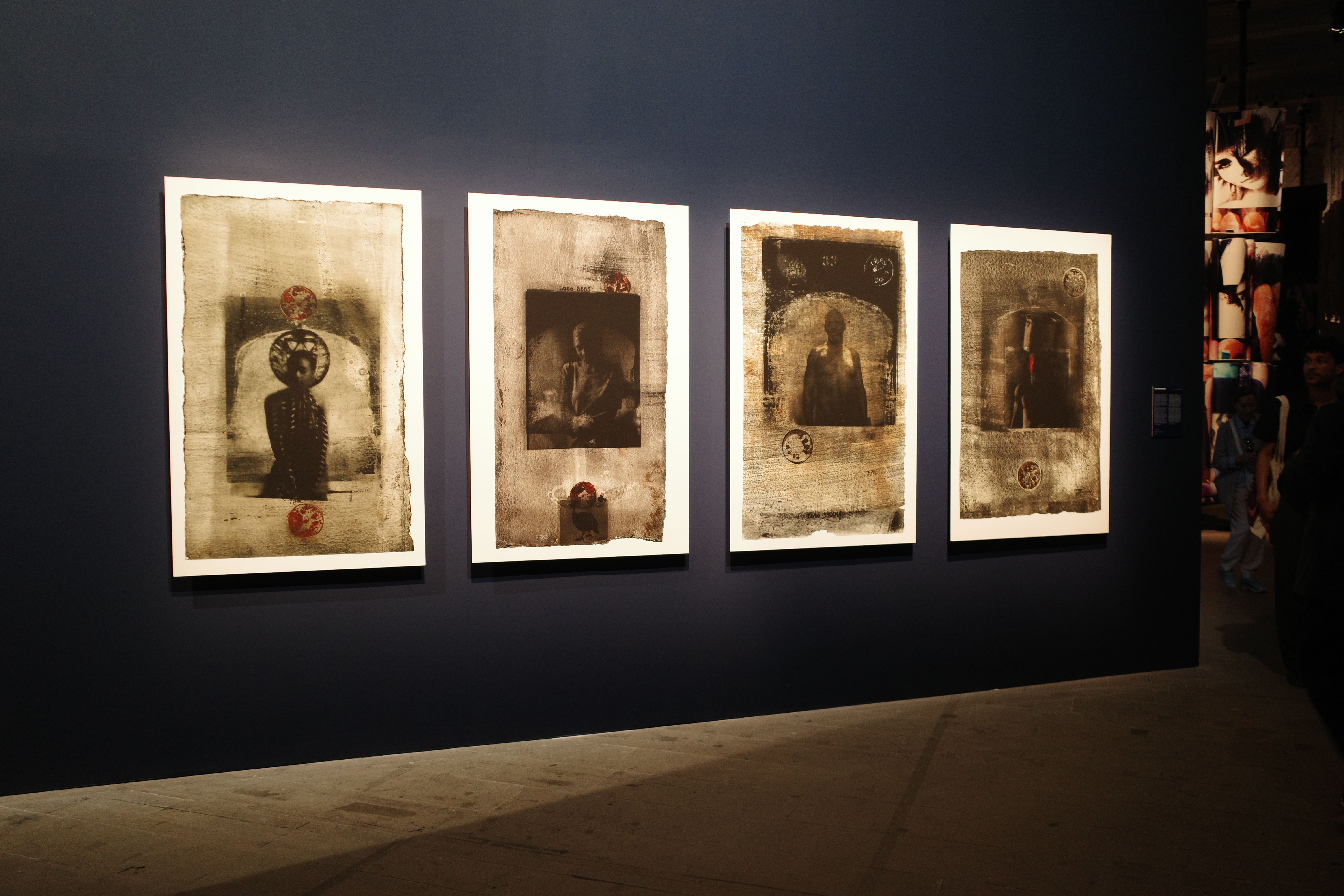
There is a filmic logic which extends into the exhibition’s material language: film is treated as a medium for weaving together visual, sonic, and spiritual forms of perception. You can see it in the work by Brazilian photographer Eustáquio Neves. Neves’ background in chemistry informs the hallucinatory materiality of his emulsion-coated photographs of the world’s largest African slave landing site, in which archival truth and speculative fiction blur.
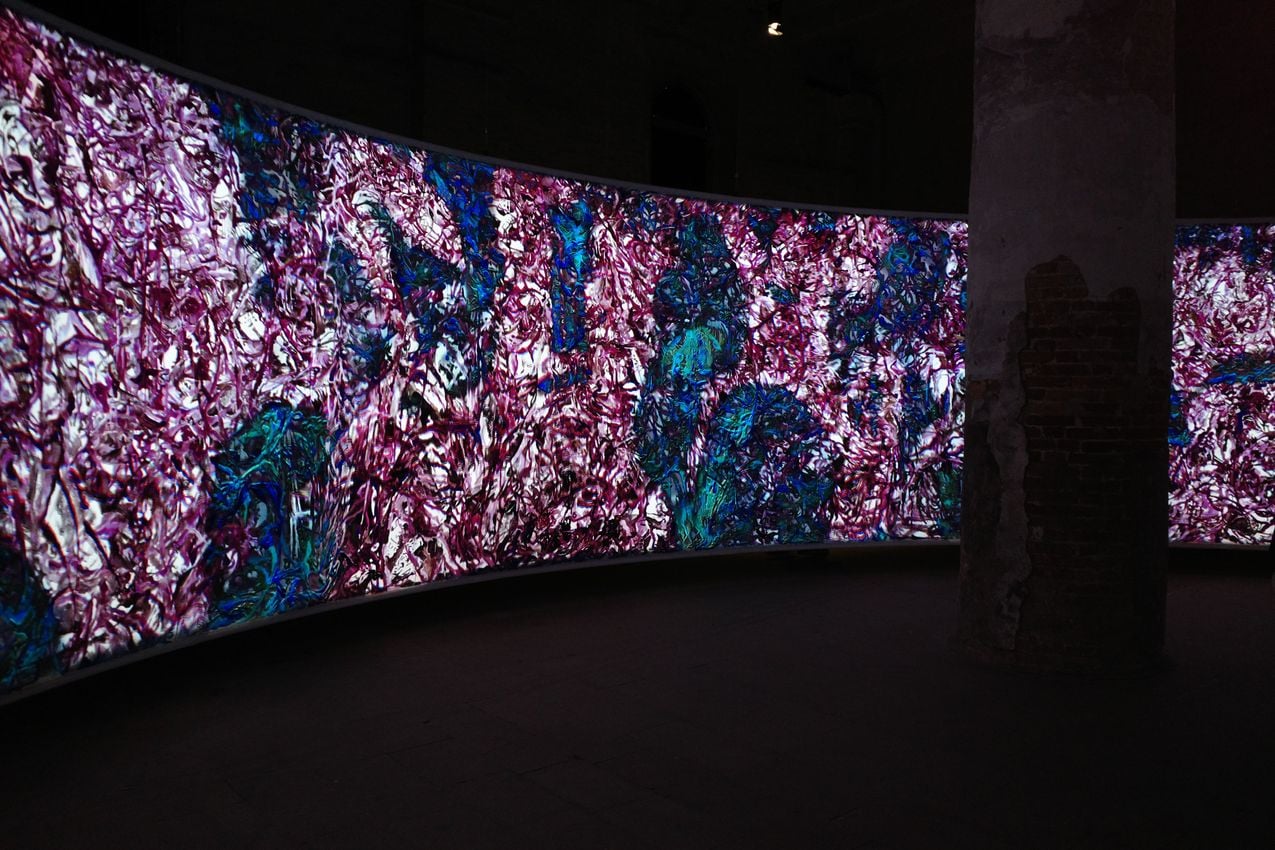
This sensibility appears in Lebanese-born Australian artist Khaled Sabsabi’s projections of near-figurative abstraction across round painterly canvases, whose drifting luminosities subtly allude to Sufi spiritual experience. This hallucinatory quality that also surfaces in Indian artist Sohrab Hura’s single channel work The Coast (2020), which is set in the atmosphere of contemporary India’s social and political violence.
“Kouoh’s curation is a marked departure from the framing of craft and ancestral spirituality as holding ethnographic rather than artistic value”
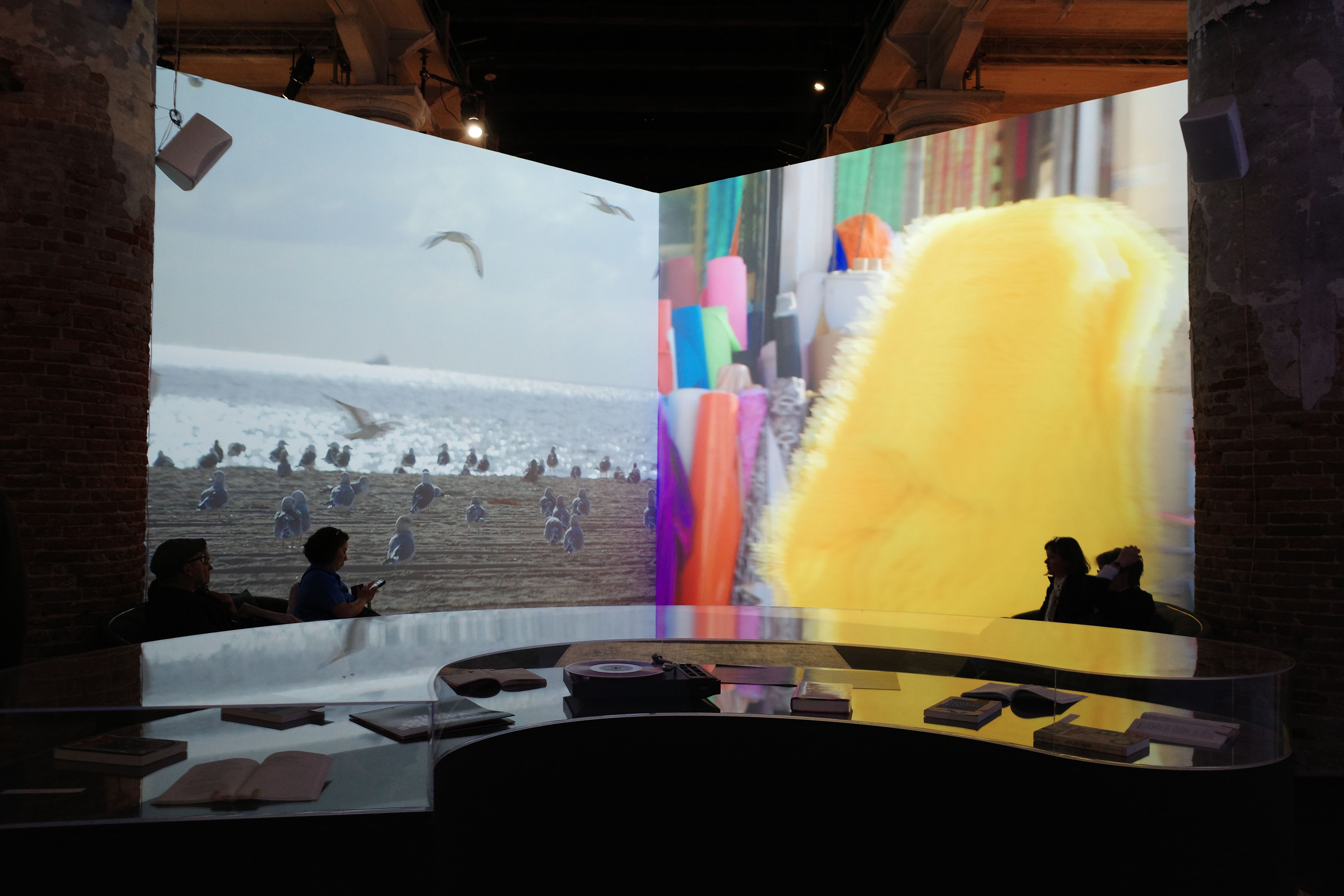
With towering projections folding inward into a diamond-shaped listening lounge, Californian artist Cauleen Smith’s The Wanda Coleman Songbook (2024) emerges as one of the exhibition’s anchor points. Reminiscent of the city symphony genre, the silent documentaries of urban environments produced in the 1920s, the installation traces the outlines of Los Angeles’ Black neighbourhoods through streets and façades, overlaid with shots of verse by the late poet Wanda Coleman, revoiced by musicians including Meshell Ndegeocello, Kelsey Lu and Moor Mother. This is a piece which embodies the exhibition’s non-didactic curatorial approach, offering a ground-up perspective on the cultural lineages that we might not immediately see.
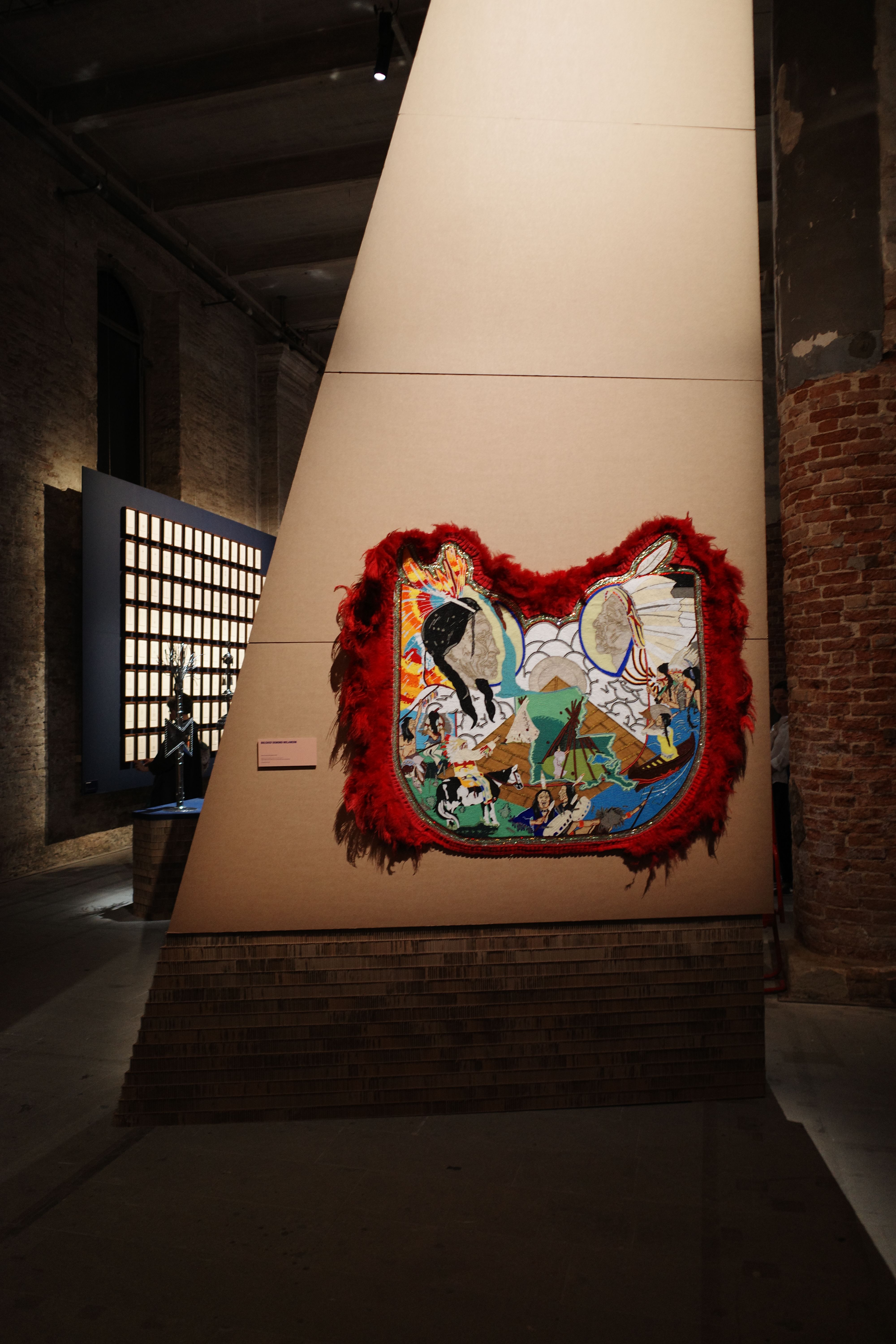
Other invocations of the urban imagination include Guadalupe Rosales’s evocation of Chicana life in 1990s Southern California and the ceremonial gown of Big Chief Demond Melancon. Melancon participated in New Orleans’s Black Masking traditions for years—which are based on ceremonies brought to America by enslaved African people—before deciding to exhibit the clothing as artworks.
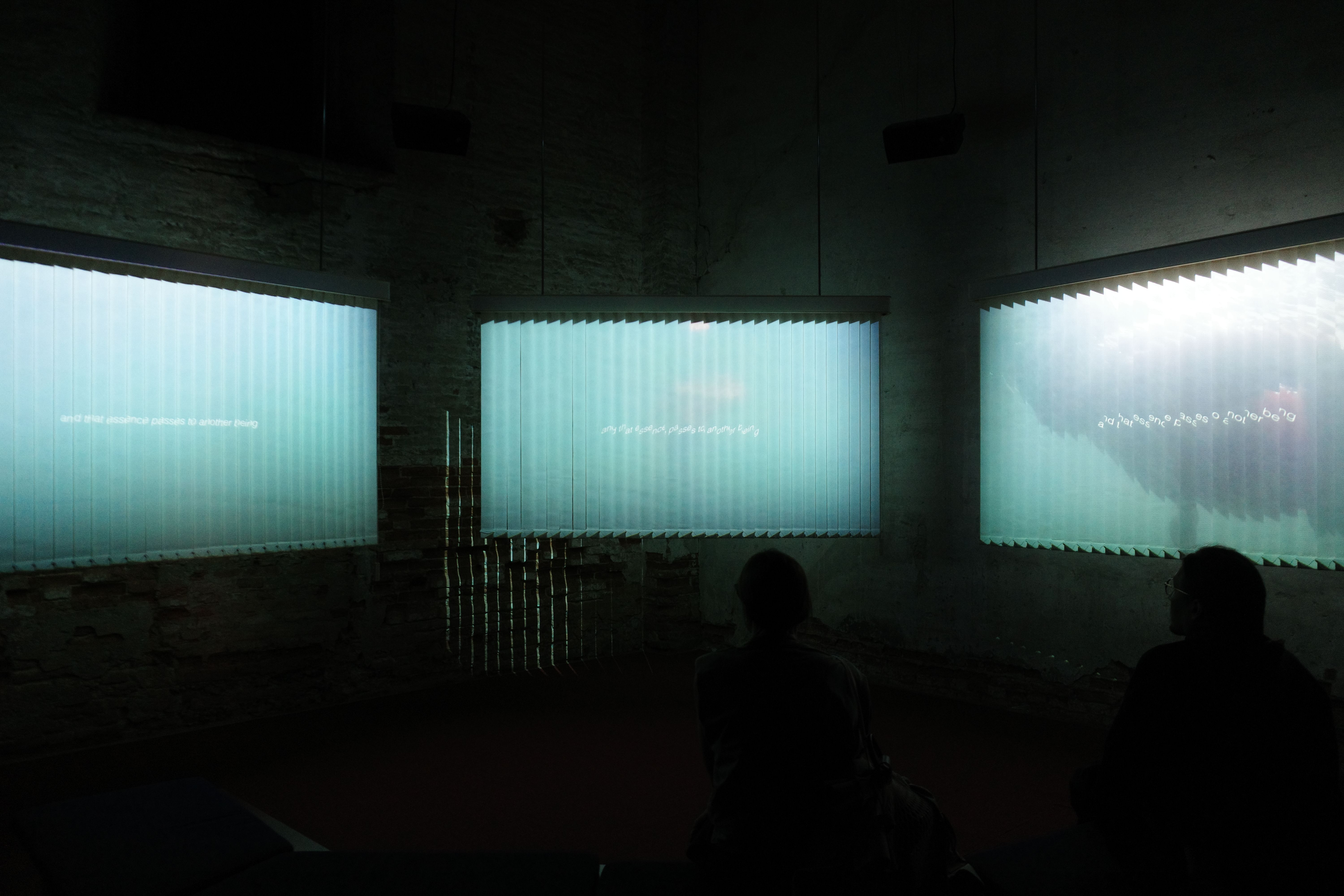
Midway through the exhibition, three film installations quietly echo one another through forms of familial haunting, intimacy and cross-generational exchange. Avi Mograbi’s conversations with his Arabic teacher Ali al-Azhari highlight intertwined Jewish and Palestinian trajectories. As their conversation traces their family histories, a pair of screens show projections of two business directories: one for Lebanon, Palestine and Syria from 1938 and the other for Gaza from 2023, as well as family photographs. One directory predates the 1948 expulsion of Palestinian people known as the Nakba, the other the war in Gaza—we do not know how many of the businesses listed in either directory survive. Mograbi’s work presents the story of the land as mutually inhabited rather than as a piece of history.
“Teaching is shown to be less a system for producing individual authors than as an extended familial ecology”
American artist Nina Katchadourian’s The Recarcassing Ceremony (2016), a film based on a game she used to play with her brother about two families of Playmobil figures, and Puerto Rican artist Natalia Lassalle-Morillo’s film Retiro (2019), based on an interview the artist did with her mother and a script they wrote together, similarly approach grief, inheritance and the question of familial continuity through reenactment and fragmented memory. It is here that the exhibition’s affinity with Toni Morrison’s Beloved—which follows the story of a family of previously enslaved people being haunted by a spirit and is quoted on banners through the Arsenale’s archways—quietly surfaces, echoing the opening invocation of posthumous continuity.
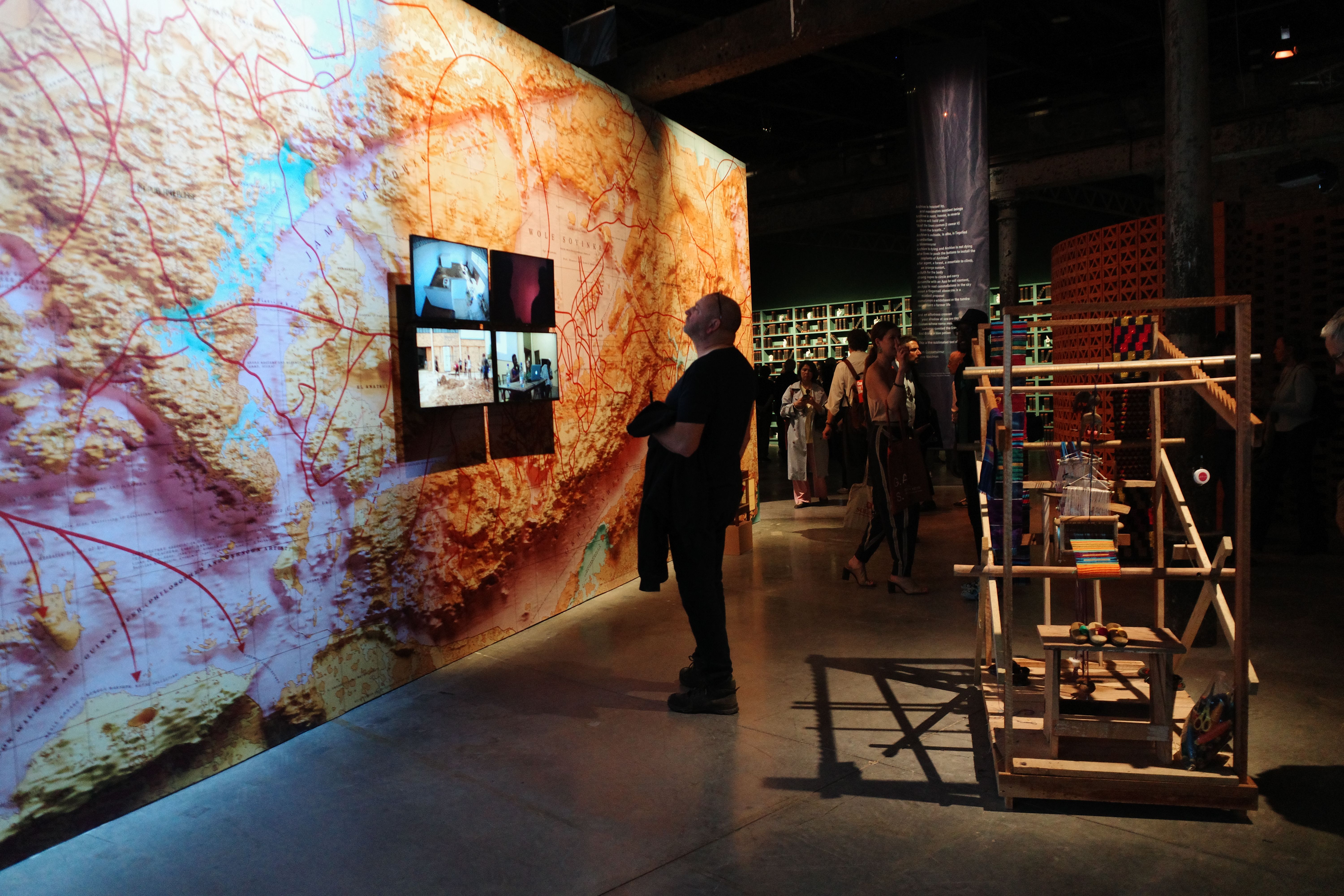
Placed toward the exhibition’s conclusion, the section devoted to schools shifts attention from artworks to the social infrastructures that sustain them. Ghana’s artist collective blaxTARLINES KUMASI transforms one space into a changing programme, renewed every two weeks: during the opening, a loom activated through performances by Ghanaian artist Pious Fiifi Davies will eventually be turned into a functioning radio station. The emphasis lies less on display than on sustaining a pedagogical environment where making, conversation, transmission and gathering remain entangled. Nearby, Nigeria’s Guest Artists Space Foundation constructs a Yorùbá clay-house for Chorus (2026), a short film reflecting on ritual, gathering and intergenerational exchange through the voices of the house’s former residents and collaborators. Across these initiatives, schooling and teaching is shown to be less a system for producing individual authors than as an extended familial ecology.
Compared with the Central Pavilion, which is dense with Global Majority iconographies, the Arsenale feels markedly more discursive, though never simply didactic. Both sections mobilise the same artists toward entirely different tonal registers. We knew from the outset that the curation intended to do something which hadn’t been done before: to enshrine African artists first championed within African intellectual networks rather than through Western validation.
References to Kouoh herself and her life are woven through the show. Some evocations feel strangely disembodied: French artist Kader Attia names her “our queen” in his end credits, and she can be glimpsed high up in one of Akinbode Akinbiyi’s photographs, and dancing in Linda Goode Bryant’s new film. But the exhibition never settles into memorial. Instead, these anchor points propose a vision of posthumous thriving. The Arsenale is bookended by artists whose encounters with Kouoh helped her in her career as a curator: at one end, Issa Samb’s courtyard, which inspired Kouoh; at the other, German artist Clarissa Herbst and Swiss artist Dominique Rust’s resurrection of a 1990s Zurich club at the site’s edge, where Kouoh worked behind the bar when she was starting out, and found inspiration in the collaborative way the space was run.
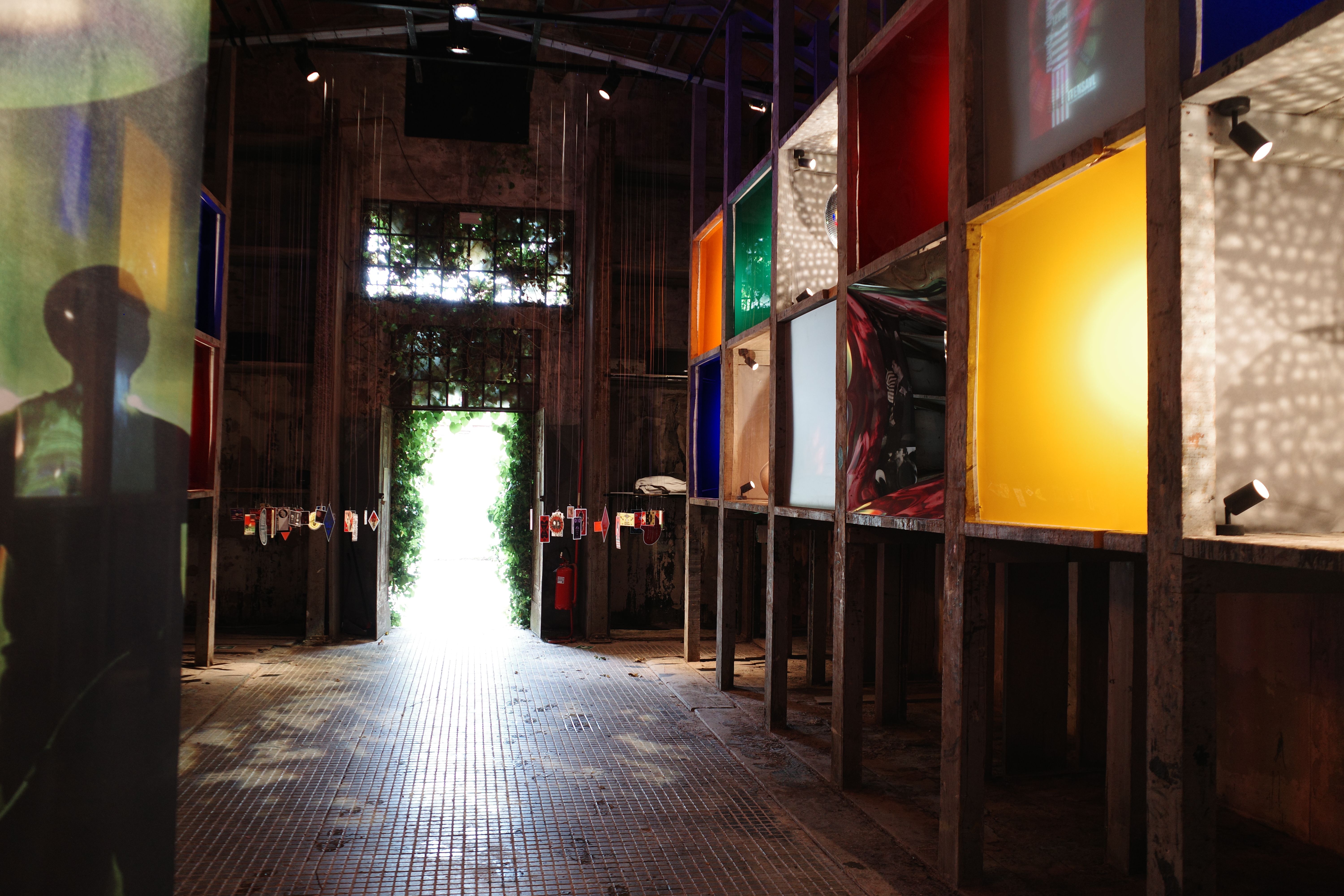
At a moment when we are suspicious of curatorial auteurs, this may be the most auteurist exhibition in decades—though one whose authorship survives less as signature than as call-and-response, diffused across artists who carry Kouoh’s presence onward.—[O]
Main image: Khaled Sabsabi, khalil (2026). Photo: Zian Chen.






A respected voice in contemporary art discourse.
Focusing on ambitious storytelling and insightful art-world commentary. Ocula Magazine publishes in-depth interviews, critical essays and timely analysis on the artists, exhibitions and ideas driving the global art world.
Learn more about Ocula Magazine
Showcasing the best of the art world.
Ocula partners with galleries from around the world to highlight their artists, artworks and exhibitions. Gallery membership is by application and invitation, with each member vetted by an independent panel.
Learn more about Ocula Membership
Specialises in the sale of major artworks.
Led by a team with deep ties to the world’s leading auction houses, galleries and collectors. Ocula’s advisory team offers bespoke services to high-net-worth clients from around the world who are looking to acquire the best of contemporary and modern art.
Learn more about our team and services