





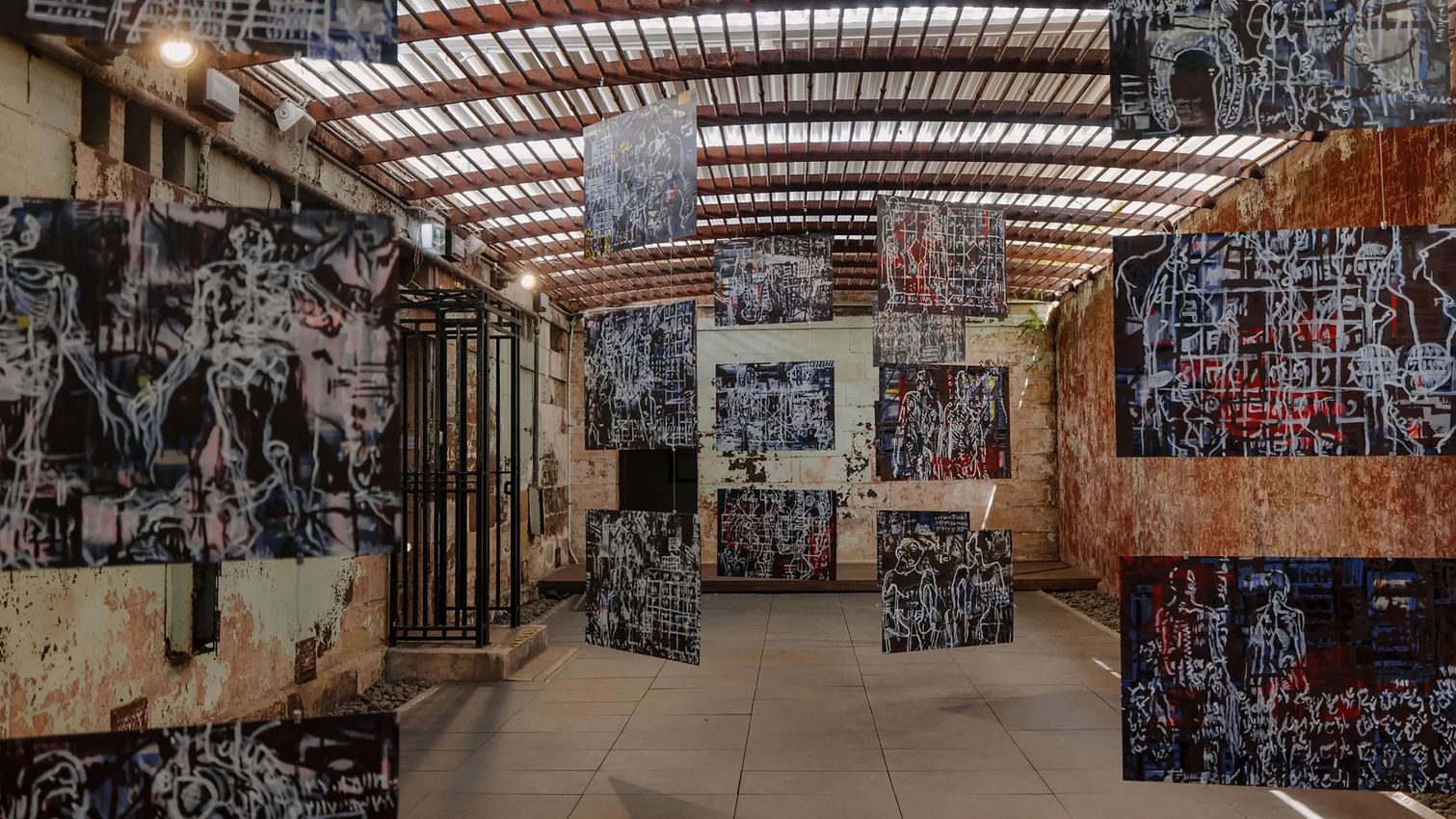
KHALED SABSABI
b. 1965, LebanonKhaled Sabsabi is a Lebanese-born Australian artist whose multi-channel video, sound and installation works are best known for exploring spirituality, conflict, migration and the lived experience of Arab and Muslim communities in Western Sydney and beyond.
Working across moving image, sculpture and painting, Sabsabi creates immersive environments that draw on Sufi cosmology and everyday social realities to reflect on nationhood, identity and belief. Sabsabi is known for landmark works such as the multi-screen installation Guerrilla (2016), the spiritually inflected 70,000 Veils (2014) and more recent projects including Knowing Beyond (2023) and Buraq (2023), which extend his ongoing engagement with Sufi thought and mystic experience. His work has been presented at institutions including the Art Gallery of New South Wales, Museum of Contemporary Art Australia, Campbelltown Arts Centre, Perth Institute of Contemporary Arts and Casula Powerhouse Arts Centre, and he will represent Australia at the 61st International Art Exhibition of La Biennale di Venezia in 2026.
Early Life and Career
Born in 1965 in Tripoli, Lebanon, Sabsabi migrated to Australia as a child, settling with his family in Sydney, where he continues to live and work. He trained in time-based art, completing a Master of Arts (Time Based Art) at the College of Fine Arts, University of New South Wales, which laid the groundwork for his sustained focus on video, sound and installation as key vehicles for social and spiritual inquiry.
From the late 1990s, Sabsabi developed a socially engaged practice embedded in the multicultural communities of Western Sydney, working in detention centres, prisons, schools, refugee and settlement camps, hospitals and youth centres alongside exhibitions in galleries and museums. This dual commitment to community-based projects and institutionally framed installations shaped a practice that moves between grassroots collaboration and large-scale, technically sophisticated works that address the politics of representation, the aftermath of conflict and the complexities of diasporic identity.
Practice, Series and Methods
Sabsabi’s work is most closely associated with multi-screen, immersive video installations that often envelop viewers in sound and image, encouraging slow looking and contemplative engagement. Using techniques such as multi-channel projection, layered soundtracks, archival footage and staged imagery, he constructs environments that collapse geographic distance between Lebanon, Western Sydney and other sites of conflict or spiritual significance.
A key strand of his practice examines the lingering effects of war and displacement through works that draw on his own memories of Lebanon and the experiences of migrant communities in Australia. In installations such as Guerrilla (2016), shown in The National at the Museum of Contemporary Art Australia, he uses dense visual layering and fragmentary narratives to probe how resistance, militancy and everyday life intersect, while resisting simplistic documentary readings. Other works focus on borderlands, literal and metaphorical, foregrounding how identities are formed in contested spaces and how media imagery mediates our understanding of distant conflicts.
Over time, Sabsabi has expanded his material vocabulary to include painting, photography and sculpture, often presented in combination with moving image. Exhibitions such as Mush at Artspace in Sydney and A Hope at P21 Gallery in London have brought together large-scale installations with more intimate works on paper and canvas, demonstrating his interest in shifting between immersive public environments and quiet, devotional formats. Across these bodies of work, he frequently uses modest materials, repetitive motifs and subdued colour palettes to create rhythm and meditative focus, inviting viewers into states of reflection rather than spectacle.
Themes and Context
Sabsabi’s practice consistently addresses the politics of nationhood, the pressures of migration and the lived realities of Muslim and Arab diasporic communities in Australia, while also insisting on the universality of questions around faith, belonging and mortality. His work engages critically with media representations of Islam and the Middle East, proposing alternative, often quieter images that foreground interiority, care and everyday ritual.
Central to his practice is his engagement with tasawwuf, or Sufism, which shapes both the content and structure of many works. Installations like Knowing Beyond and Buraq draw directly on Sufi cosmology, using repetition, abstraction and sound to suggest experiences that move “beyond” the visible, while remaining grounded in the specifics of place and community. This interplay of the mystical and the mundane positions Sabsabi within broader currents of socially engaged and spiritually informed contemporary art, in conversation with debates around postcoloniality, decolonisation and the ethics of representing conflict.
Exhibitions, Biennials and Recognition
Sabsabi has exhibited widely across Australia, with significant solo presentations at institutions including Perth Institute of Contemporary Arts (2018), the Art Gallery of New South Wales (2020), Campbelltown Arts Centre (2022) and The Lock-Up in Newcastle, which hosted a major survey exhibition from September to November 2024. Earlier projects such as Mush at Artspace and long-term collaborations with Casula Powerhouse Arts Centre and Fairfield City Museum & Gallery have further consolidated his reputation as a key figure in contemporary art in Western Sydney and nationally.
Internationally, he has participated in major biennials and triennials including the 18th and 21st Biennale of Sydney, the 9th Shanghai Biennale, Sharjah Biennial 11, the 5th Marrakech Biennale, the 1st Yinchuan Biennale, the 3rd Kochi-Muziris Biennale and the Adelaide Biennial of Australian Art 2018, among others. In 2023 he received the inaugural Creative Australia Award for Visual Arts, and in 2024 he was awarded the Mordant Family and Creative Australia Affiliated Fellowship at the American Academy in Rome, underscoring both national and international recognition of his contribution. Sabsabi is represented by Milani Gallery, Brisbane, and has works held in public and private collections in Australia and abroad. In 2026 he will represent Australia at the 61st International Art Exhibition of La Biennale di Venezia, presenting a new project for the Australia Pavilion with curator Michael Dagostino.
Khaled Sabsabi FAQs
What is Khaled Sabsabi best known for?
Khaled Sabsabi is best known for his multi-channel video and installation works that explore spirituality, conflict, migration and the experiences of Arab and Muslim communities in Australia. His immersive environments often employ layered sound and image to create contemplative spaces that invite viewers to reflect on faith, politics and everyday life.
How does Sufism influence Khaled Sabsabi’s work?
Sufism, or tasawwuf, is central to Sabsabi’s practice and informs both the themes and structures of many of his installations. Works such as Knowing Beyond and Buraq draw on Sufi cosmology and ideas of spiritual journeying, using repetition, abstraction and sound to evoke experiences of transcendence grounded in contemporary social realities.artistprofile.
Where has Khaled Sabsabi exhibited?
Sabsabi has exhibited widely in Australia at institutions including the Art Gallery of New South Wales, Museum of Contemporary Art Australia, Campbelltown Arts Centre, Perth Institute of Contemporary Arts, Casula Powerhouse Arts Centre and The Lock-Up. Internationally, his work has featured in the Biennale of Sydney, Shanghai Biennale, Sharjah Biennial, Marrakech Biennale, Kochi-Muziris Biennale, Yinchuan Biennale and exhibitions across Europe, Asia and the Middle East.milanigallery.
What awards has Khaled Sabsabi received?
In 2023, Sabsabi received the inaugural Creative Australia Award for Visual Arts, recognising his significant contribution to contemporary art in Australia. He was subsequently named the Mordant Family and Creative Australia Affiliated Fellow at the American Academy in Rome for 2024–25, and is the selected artist to represent Australia at the 2026 Venice Biennale.
Where can I see Khaled Sabsabi’s work?
Sabsabi’s works are held in public and private collections in Australia and internationally, with ongoing representation and exhibitions through Milani Gallery, Brisbane. His forthcoming project for the Australia Pavilion at the 61st Venice Biennale in 2026 will provide a major opportunity to experience his recent work alongside future presentations at key Australian institutions.creative.
Ocula | 2026








Explore and Follow Artists Shaping Contemporary Art
A respected voice in contemporary art discourse.
Focusing on ambitious storytelling and insightful art-world commentary. Ocula Magazine publishes in-depth interviews, critical essays and timely analysis on the artists, exhibitions and ideas driving the global art world.
Learn more about Ocula Magazine
Showcasing the best of the art world.
Ocula partners with galleries from around the world to highlight their artists, artworks and exhibitions. Gallery membership is by application and invitation, with each member vetted by an independent panel.
Learn more about Ocula Membership
Specialises in the sale of major artworks.
Led by a team with deep ties to the world’s leading auction houses, galleries and collectors. Ocula’s advisory team offers bespoke services to high-net-worth clients from around the world who are looking to acquire the best of contemporary and modern art.
Learn more about our team and services