The art world in focus
Subscribe to our newsletter for news and insights on artists, galleries and exhibitions.
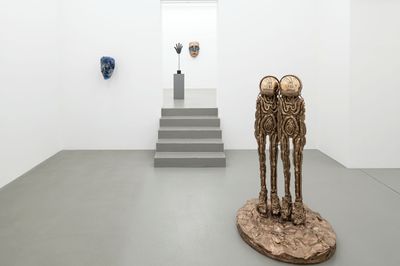
Exhibition view: Jean-Marie Appriou, Gemini; Andrew Lord, a sculpture of my left hand and five embraces, Galerie Eva Presenhuber, Vienna (9 November–22 December 2023). © Jean-Marie Appriou, Andrew Lord. Courtesy the artists and Galerie Eva Presenhuber, Zurich/Vienna. Photo: Jorit Aust.
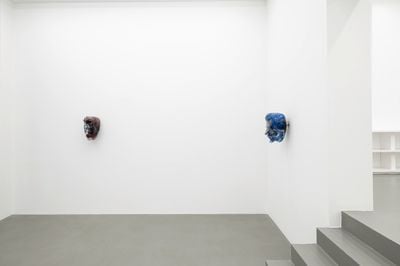
Appriou’s exhibition begins in the entrance gallery, with three casted glass portraits of Austrian poet Rainer Maria Rilke on the wall. In a dark hue of sepia, black, and blue respectively, each head holds plumes of white swirling within their semi-transparent interiors.
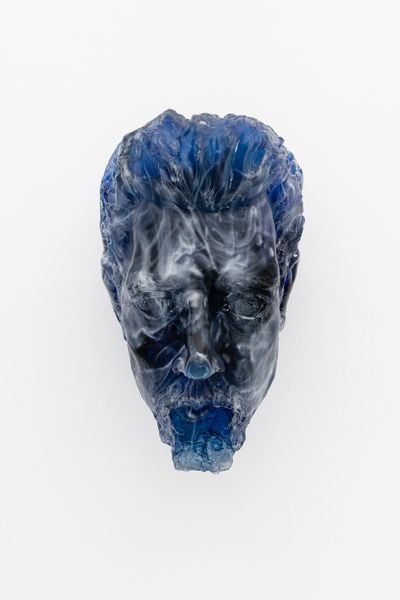
The three works belong to a new series that Appriou is dedicating to artists and writers who have inspired him, among them Mary Shelley, Charles Beaudelaire, and Edgar Allen Poe. In Gemini, Appriou explores the relationship between poetry and sculpture, taking as the point of departure a letter Rilke sent to Auguste Rodin while writing a monograph on the sculptor. In it, he asks, ‘It is not just to write a study that I have come to you, it is to ask you: how should I live?’
His admiration for the artist led Rilke to compose a body of ‘poem things’ that evoke the material solidity of sculpture. In this encounter between the two artists, Appriou emphasises the multiplying potential of artistic inspirations and influences, and how these might mushroom into altogether new creations.
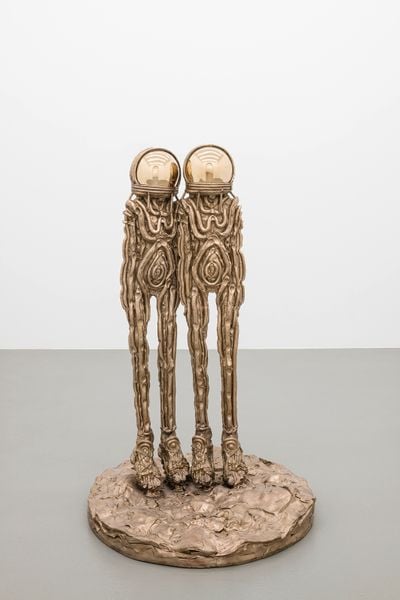
The energetic force of creative fusion is given a futuristic dimension in Appriou’s work, which often takes on hybrid animal, human, and plant forms through a range of materials such as aluminium, bronze, glass, wax, and clay. Surrounded by Rilke’s portraits at Eva Presenhuber, for example, is the waxed bronze sculpture The Poet and the Sculptor (mitosis) (2023), showing a pair of astronauts with disproportionately long legs.
The astronaut, a recurring motif in his practice, reflects the continual human quest to understand the unknown. For an artist, this may translate into the willingness to experiment and exchange new ideas, despite not knowing the outcome.
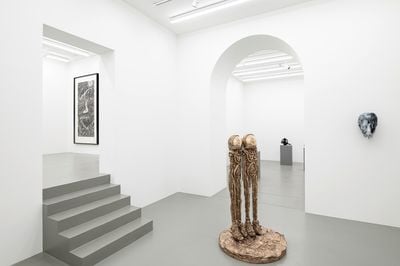
Appriou has been known to produce varied textures in his work, calling them the ‘skin of sculpture’. Among the works on view in Fire on the Sea (2021), his solo exhibition at Eva Presenhuber, Zurich, were patinated and glass sculptures with rugged surfaces reminiscent of tree barks. In The Poet and the Sculptor (mitosis), Appriou polished the astronaut’s helmets, contrasting them with the coarse metal vines making up their elongated bodies. The reflective surfaces suggest clarity of vision, while denying viewers access to their interiors.
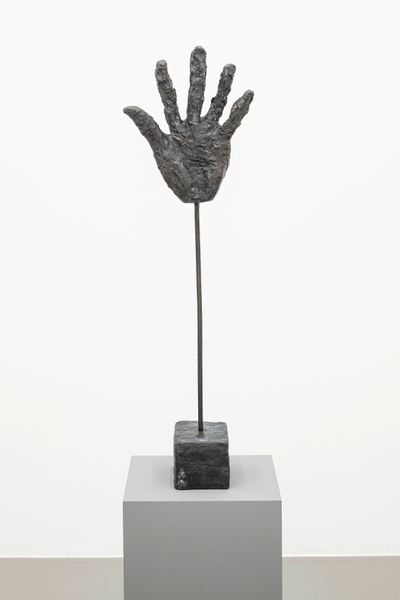
The exertion of the sculptural surface is also central to Lord’s practice, whose textured bronze sculpture My left hand (from the series Atlas of the World) (2021/2023) faces the street in a room situated up a short flight of stairs from the entrance gallery. Despite the claim of ownership in the title, the outstretched hand is detached from the body and mounted on a metal rod and plinth, foregrounding the artist’s physicality in its absence.
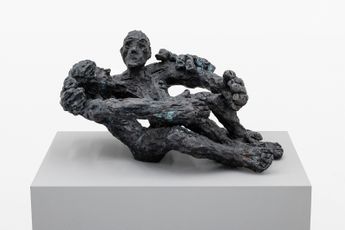
Lord’s latest works in a sculpture of my left hand and five embraces marks a return to figurative descriptions for the artist, whose practice since the 1970s has navigated the vast possibilities of expressing the body in sculptural form.
‘The Italian set in intense light. Angled. Black’ series (1981), for example, consists of angular ceramic vessels based on his drawings of the fall of light and shadows on vases and coffee pots. In ‘Breathing, biting, swallowing, tasting, smelling, listening, watching’ (1994–2000), the artist used the parts of his body required by the actions in the title to create a series of elongated, vessel-like forms.
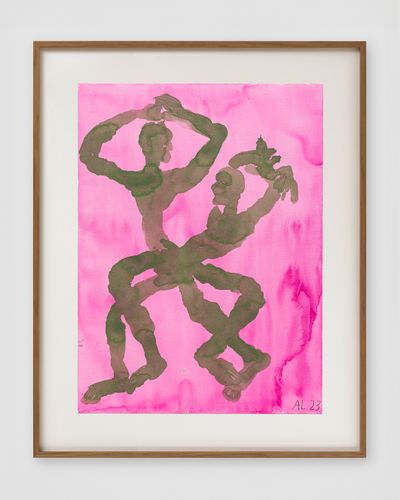
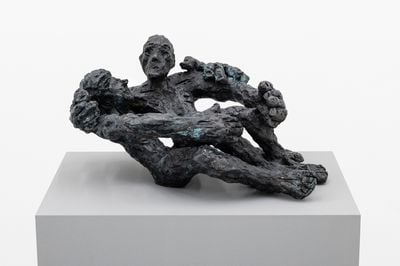
At Eva Presenhuber, Lord emphasises the corporeality of touch in his five embrace sculptures (2023), each of which depicts two bodies in intimate, wrestling embraces. In the nearby gouache paintings, also titled embrace (2023), bodies similarly weld together, the brushstrokes expressive and sensual against monochrome backgrounds.
It is a fine balance between personal expression and the fusion of external influences that makes the artists’ work their own. As Lord reveals of this process, materialising an idea involves passing it through art to ’[make] a thought physical, of giving it form, and when you’ve found a way to build it then it becomes yours again, your own mark.’ —[O]
A respected voice in contemporary art discourse.
Focusing on ambitious storytelling and insightful art-world commentary. Ocula Magazine publishes in-depth interviews, critical essays and timely analysis on the artists, exhibitions and ideas driving the global art world.
Learn more about Ocula Magazine
Showcasing the best of the art world.
Ocula partners with galleries from around the world to highlight their artists, artworks and exhibitions. Gallery membership is by application and invitation, with each member vetted by an independent panel.
Learn more about Ocula Membership
Specialises in the sale of major artworks.
Led by a team with deep ties to the world’s leading auction houses, galleries and collectors. Ocula’s advisory team offers bespoke services to high-net-worth clients from around the world who are looking to acquire the best of contemporary and modern art.
Learn more about our team and services