





‘Supernurse’ Ania Nowak Performs at Salzburger Kunstverein
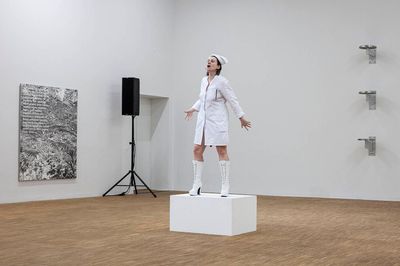
Ania Nowak, Obelix Nutrix (2024). Courtesy Salzburger Kunstverein, Austria.
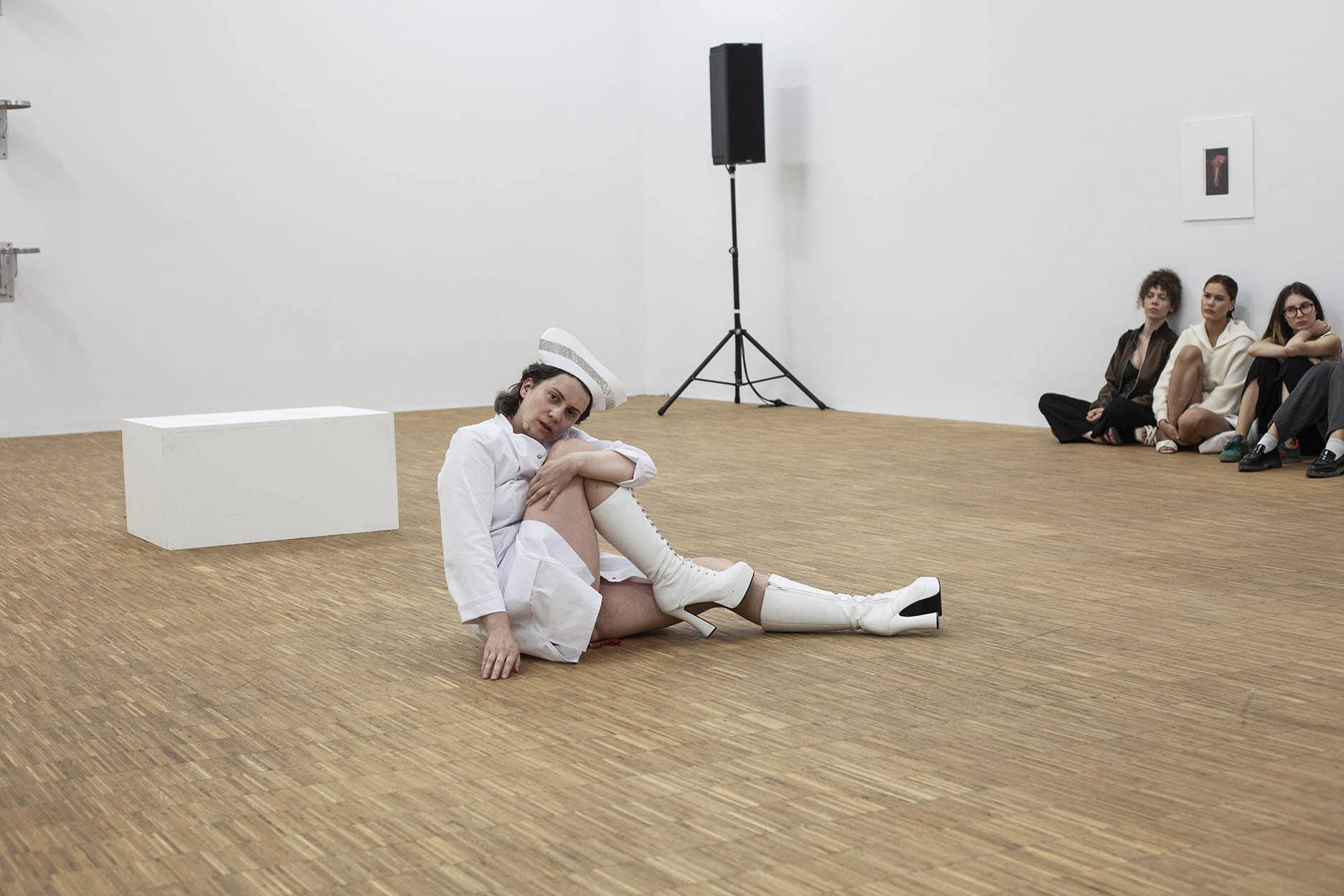
Obelix Nutrix (2024) is a newly commissioned work for Salzburger Kunstverein’s performance series ‘Smart Nursing’, curated by institutional director Mirela Baciak. In the words of the exhibition literature, the series offers an ‘examination of caring practices’ and explores how professions such as nursing are ‘transition[ing] into digital realms’. Nowak’s contribution concludes the series, which began with performances by Liesel Burisch and Anna Witt.
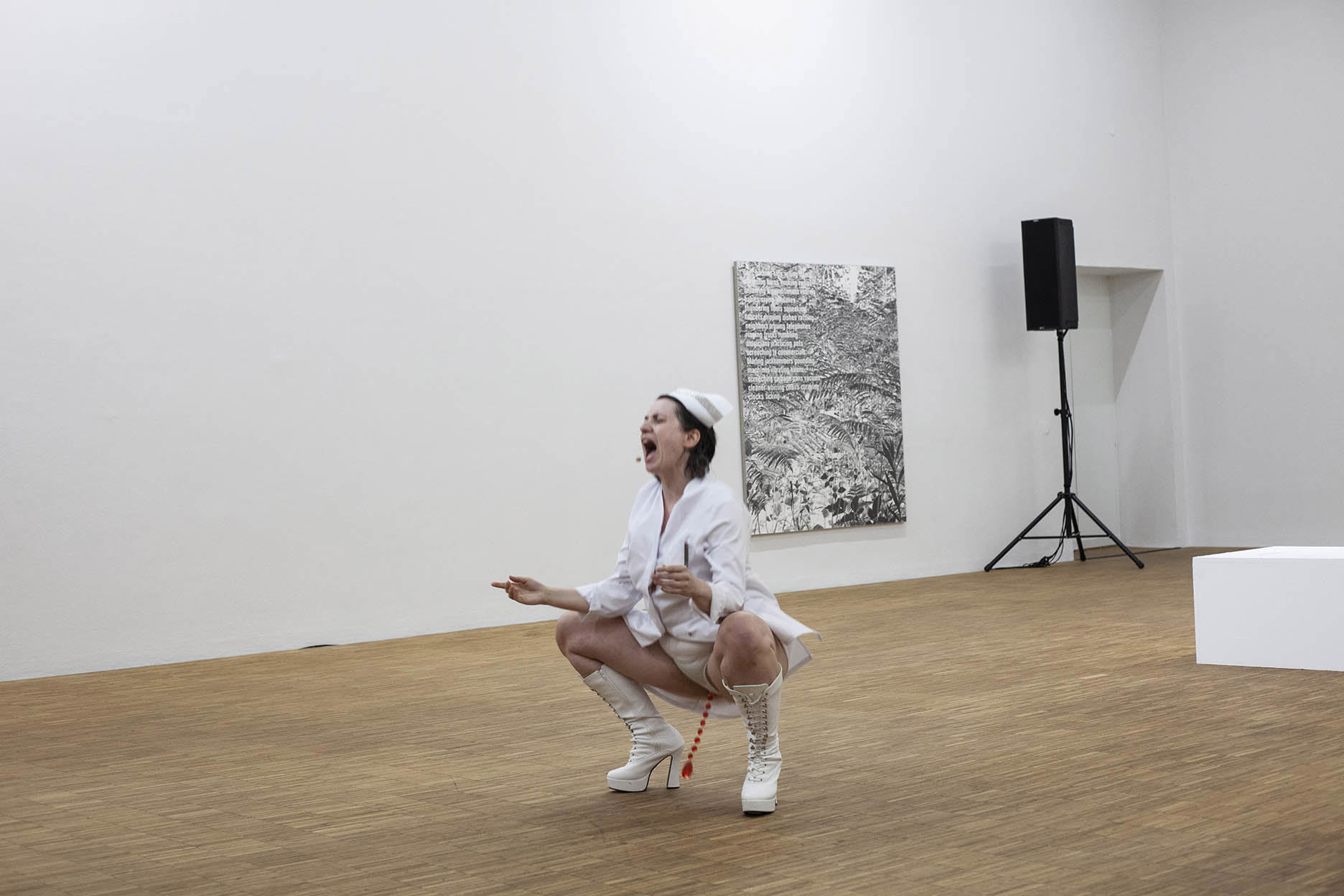
Nowak’s dense, 30-minute performance converges historical and professional gender biases, sexuality, power dynamics, and the emerging landscape of digital caregiving. ‘Your nurse Ania’, as the artist refers to herself, is flirty, slightly promiscuous, and wields control with subtly intimidating care. Throughout the performance, she deftly flips the power dynamics, starting as the one seemingly needing attention and painkillers, engaging in short-lived relationships with the audience. You might think you’re there to hand her ibuprofen, but don’t get too comfortable. The second wave of pain is on its way. While she ‘doesn’t mean to overstep’, she tells us, you might find yourself giving her ‘a little kissy kissy kiss’ to relieve her period cramps.

Obelix Nutrix is a seamless display of audience power play that inverts patriarchal norms and explores ambiguities surrounding the concept of care through discreet psychological manoeuvres. Given the deep-rooted gender stereotypes that prevail in professional fields, the figure of authority—the doctor—is still typically regarded as male, while the caregiver—a role of lesser importance—is usually still perceived as female. Before Florence Nightingale’s healthcare reforms earned her the moniker ‘the mother of nursing’, the profession was generally regarded as a low-status occupation often carried out by female sex workers. ‘I’m doing this for money and also for free after work,’ sings Nowak. Historically, the professionalisation of nursing allowed women to gain some agency and status. ‘It’s in me. It’s my world. I care for you. I risk for you. I’m a supernurse,’ Nowak continues. In other words, we women can fix you.

‘I’m the first you see when you are born and the last person you’ll see when you die,’ Nowak intones, invoking Jacques Derrida’s concept of pharmakon from ‘Plato’s Pharmacy’ (1981), which conveys the dual nature of medicine as both cure and poison. Nowak’s practice examines how various binaries shape hierarchies and power dynamics, particularly in the field of caregiving. The nurse must be a calming, reliable presence, always there when needed, yet also maintaining control. It’s a tightrope act, demanding both a compassionate, patient-centred approach and a bureaucratic, authoritative mindset while managing critical responsibilities in which one misstep could be fatal. Pop culture, of course, is rife with such deadly caregivers as envisioned by the male gaze: Nurse Ratched in Ken Kesey’s One Flew Over the Cuckoo’s Nest (1962), Annie Wilkes from Stephen King’s Misery (1987), or the sultry Elle Driver in Quentin Tarantino’s Kill Bill (2003). There is a curious link here between female authority and monstrosity, manipulative mind games and fostering co-dependency through ‘care’.
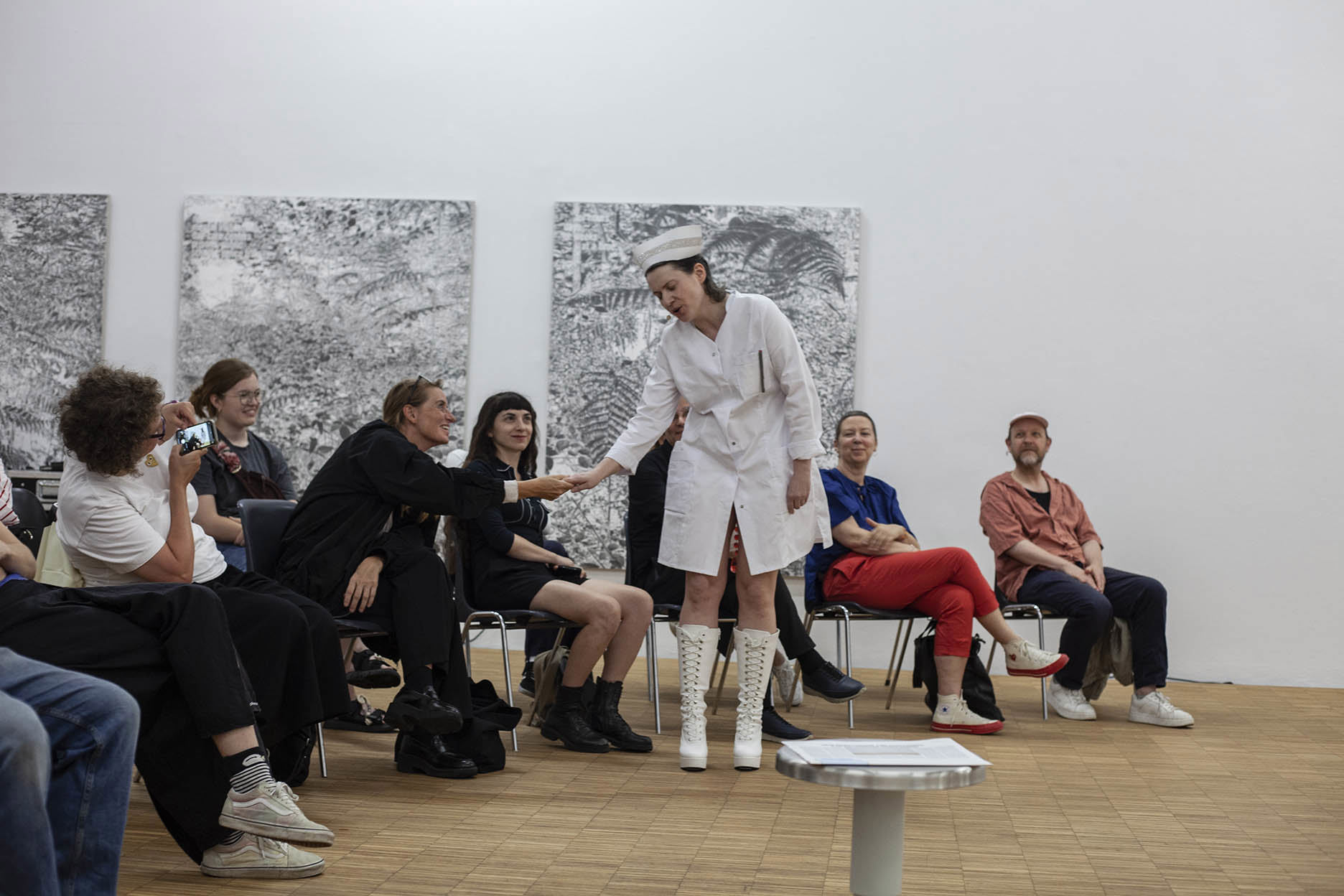
A further duality can be found within Nowak’s practice: physical movement and language carry equal heft. In her introduction to an interview with the artist, Baciak describes how Nowak ‘reflects very strongly on the language of care’.1 To a soundtrack that features snippets of Nightingale’s diaries, the artist’s language subtly shifts, at times becoming emotionally detached, coldly professional, and occasionally rhythmical—reminiscent, in fact, of ChatGPT. In the final part of the performance, the scene shifts to introduce a patient undertaking an assisted death. In this vulnerable scenario, the encounter with ‘your nurse’, along with the contemplation of life’s absolute end, is conveyed through a vocabulary that feels unsettlingly remote. Nowak’s calm, dispassionate voice guides you through the procedure of taking the final pill. ‘You won’t feel any pain; it will be the end,’ she intones with a blank expression, sending a chill up your spine as the audience remains rapt in grave silence for just a beat too long after the performance ends. —[O]
1 Mirela Baciak, Video interview with Ania Nowak (Salzburger Kunstverein: Salzburg, 2024), Archive of Salzburger Kunstverein, 2024.
Žanete Liekīte was resident at Salzburger Kunstverein in 2024. She is one of five independent writers selected to participate in a writer’s residency conceived in a partnership between Ocula and Salzburger Kunstverein.
Main image: Ania Nowak, Obelix Nutrix (2024). Courtesy Salzburger Kunstverein, Austria.

A respected voice in contemporary art discourse.
Focusing on ambitious storytelling and insightful art-world commentary. Ocula Magazine publishes in-depth interviews, critical essays and timely analysis on the artists, exhibitions and ideas driving the global art world.
Learn more about Ocula Magazine
Showcasing the best of the art world.
Ocula partners with galleries from around the world to highlight their artists, artworks and exhibitions. Gallery membership is by application and invitation, with each member vetted by an independent panel.
Learn more about Ocula Membership
Specialises in the sale of major artworks.
Led by a team with deep ties to the world’s leading auction houses, galleries and collectors. Ocula’s advisory team offers bespoke services to high-net-worth clients from around the world who are looking to acquire the best of contemporary and modern art.
Learn more about our team and services