
The art world in focus
Subscribe to our newsletter for news and insights on artists, galleries and exhibitions.
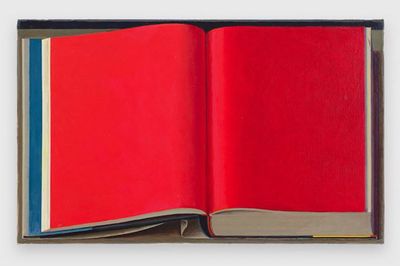
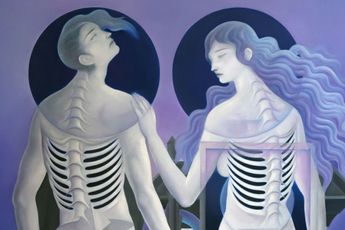
Liu Ye, Book Painting No. 6 (2014–2015). © Liu Ye. Courtesy the artist and David Zwirner.
According to the press release, the artist’s strategy of painting books invokes ‘an atmosphere of meditation’ that is based on his love of reading and appreciation of Western art and literature, and the book does indeed seem to be an object that bears a lot of personal significance for Liu, as testified by the meticulous layers of paint and the time that each painting takes to complete.
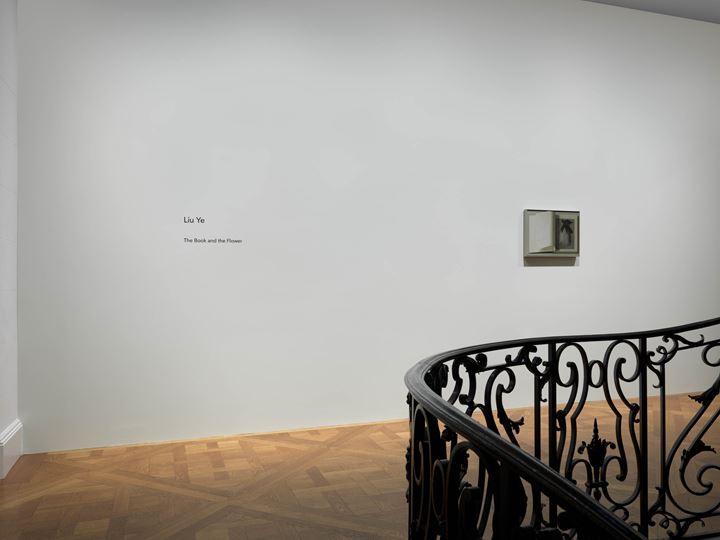
Several world-renowned books of art and literature are the subject of Liu’s painterly interpretations, most of which are reproductions that are intervened by a certain sleight of hand.
“To defer to the now archaic discourse of the complicated relationship between painting, photography, and mechanical reproduction is far from productive in the age of digital communication and cultural accountability.
In Book Painting No. 21 (Karl Blossfeldt, The Complete Published Work, Taschen GMBH, 2017) (2018), the book is flipped upside down, giving the image and its accompanying text a cryptic quality reminiscent of an illuminated manuscript. The work also incorporates a temporal dimension by depicting fine details such as the ray of blue-tinted morning light cast on the page, and a bookmark in use.
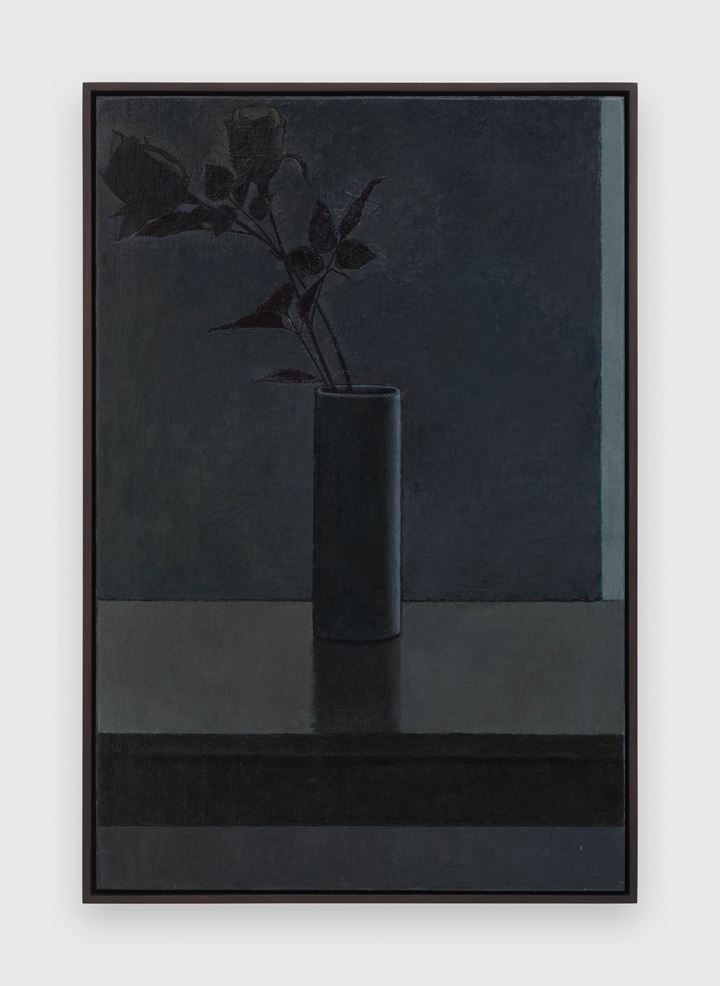
Book Painting No. 21 is one of three paintings in the show that illustrate pages taken from publications featuring the photographs of German photographer Karl Blossfeldt, Wunder in der Natur (1942) and The Complete Published Work (2017).
Blossfeldt, who made his own camera, was known for his magnified black and white images of plant specimens that drew attention to the sculptural qualities of flora and their intricate textures.

It is important to point out that Liu’s consistent practice of reproducing books as paintings involves not only meditation, but also mediation. If books function as vessels that mediate words, images, and concepts for the reader, then an artist recreating these vessels as authored forms needs to acknowledge their own subjectivity as new mediators.
To defer to the now archaic discourse of the complicated relationship between painting, photography, and mechanical reproduction is far from productive in the age of digital communication and cultural accountability.

Even if we were to understand this series as meditative and poetic, what the artist’s quotations consist of cannot be ignored.
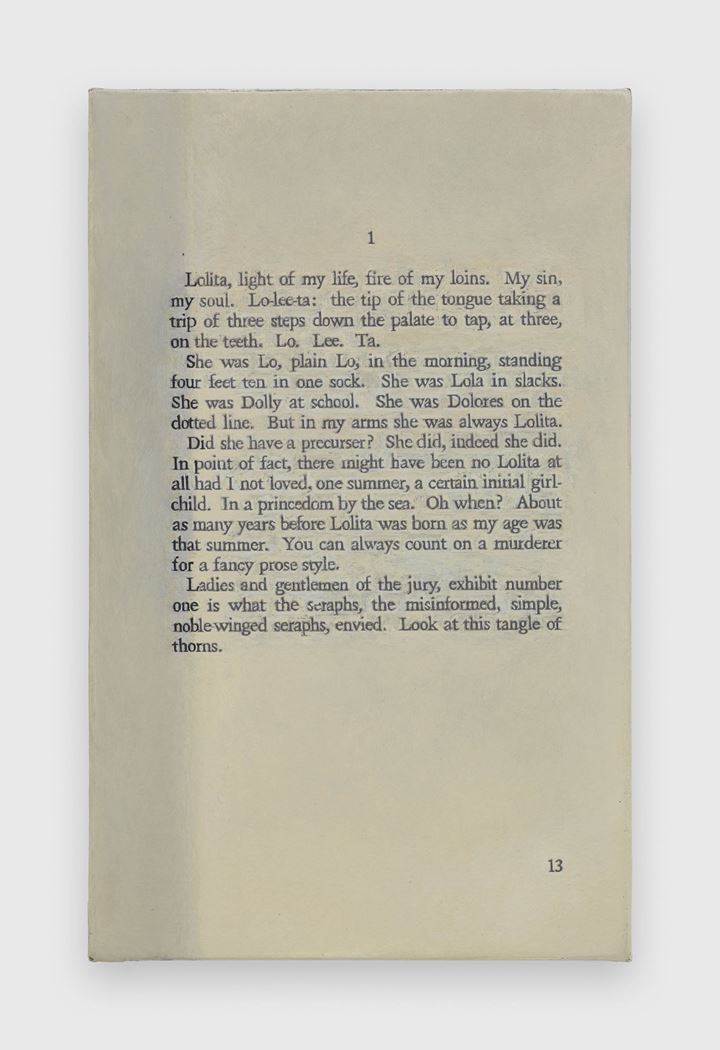
Take Book Painting No. 15 (Lolita, The Olympia Press, 1955, Page 13) (2017), which reproduces the first page of Vladimir Nabokov’s Lolita—a text that begins with the notorious line, ‘Lolita, light of my life, fire of my loins’. With the sexual objectification and exploitation associated with Nabokov’s young female character—a minor—going utterly unacknowledged, the same unregulated predatory desires have been regurgitated and seared into Liu’s rendered pages.
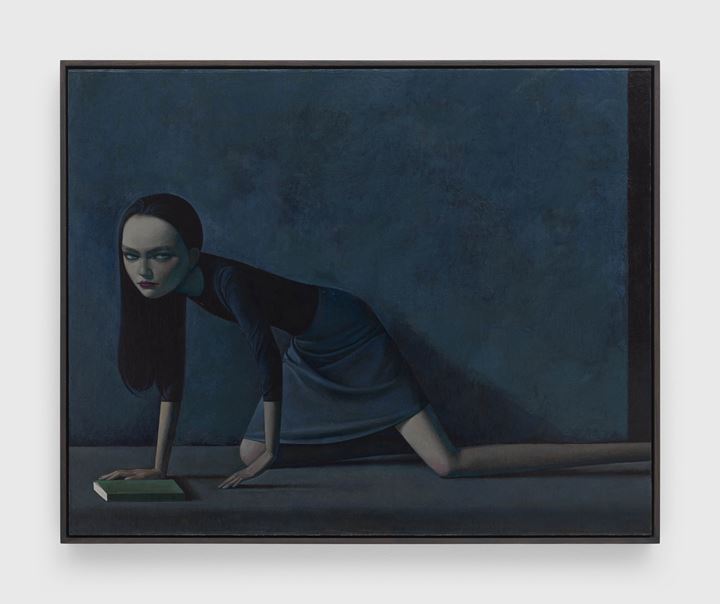
What happens then, when the Lolita painting is placed next to Banned Book No. 5 (Balthus Variation) (2019–2020), as it is in this exhibition?
In it, a young girl crouches on her knees, bearing traces of the stylistic traits of Liu’s portraiture—large eyes and impossibly elongated limbs. The expression on her face is in line with her seductive pose, as she crawls over the pages of an open book with a green cover.
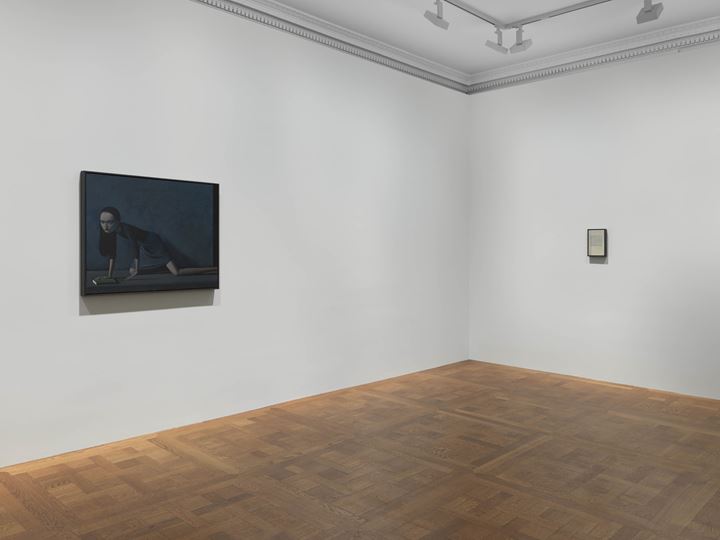
Banned Book No. 5 references a painting by Balthus, The Blanchard Children (1937), in which a girl crouches over an open book as her brother leans back against a table.
Liu’s reproduction gestures towards, if not explicitly, the controversy involving Balthus and his paintings of prepubescent girls in provocative poses, such as Thérèse Dreaming (1938), which features a girl sitting with her legs tantalisingly open.
Whether or not Liu is alluding to the recent online petition to remove Thérèse Dreaming from The Metropolitan Museum of Art due to its paedophilic voyeurism and the resulting implications of censorship, or the issues surrounding Balthus’ oeuvre more broadly, the straightforward manner in which he references canonical works of art and literature suggests that he does not feel the need to spell out his positionality.
All is subject to the process of meditation, in which the mediator’s role is diluted, unexamined, and divorced from the turmoil of reality. What, then, is The Book and the Flower attempting to convey as it continues to mediate modernist, normative, and male-centric viewpoints? —[O]
A respected voice in contemporary art discourse.
Focusing on ambitious storytelling and insightful art-world commentary. Ocula Magazine publishes in-depth interviews, critical essays and timely analysis on the artists, exhibitions and ideas driving the global art world.
Learn more about Ocula Magazine
Showcasing the best of the art world.
Ocula partners with galleries from around the world to highlight their artists, artworks and exhibitions. Gallery membership is by application and invitation, with each member vetted by an independent panel.
Learn more about Ocula Membership
Specialises in the sale of major artworks.
Led by a team with deep ties to the world’s leading auction houses, galleries and collectors. Ocula’s advisory team offers bespoke services to high-net-worth clients from around the world who are looking to acquire the best of contemporary and modern art.
Learn more about our team and services