






Locust Jones at Art Central Hong Kong 2016
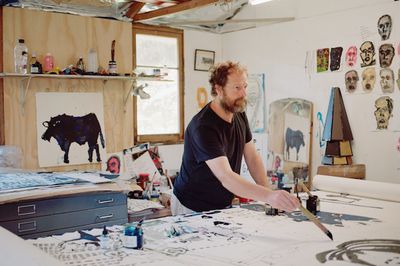

The 2016 edition of Art Central HK will include the return of the PROJECTS section – a presentation of curated ambitious large-scale works and spatial interventions that challenge the confines of a traditional art fair booth. Participating this year will be New Zealand-born artist, Locust Jones, known for creating vast panoramic hanging scrolls. Prior to the fair, Ocula spoke with the artist about his new work Back to the Dark Ages, delving into his complex process and the contemporary socio-political issues his piece interrogates.
Could you please begin by talking me through your creative process?
I listen and read a lot of news from around the world as well as reading about historical events. I interpret this information and the result is that fragments of news stories are inserted into my drawing as a layering of text and line. My method is fast paced so it feels like the imagery haemorrhages onto the paper in a frantic stream of consciousness.
I cut out images and pieces of text from magazines, newspapers and journals that I find interesting and lay them on the surface of the drawing as prompts for me to draw, moving them around kind of like a jigsaw puzzle. I have many images, including world maps, on the studio walls and the radio live streaming or feeding me news from around the world. It is from these sources that I build my compositions.
You work with a wide variety of medium on each piece—from shellac to watercolour to pigment—how do you feel this layering technique informs the work?
Different mediums assist in varying the line and creating layers in my work. I often apply various mediums with large Bamboo sticks, working quickly to pile images one upon the other. The daily news is coming at me in a great tumble and I feel the best way to record the urgency is to work with mediums such as pencil and ink so as to get the message down quickly.
There is something primitive about your imagery, could you discuss what has inspired this creative style?
I started making art when I was 25 as a result of an automobile accident. I was hospitalised for many months and I began drawing as part of my recovery; I never stopped. I was trying to render what I was going through so the drawings I made were both violent and visceral, as the accident was really serious. I guess from there I moved onto violent news stories and historical events. Violence has a primitive edge and I think the way I work (the immediacy and pace of my method) somehow works with the material I render in a primitive expressive way.
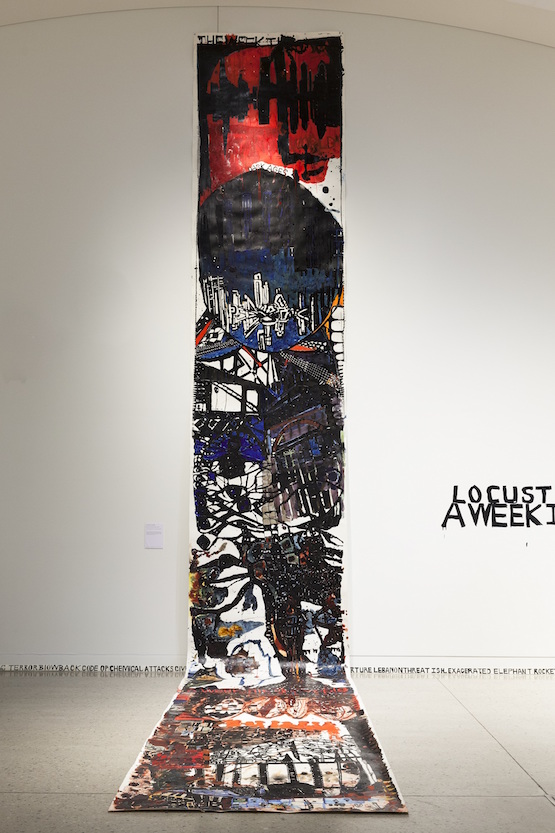
What is the socio-political focus of Back to the Dark Ages? And are there any texts or media stories it references in particular?
Yes this work references many media stories—911, the Charlie Hebdo attacks in Paris, film rolls, geo-politics, drone spying and surveillance, world maps, our fragile eco system, extinct species (in particular sea turtles and rhinoceros) and the ongoing refugee crises. There is also a tree in this work; the tree branches reach out and spread to all the cataclysms affecting the world so it was apt to call this piece Back to the Dark Ages.
Please could you explain the relevance of working on a scroll?
For me the relevance is that I can tell a story. A scroll unfurls and allows me to keep adding a narrative. I’m recording and interpreting my version of history - it seems natural for me to keep on going in a long unfolding line. I only roll out about 3 meters at a time, when it’s dry I roll it up and work on the next 3 meters. I rarely go back over a work, installing it for the first time is when I see the work in its entirety.
The PROJECTS section of Art Central HK is said to enable artists to challenge the confines of the art fair booth. Why, if at all, do you think such intervention is necessary?
I don’t find the booth restricting, but the PROJECTS section does benefit large-scale work by allowing it extra freedom and encouraging ambitious installation. It compliments the booth and adds an extra dimension to the fair. I would like to thank my gallerist, Dominik Mersch for this opportunity. —[O]
Main image: Image: Locust Jones. Courtesy the artist and Dominik Mersch Gallery, Sydney.



A respected voice in contemporary art discourse.
Focusing on ambitious storytelling and insightful art-world commentary. Ocula Magazine publishes in-depth interviews, critical essays and timely analysis on the artists, exhibitions and ideas driving the global art world.
Learn more about Ocula Magazine
Showcasing the best of the art world.
Ocula partners with galleries from around the world to highlight their artists, artworks and exhibitions. Gallery membership is by application and invitation, with each member vetted by an independent panel.
Learn more about Ocula Membership
Specialises in the sale of major artworks.
Led by a team with deep ties to the world’s leading auction houses, galleries and collectors. Ocula’s advisory team offers bespoke services to high-net-worth clients from around the world who are looking to acquire the best of contemporary and modern art.
Learn more about our team and services