





Shannon Te Ao’s Invisible Presence in the Gwangju Biennale
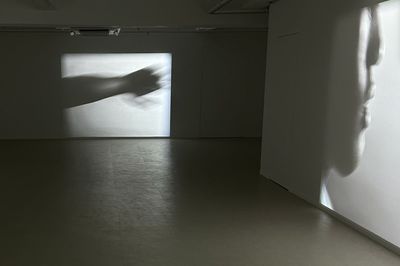
Shannon Te Ao, Ia rā, ia rā (rere runga, rere raro) Everyday (I fly high, I fly low) (2022). Three-channel video with sound. Exhibition view: Aotearoa New Zealand Pavilion, Pansori, a soundscape of the 21st century, 15th Gwangju Biennale (7 September–1 December 2024). Courtesy Gwangju Biennale Foundation.

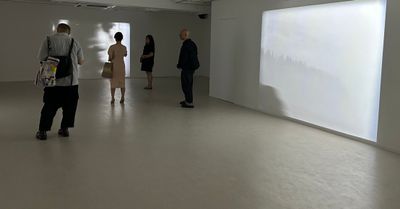
Burrowed discreetly in the streets of Gwangju’s Dong district, a skinny set of stairs leads visitors up to Shannon Te Ao‘s work, Ia rā, ia rā (rere runga, rere raro)—Everyday (I fly high, I fly low). Presented as Aotearoa New Zealand’s contribution to this year’s Gwangju Biennale Pavilion, the large-scale, black-and-white video installation whispers across three walls of an intimate room, its imagery accompanied by an evocative soundtrack.
Curated by Karl Chitham, director of the Dowse Art Museum, the work occupies the entire second floor of Suha Gallery, whose low-beamed ceiling reinforces the work’s exploration of movement between realms. Visitors are drawn to the centre of the room, where the installation unfolds around them.
Across the space, shifting images capture a previously documented performance of two men in dance-like motion. Close-ups brush the cool curve of a shoulder; silhouettes register a tender embrace; gestures suspend movement in time. The figures appear and recede across the three projections—glimpsed to one side before dissolving and re-emerging on another. The work references the movements of the tīwakawaka (also known as the fantail or pīwakawaka), a bird endemic to Aotearoa New Zealand. Often perceived as companionable, flitting between branches and along walking paths, it is also regarded as a harbinger of death.
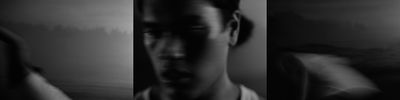
In Māori histories, the tīwakawaka is a significant protagonist, associated with traversing the threshold between the physical and spirit worlds. In one narrative, the demi-god Māui sought immortality by passing through the body of Hine-nui-te-pō, the goddess of death, while she slept, but was thwarted by a tīwakawaka, whose cackling woke her. The interruption is understood as an act of revenge, recalling Māui’s earlier mistreatment of the bird, which is said to account for its distinctive appearance.
Discussing his work in Gwangju, Te Ao explains he is drawn to Māori whakataukī (proverbs) and waiata (song) for the rich imagery used to describe everyday existence. The lyrics of the soundtrack that accompany the work—written and sung in te reo Māori by the artist’s friend and long-term collaborator, Kurt Komene—reference the daily routine and flight of the tīwakawaka and its associations with both tangible and intangible realities.
Regarding Komene’s contribution, Te Ao refers to pao (song), reflecting his broader interest in linguistic play across his video-based and performative practice. Although born in Aotearoa and now living in Te Whanganui a Tara, Wellington, Te Ao grew up in Australia, and his work reflects an ongoing effort to understand his Māori culture and assert it within cultural spaces and discourses. The work is both personal and political. His consistent practice of working with collaborators, such as Komene, speaks to a commitment to multiple perspectives and forms of knowledge.
The landscape footage that appears in Ia rā, ia rā (rere runga, rere raro) was filmed in Taupō, where Te Ao’s iwi (tribe), Ngāti Tūwharetoa, connects. It is the valley the artist’s father used to traverse, plotting a path to the burial place of his ancestors. This landscape has appeared in other works, with Te Ao reusing footage across iterations to explore how presentation shapes audience response.

The Queensland Art Gallery originally commissioned the work presented in Korea for the 10th Asia Pacific Triennial. In that earlier iteration, it was presented across one wall for the audience to view from afar. In Gwangju, where the loss and suffering endured during the Korean War (1950–53) and the Gwangju Uprising (1980) remain palpable, the work acquires a distinct context and heightened poignancy.
The tīwakawaka is a common little bird, yet a reminder of mortality. Its invisible existence in Te Ao’s work proposes an expanded perspective of reality—one that invites openness to multiple ways of being. What we see and perceive is not all that is present. Those we think we have lost, are always with us.—[O]
Initiated by the Office for Contemporary Art Aotearoa and presented in partnership with Te Tuhi and The Dowse Art Museum, Shannon Te Ao’s ‘Ia rā, ia rā (rere runga, rere raro)—Everyday (I fly high, I fly low)’ is presented in Gwangju, South Korea, as Aotearoa New Zealand’s contribution to the 15th Gwangju Biennale Pavilion (2024). It is shown at Suha Gallery, 158-4 Dongmyeong-dong, Dong-gu, Gwangju (7 September–1 December 2024).
Main image: Shannon Te Ao, Ia rā, ia rā (rere runga, rere raro) Everyday (I fly high, I fly low) (2022). Three-channel video with sound. Exhibition view: Aotearoa New Zealand Pavilion, Pansori, a soundscape of the 21st century, 15th Gwangju Biennale (7 September–1 December 2024). Courtesy Gwangju Biennale Foundation.


A respected voice in contemporary art discourse.
Focusing on ambitious storytelling and insightful art-world commentary. Ocula Magazine publishes in-depth interviews, critical essays and timely analysis on the artists, exhibitions and ideas driving the global art world.
Learn more about Ocula Magazine
Showcasing the best of the art world.
Ocula partners with galleries from around the world to highlight their artists, artworks and exhibitions. Gallery membership is by application and invitation, with each member vetted by an independent panel.
Learn more about Ocula Membership
Specialises in the sale of major artworks.
Led by a team with deep ties to the world’s leading auction houses, galleries and collectors. Ocula’s advisory team offers bespoke services to high-net-worth clients from around the world who are looking to acquire the best of contemporary and modern art.
Learn more about our team and services