The art world in focus
Subscribe to our newsletter for news and insights on artists, galleries and exhibitions.
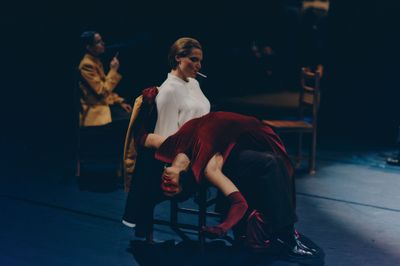
Wu Tsang / Moved by the Motion, Carmen (2024). Production Schauspielhaus Zürich, co-production Hartwig Art Foundation, presented in Amsterdam by Hartwig Art Foundation and Holland Festival. Photo: Inès Manai.
Interweaving elements from musical theatre and visual essay, Wu Tsang‘s 2024 adaptation of Georges Bizet’s opera Carmen (1875) pulses with political themes. An archaeologist narrator, scripted by Sophia Al Maria, forms a meta-narrative investigating the disappearance of a stateless, nameless Romani woman. As she references mass atrocities and unmarked graves, it becomes clear that she is talking about Palestine. ‘When I researched its origins, I found that Carmen plays out a European fantasy of otherness,’ Tsang told me at the work’s premiere on 23 June as part of the Holland Festival in Amsterdam.

The adaptation was co-produced by Schauspielhaus Zürich and Hartwig Art Foundation (HAF), which is expected to open a new museum in Amsterdam’s former courthouse—a Brutalist building on Parnassusweg—in a few years. Founded in 2020 by billionaire philanthropist Rob Defares, who also runs a medical foundation, HAF, which recently co-produced Carmen as a film, creates collaborative frameworks for large-scale, boundary-pushing artwork.
“Private foundations like HAF, unburdened by government policy, play an increasingly active role in supporting cultural production.
The new museum comes at an interesting moment in the Netherlands where, critic and curator Nat Muller explains, art funding is predominantly public. ‘In 2011, budget cuts by the conservative right-wing government left the sector reeling,’ she tells me, ‘with many unique art platforms having to shut their doors ... The current populist, far-right government deems culture “elitist” and has announced high VAT increases on art, culture and books—worse is very likely to come. Private foundations like HAF, unburdened by government policy, play an increasingly active role in supporting cultural production.’

Fundamental to this is an interrogation of the notion of a ‘dispersed’ museum, according to HAF director Beatrix Ruf, who has experience at both private collections and institutions, such as Stedelijk Museum and Kunsthalle Zurich. Dressed in all-black and wearing aviator frames, she emanates a quiet gravitas. ‘I’ve always been interested in infrastructure,’ she tells me. ‘Not in terms of bricks and mortar but concerning the responsibility for publicness ... Art is only meaningful in a collective sense.’
“We have huge amount of undefined space that could become a lot of things.
For Ruf, this entails a space in which artists, producers, and thinkers can live and work, with access to communal kitchens and gardens, in addition to safe spaces for diverse communities to convene. This concept of museum as host is on the rise with institutions-in-the-making—especially in project director Stephanie Rosenthal’s vision for the upcoming Guggenheim Abu Dhabi. ‘We have huge amount of undefined space that could become a lot of things,’ Ruf tells me of HAF. ‘Along with a white cube, we have spaces acoustically equipped for anything from recording to sound installations ... We are also thinking of offering networked workshops through which invited institutions or knowledge entities can become part of our museum.’
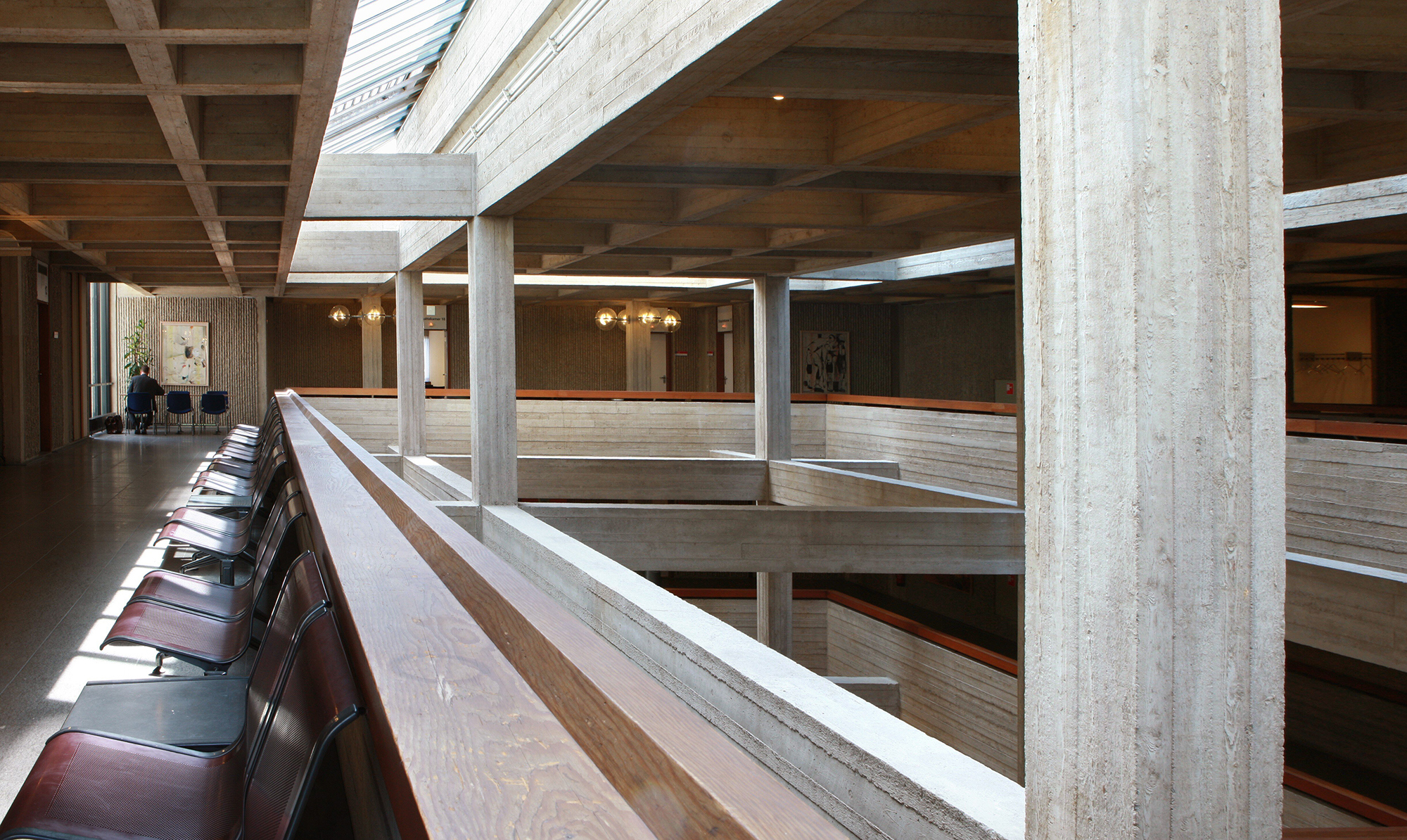
Through this re- or un-structured museum format, HAF contests the role of collections and sole ownership. Instead of building another independent art collection, the foundation intends to merge its works with those of the national collection—the Rijkscollectie—making them accessible to all institutions. Despite having ‘everything from a carriage to a Rembrandt’, the Rijkscollectie doesn’t currently have an active policy for collecting contemporary art. To that end, HAF will gift its acquisitions to the Rijkscollectie to create a cutting-edge collection with improved loan and conservation proficiencies, in a synthesis that enables each institution to play to its individual strengths.

For HAF, a major part of this will be performance education through contributions to the public archive of New York’s Performa Biennial, which documents 20th- and 21st-century performance, as well as two fellowships (curatorial and archival), and co-productions. In 2023, the foundation co-commissioned Julien Creuzet, a Martinican artist and poet representing France at this year’s Venice Biennale, to create his first large-scale performance piece.
Conceived with choreographer Ana Pi, Algorithm ocean true blood moves (2023)—which was performed in Amsterdam in June in collaboration with the Dutch National Opera—employs movement, sculpture, and animated video to evoke decolonising histories of the Black Atlantic and the migration of dance from Africa.
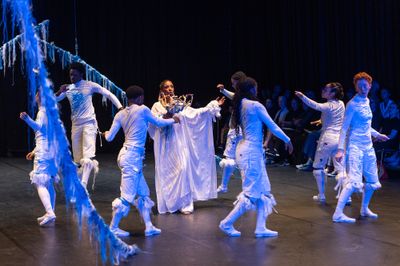
The ocean is an ever-present symbol, dredging up slippery memories of buried histories through viscous sound in a joyful oceanscape. I was reminded of simbi, the serpentine water spirits that travelled from Africa to Haiti as an Afro-spiritual Hoodoo tradition connecting the divine and natural worlds.
“[At HAF,] we are investing a lot in how images can destabilise our understanding of the world.
For the movement, Creuzet mined what he calls the ‘library of gestures’—aka the internet. ‘As Afro-diasporic persons, we have colonial histories inside our bodies, but such ancestral knowledge is disappearing,’ he told me. ‘Social media allows us to identify how the gesture jumps from the past to the future inside our present. [As artists] our creative role is in the reinterpretation of the gesture.’
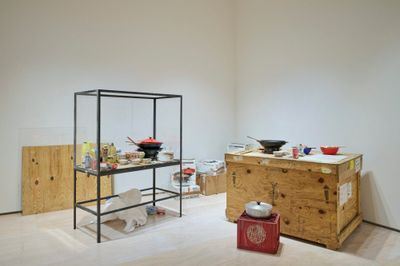
Creuzet’s work is now part of the HAF collection, as is Rirkrit Tiravanija‘s groundbreaking Untitled (Pad Thai), a 1990 cooking performance that sedimented relational aesthetics and critiqued Western-centric notions of the art object. ‘Rirkrit is such an important artist in terms of how the so-called Western world relates to differing ideas of societal surplus,’ Ruf observes. ‘What does it mean for a society to create a surplus—whether that constitutes what we might understand as art, or whether it’s things like generosity and hospitality? [At HAF,] we are investing a lot in how images can destabilise our understanding of the world.’
While it’s still too early to tell whether it will succeed, HAF’s approach feels decentred and artist-driven. By commissioning artists over a series of works, the foundation is not only elevating creative practices in non-traditional, genre-crossing formats, but making a statement on longevity. At a time when cultural institutions are crumbling, there is comfort to be found in the focal shift from objects to experiences, and towards global perspectives that tell counter-histories. —[O]
A respected voice in contemporary art discourse.
Focusing on ambitious storytelling and insightful art-world commentary. Ocula Magazine publishes in-depth interviews, critical essays and timely analysis on the artists, exhibitions and ideas driving the global art world.
Learn more about Ocula Magazine
Showcasing the best of the art world.
Ocula partners with galleries from around the world to highlight their artists, artworks and exhibitions. Gallery membership is by application and invitation, with each member vetted by an independent panel.
Learn more about Ocula Membership
Specialises in the sale of major artworks.
Led by a team with deep ties to the world’s leading auction houses, galleries and collectors. Ocula’s advisory team offers bespoke services to high-net-worth clients from around the world who are looking to acquire the best of contemporary and modern art.
Learn more about our team and services