





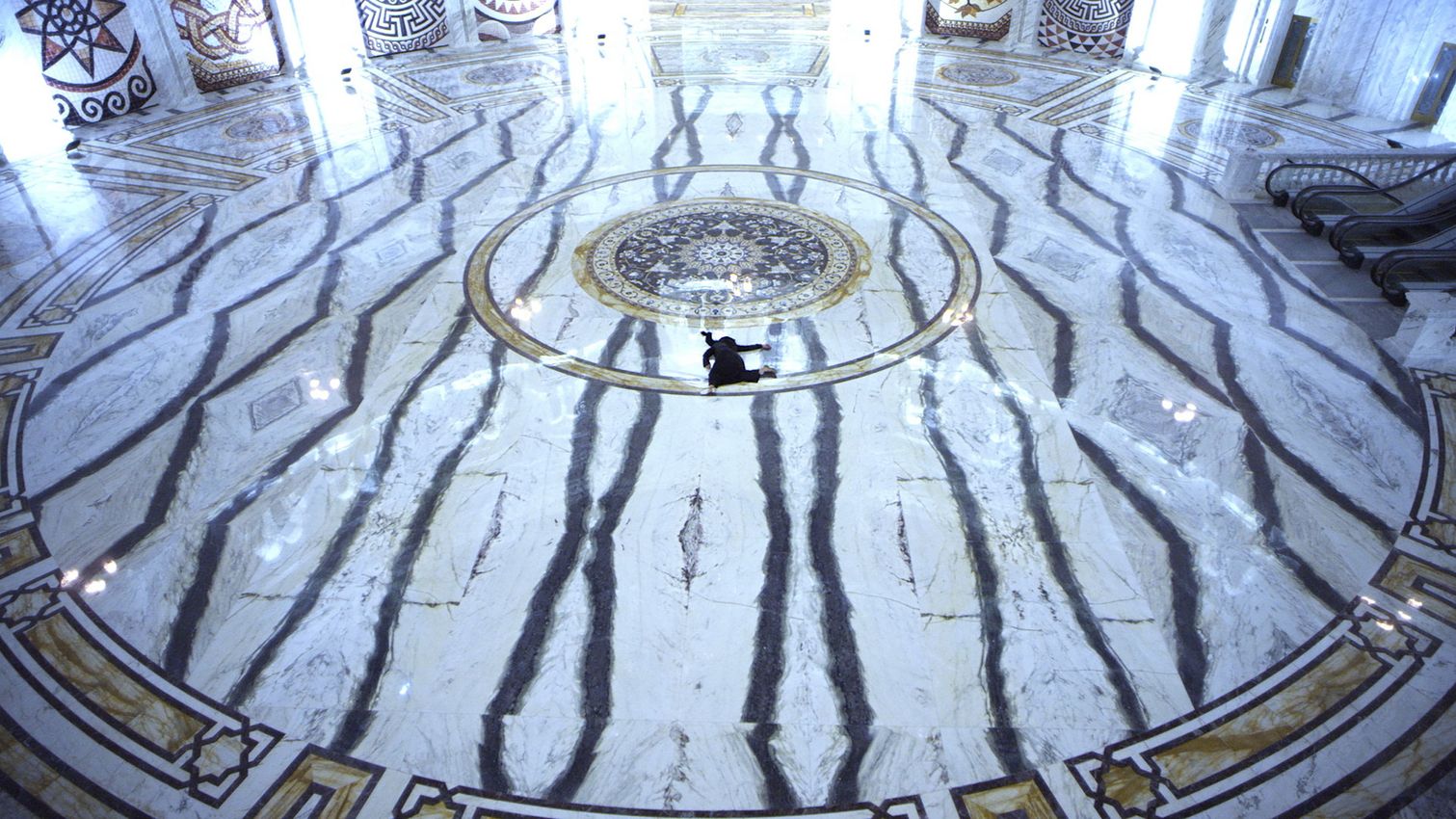
SOPHIA AL-MARIA
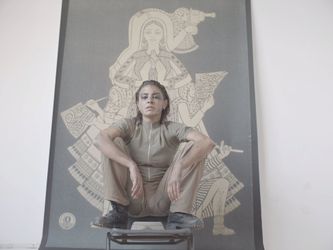
b. 1983, United StatesSophia Al-Maria is an artist, writer, and filmmaker. She grew up between the United States and Qatar before moving to Egypt to study comparative literature at the American University in Cairo. She next completed a graduate degree in aural and visual cultures at Goldsmiths, London.
The seemingly disparate sources of inspiration for Al Maria’s multidisciplinary practice include pop culture, anime, Arabic poetry, sci-fi, and her personal experience of pollution and climate change. Working primarily with film and narrative text, the artist weaves captivating tales as a way to process her thoughts and feelings about the future, particularly in the current extinction climate. Her recent work focuses increasingly on the isolation of individuals via technology, consumerism as proxy religion, and how agency and chance play in the blinding approach of an uncertain future.
Growing up between the Pacific Northwest and the Gulf, Al Maria saw firsthand the effects of pollution and global warming. Her sci-fi and fantasy style depictions for the future do not focus on a utopia but rather, recognize the possibility of the end of life as we know it. Despite her fear of an apocalyptic future for mankind, Al Maria remains fascinated by ruins. Pre-Islamic poetry often begins with al-atlal(literally ‘the ruins’) in which the poet may describe a site abandoned by his great love; the ash of a burnt-out fire, the evidence of a tent in which she laid down her head. This method of elevating the detritus of existence had a profound effect on the artist, informing much of her work.
Along with friend and musician Fatima Al Qadiri, Al Maria coined the concept of Gulf Futurism. In Sad Sack, a recently published collection of writings, Al Maria explores the possibility that, in some respects, the Gulf is already living within the future imagined by those in the West. She investigates the various ways in which this future is not evenly distributed or that it is simply misunderstood, particularly with regards to feminism. Misunderstanding and bias are partly responsible for Al Maria’s mistrust in narratives and experiments with works told from the viewpoint of an omega character, giving a worm’s-eye perspective. In her richly imaginative works, Al Maria demonstrates the fascinating way in which storytelling is used to understand the past and to imagine the future.
Her writing has appeared in Harper’s Magazine, Five Dials, Triple Canopy, and Bidoun. In 2007, she published her first autobiographical novel, The Girl Who Fell to Earth (Harper Collins Perennial). She was invited to participate in the 2016 Biennial of Moving Images in Geneva, Switzerland. The artist has also participated in the Inhabitation residency at Villa Empain, Boghossian Foundation, Brussels (2016).
Al Maria is the author of Sad Sack, Virgin With A Memory and The Girl Who Fell To Earth and has also guest edited an issue of the experimental art-writing journal The Happy Hypocrite, entitled Fresh Hell.
She was the Whitechapel gallery’s writer in residence 2018. Al Maria currently lives and works in London, UK.
Text courtesy The Third Line

Representative Artworks

View story
View story
View story

View story
View story
View story
Sophia Al-Maria in Ocula Magazine









Explore and Follow Artists Shaping Contemporary Art
A respected voice in contemporary art discourse.
Focusing on ambitious storytelling and insightful art-world commentary. Ocula Magazine publishes in-depth interviews, critical essays and timely analysis on the artists, exhibitions and ideas driving the global art world.
Learn more about Ocula Magazine
Showcasing the best of the art world.
Ocula partners with galleries from around the world to highlight their artists, artworks and exhibitions. Gallery membership is by application and invitation, with each member vetted by an independent panel.
Learn more about Ocula Membership
Specialises in the sale of major artworks.
Led by a team with deep ties to the world’s leading auction houses, galleries and collectors. Ocula’s advisory team offers bespoke services to high-net-worth clients from around the world who are looking to acquire the best of contemporary and modern art.
Learn more about our team and services