





6 Artworks to See at Tokyo Gendai 2024
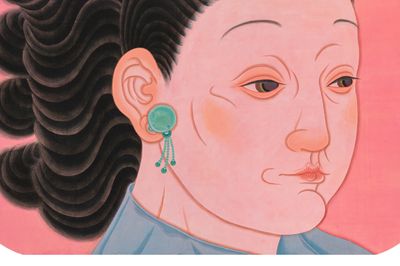
Tseng ChienYing, Airing (2024) (detail). Ink and colours on paper, mineral pigments. 95.5 x 140 cm. Courtesy Each Modern, Taipei.
Home to an exceptionally rich contemporary art scene, Tokyo will soon host the second edition of the international art fair, Tokyo Gendai.
Running at PACIFICO Yokohama from 5 to 7 July 2024, the fair features Japanese and international galleries, alongside a programme of talks, exhibitions, and events.
Ahead of the opening, Ocula Advisors select six must-see artworks at the fair, from Hiroto Tomonaga‘s abstract painting at KOSAKU KANECHIKA and Chien-Ying Tseng‘s ink-on-paper portrait at Each Modern to Yuji Ueda‘s blistering ceramic at BLUM.
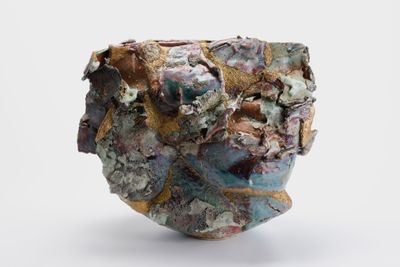
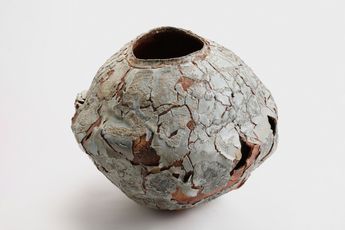
Yuji Ueda‘s Untitled at BLUM
Yuji Ueda’s ceramic, Untitled, has compelling contrasts, featuring rough, textured surfaces juxtaposed with smooth, polished areas.
The work’s irregular surface—ranging from lumpy, cracked, and blistered to grainy, gritty, porous, and smooth—imbues it with complexity, suggesting a dialogue between chaos and craftsmanship. It evokes a celestial quality, resembling a fragment from outer space, perhaps a piece of a planet or star fallen into Earth’s orbit.
The work reveals a spectrum of organic hues—earthy browns, ochres, and greys—interspersed with purple-blue tones reminiscent of petrol slicks. Segments of thick, milky glaze accumulate in alcoves, adding depth to the piece.
Ueda’s harmonious blend of textures and colours invites tactile exploration and showcases his mastery in exploring the infinite possibilities of ceramics.
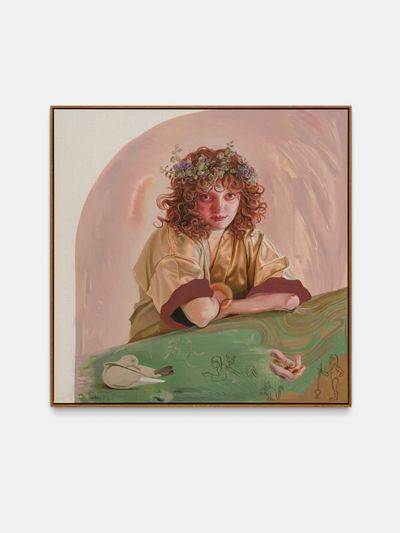
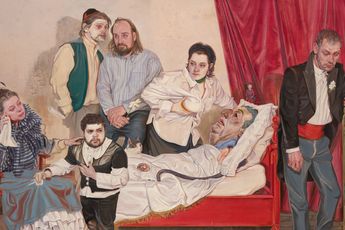
Kati Heck‘s Dr. Putti II (Deal für ‘s Morgenrot) at Sadie Coles HQ
Ocula Advisors have long admired Kati Heck’s paintings, which blend the styles of Old Masters like Hieronymus Bosch with those of 20th-century painters such as Alice Neel.
Her charming yet enigmatic portraits are filled with intriguing symbols.
In Dr. Putti II (Deal für ‘s Morgenrot), a young woman sits at a table with a flower crown in her hair. From the table, a hand—not the subject’s—emerges, nails painted the same green as the table, above which a bird with folded wings rests beside a ring and drawings.
The subject’s direct gaze, glassy eyes, and pink complexion amplify the uncanny feeling, reminiscent of scenes from horror films.
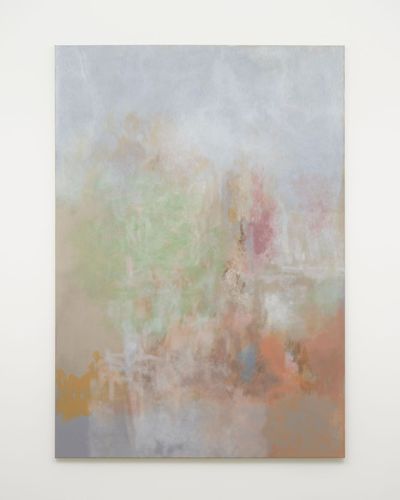
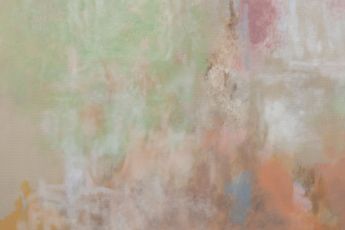
Hiroto Tomonaga‘s In the distance at KOSAKU KANECHIKA
Hiroto Tomonaga’s soft-hued paintings resemble distant landscapes obscured by mist, haze, or dappled light.
The Japanese artist strives to capture transitory moments, fascinated by perceptual shifts within a painting as the eye darts between foreground and background.
His work reflects this back and forth through layering and erasing marks with oil and tempera. Through this process, the painter captures depth and distance on canvas in a way that implies swirling mist.
In the distance (2024), pastel tones of green, pink, and orange, melt and blend against a serene backdrop of pale blue.

Chien-Ying Tseng’s Airing at Each Modern
Chien-Ying Tseng uses traditional Chinese ink to depict contemporary perceptions of the human figure. Blending classical techniques with modern themes, his portraits honour tradition while celebrating individual and collective identities.
The Taiwanese artist’s works often feature bold contours, vivid colours, and expressive details. Deeply influenced by Buddhist art, his paintings reveal glimpses into human desires, such as longing, ambition, love, and inner conflict, through detailed expressions, actions, and gestures.
Airing (2024) is subtler, showing the profile of a figure with flowing black hair, slight wrinkles, rosy cheeks, and weary eyes. Tseng’s delicate brushwork captures her exhaustion, with fine lines highlighting the weariness etched into her face.
Discussing his work, Tseng explains, ‘I want to use a kind of individual perspective to get to the society and era, and try to show the appearance of human existence. I want to discuss the state of “people” in the phenomenon, not the social phenomenon itself.’
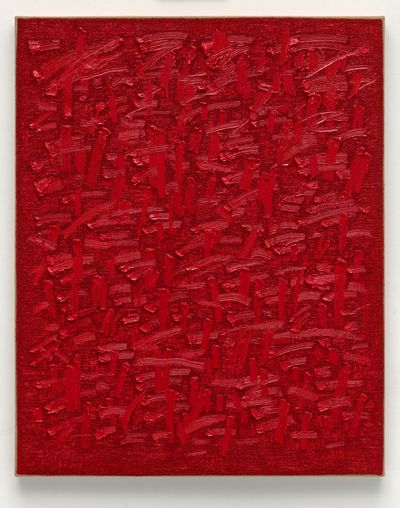
Ha Chong-Hyun‘s Conjunction 23-26 at Almine Rech
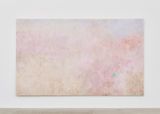
Ha Chong-Hyun is celebrated for pioneering abstract art in postwar South Korea, particularly through Dansaekhwa—a monochromatic style that emerged in the late 1960s and 70s, focusing on process, tactility, and surface.
His ‘Conjunction’ paintings, begun in the early 1970s, are created using his labour-intensive technique of bae-ap-bub. This involves pushing paint through the coarse weave of burlap from the back to the front, creating distinct textures that highlight the materiality of the painting surface, giving it an almost sculptural quality.
In a 2017 interview with Ocula, Ha Chong-Hyun explained, ‘I have continuously used the title ‘Conjunction’ since the early 1970s, because it is really the essence of my work: the conjunction between the materials—oil paint and hemp cloth—and my spirit and performance.’
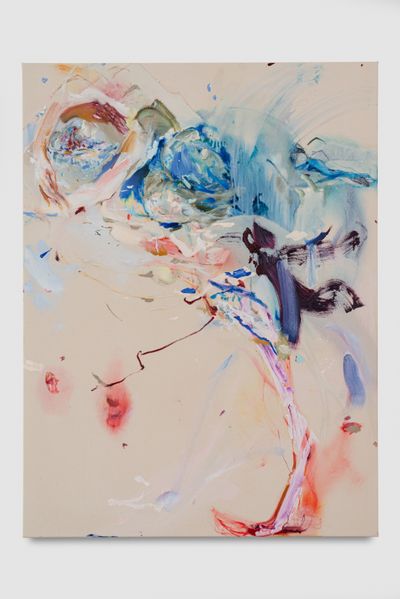
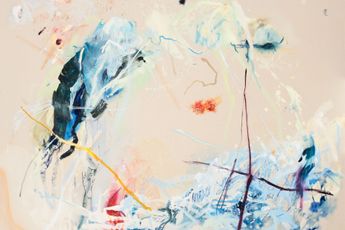
Araminta Blue‘s Mirror pool at rosenfeld
Araminta Blue considers her paintings as sanctuaries detached from reality.
The Cypriot-born, London-based artist and graduate from Slade School of Art’s Painting MFA makes large-scale works distinguished by bold, gestural brushstrokes and rich palettes that range from intense, saturated hues to subtle, muted tones.
She transforms oil paint, diluting it to mimic watercolours, and applies it in washes, scrubbing, slicking, and scratching it with rags or thickening it to a cement-like consistency.
Amid translucent layers and visibly scrubbed-out marks, human figures emerge—their hands outstretched, faces floating in negative space, with bloated bellies. These bodies appear fragmented and vulnerable, with some parts missing or disintegrating into the background. Others assert themselves boldly with bright colours and vigorous brushstrokes.
In Mirror pool (2024), the figure is elusive. Long strokes of white and pink hint at a leg extending from a swirl of colour and energetic marks, evoking a body immersed in water, blending into its fluidity. —[O]
Selected Artworks
Main image: Tseng ChienYing, Airing (2024) (detail). Ink and colours on paper, mineral pigments. 95.5 x 140 cm. Courtesy Each Modern, Taipei.










A respected voice in contemporary art discourse.
Focusing on ambitious storytelling and insightful art-world commentary. Ocula Magazine publishes in-depth interviews, critical essays and timely analysis on the artists, exhibitions and ideas driving the global art world.
Learn more about Ocula Magazine
Showcasing the best of the art world.
Ocula partners with galleries from around the world to highlight their artists, artworks and exhibitions. Gallery membership is by application and invitation, with each member vetted by an independent panel.
Learn more about Ocula Membership
Specialises in the sale of major artworks.
Led by a team with deep ties to the world’s leading auction houses, galleries and collectors. Ocula’s advisory team offers bespoke services to high-net-worth clients from around the world who are looking to acquire the best of contemporary and modern art.
Learn more about our team and services