




CASSI NAMODA
b. 1988, MozambiqueThrough figurative paintings packed with personal, cultural, historical, and theological references, contemporary artist Cassi Namoda weaves together complex post-colonial narratives that cross geographical, temporal, and spiritual borders.
Early life and Influences
Cassi Namoda’s biography strongly resonates with her work. Born to a Mozambican mother and an American father in Maputo, Mozambique, she grew up travelling around the world and experiencing different cultures. Along with her travels, African films were a prominent early influence. Namoda studied film at the Academy of Art University in San Francisco, graduating with a BFA in cinematography.
Cassi Namoda’s partner Henry Taylor, an established American painter, is credited by the artist with encouraging Namoda to return to painting, an interest Namoda held in childhood before pursuing film and fashion.
Seminal Paintings
Now based in the United States, Cassi Namoda’s artistic output is a culmination of her personal connection to Mozambique and broader African and global cultures experienced during her travels.
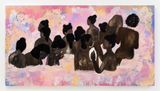
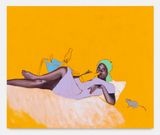
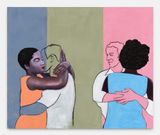
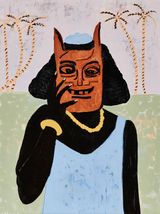
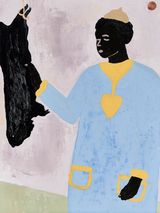
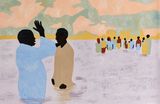
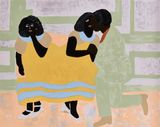
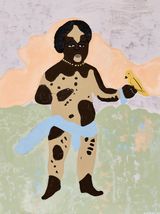
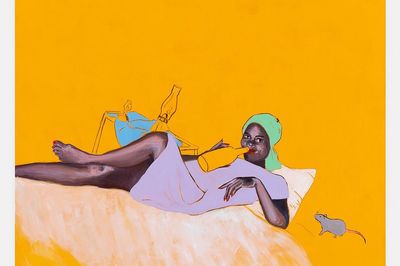
Namoda’s paintings are like film stills that capture scenes from a larger narrative, with many cultural and spiritual connotations. They are snapshots of both banal and life-changing moments, formal and informal social activities.
Within these scenes, Namoda builds a nuanced image of post-colonial Mozambique, exploring themes of family, identity, and spirituality. Using East African proverbs for titles, the artist gives further depth to the complex myriad of references that forms the content of the images.
Painting from scratch, Namoda references archival photographs, personal memories, literature, history, and art history. Just as Namoda collapses time by melding contemporary and historic imagery, so too does she fuse spiritual imagery and with earthly narratives.
In A young family departs Pemba, in search of safety and compassion (2020), there are spiritual elements as a pregnant woman with angel-like wings and a man wheeling a bicycle follow a pink road towards a black and gold cosmos filled with planetary forms.
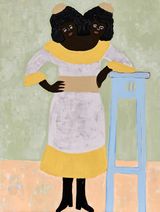
Earlier works, like Sasha and Zamani’s Tropical Romance (2018) and The Joy of Love (2019), are painted with thick black outlines, which later give way to a softer handling of lines. In later works, figures gaze out at the viewers from an evocative backdrop of shifting colours that pushes the figures to the foreground. Background tones and colour subtly convey the inner emotions of the scene.
Repeating motifs and characters can be found across Namoda’s works, such as a red chair, used as a religious symbol, and a circular moon that appears in the corner of several of her works. Recurring characters include Maria, a personification of Mozambique and the brutalised women uninterested in the country’s war of liberation, and a pair of conjoined twins, inspired by the ill-fated Christine and Millie McKoy. In Cassi Namoda’s interview for BOMB, she explains, ‘it’s almost divine when I’m working with figures and they start to form themselves. It would be a waste not to bring them back.’
Performance Art
Alongside her painting, Namoda also stages performances relating to themes present across her works. Cassi Namoda’s Pippy Houldsworth exhibition, Little is Enough For Those in Love (2020), featured an activation of her installation Tea of Nostalgia (2019), in which the artist served Mozambican tea in a colonial tea set—a non-verbal statement that sets herself within her family history.
Exhibitions
Cassi Namoda’s solo exhibitions include Little is Enough For Those in Love, Pippy Houldsworth Gallery, London (2020); The Day a Monkey is Destined to Die All Trees Become Slippery, François Ghebaly, Los Angeles (2019); Outside the Witch Doctor’s House, Nina Johnson Gallery, Miami (2018); and Cassi Namoda, Harper’s Books, Hamptons, New York (2017).
Namoda’s group exhibitions include American Women: The Infinite Journey, La Patinoire Royale-Galerie Valérie Bach, Brussels (2020); LA Dreams 2, CFHILL, Stockholm (2019); and Coping Mechanisms, Library Street Collective, Detroit (2018).
Further information
Cassi Namoda’s Instagram can be found here.
Michael Irwin | Ocula | 2021
























Explore and Follow Artists Shaping Contemporary Art
A respected voice in contemporary art discourse.
Focusing on ambitious storytelling and insightful art-world commentary. Ocula Magazine publishes in-depth interviews, critical essays and timely analysis on the artists, exhibitions and ideas driving the global art world.
Learn more about Ocula Magazine
Showcasing the best of the art world.
Ocula partners with galleries from around the world to highlight their artists, artworks and exhibitions. Gallery membership is by application and invitation, with each member vetted by an independent panel.
Learn more about Ocula Membership
Specialises in the sale of major artworks.
Led by a team with deep ties to the world’s leading auction houses, galleries and collectors. Ocula’s advisory team offers bespoke services to high-net-worth clients from around the world who are looking to acquire the best of contemporary and modern art.
Learn more about our team and services