Press Release

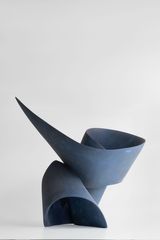
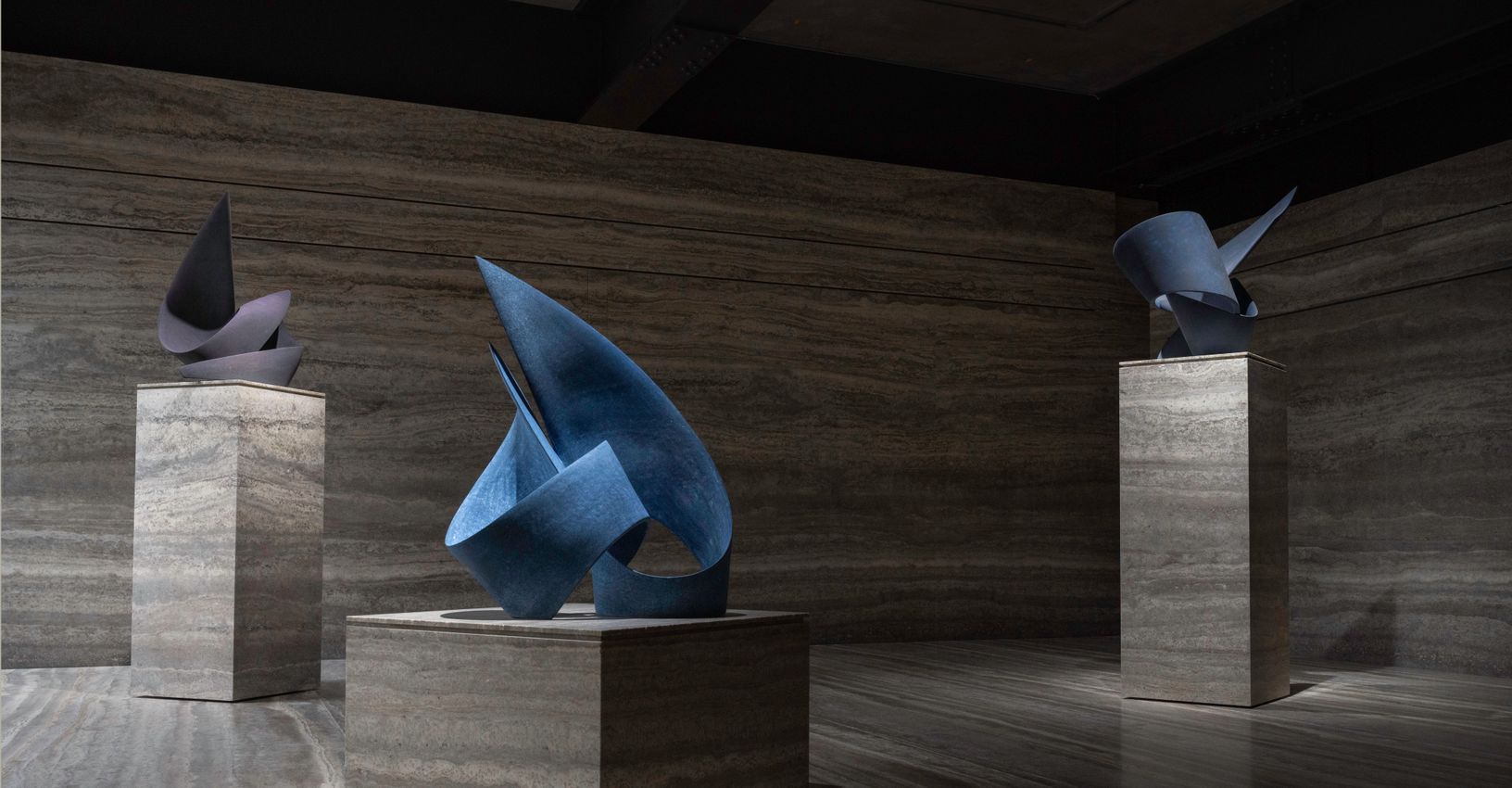
Is it an antithesis to the potter’s wheel? Or an attempt to defy gravity? Neither. It is born from a simple, irrepressible desire to see the landscapes that lie beyond the ridges yet unseen. With such longing, ceramic artist Kanjiro Moriyama bids farewell to the potter’s wheel that has defined his practice for decades, stepping instead into the uncharted territory of hand-building. For there is only one direction in which an artist should move—forward. His aspiration lives within those sharp yet gentle curves, cutting through the air as though reaching toward the heavens themselves.

Looking back, I realise the signs were already there. It was December of 2020, during Moriyama’s fourth solo exhibition at Kanata, held in the midst of the pandemic. Beneath the cold winter sky, the gallery was painfully quiet. Visitors came only sporadically, and I remember feeling an overwhelming sense of frustration—not because the exhibition lacked anything, but because it possessed everything. Our gallery in Nishi-Azabu was filled with what I believed to be the culmination of a young artist’s extraordinary journey. Each work stood with remarkable confidence, and together they formed an exhibition of breathtaking beauty.

Late one evening, after everyone had gone home, I wandered through the silent gallery alone. I stood before the works for what felt like an eternity, mesmerised by the luminous ridge lines that emerged beneath the moonlight. That memory has never left me. Perhaps that is why it still lingers so vividly in my mind’s eye. The exhibition sold out, for which I remain deeply grateful. Yet what saddened me was knowing that so few people had the chance to experience that same moment of wonder. During those dark and uncertain days, there was simply nothing to be done.

Nearly six years have passed since. And now, at last, Moriyama’ s long-awaited new exhibition, SHIN / RISE, is finally before us. Those six years were anything but idle. During that time, Moriyama became the father of three children and grew, both in reputation and in spirit, into one of Kanata’s defining artists. As a rural artist based in Koishiwara yet deeply inspired by the great Sueharu Fukami, I still remember the young 28-year-old knocking on our door, armed with little more than talent and an unproven conviction. Since then, we have shared countless battles together. We have weathered uncertainty, celebrated triumphs, endured disappointments, and continued forward side by side.

Growth is never linear. Like the graceful curves that have become Moriyama’s signature, the path of an artist bends, circles back upon itself, and finds its way only through countless detours. Yet somehow, with each and every turn, it is forward that we persevere.

No matter how extraordinary his achievements became through his unparalleled mastery of the wheel and the kiln, Moriyama never allowed himself to become satisfied. Instead, he chose to aim higher still. And in pursuit of greater freedom in form, he did not hesitate to abandon the very technique that had become synonymous with his name.

Technique, after all, is only a means to an end. It is never the final destination. And the road ahead demanded far more than learning a new method of shaping clay. Every aspect of his practice—forming, firing, even the chemistry of his myriad glazes—had to be reconsidered from the ground up. That six years have passed is hardly surprising. Such a transformation cannot be accomplished through sheer perseverance alone. And yet, underneath every change, the currents that have always sustained his work remain untouched: his elegant sense of beauty.

Now the curtain rises on the next chapter of an artist who, despite every accolade, has never mistaken achievement for arrival—who remains as humble as he is ambitious, and whose gaze has never ceased looking toward the horizon beyond. The world feels a little brighter than it did six years ago. Kanata, too, has entered a new chapter. And within our new home in Omotesando, the moonlit edges of Moriyama’s latest works once again invite us to look beyond what we know. To believe in what lies over the next horizon.

For Kanjiro Moriyama, a new dawn rises yet again.

Text by Wahei Aoyama | A Lighthous Called Kanata

Read More

Installation Views

Also Exhibiting at A Lighthouse called Kanata

About the Gallery
A Lighthouse called Kanata pursues the reevaluation of contemporary Japanese art in the 21st century, thereby expanding the boundaries of contemporary art from a diversified, multi-ethnic perspective. Through the innovation of aesthetic traditions, Kanata focuses on abstract paintings and sculptures by both Japanese and international artists, reimagining beauty through an emphasis on materiality and technical excellence. The Tokyo gallery hosts multiple exhibitions as well as participating at major fairs throughout the world, while further enriching its program with publications that capture both emerging and established artists. Kanata also partners with leading international institutions such as the Metropolitan Museum (NY), the V&A (London), and the Rockbund and Long Museums (Shanghai), among others, creating critical platforms for the recognition of the gallery’s aesthetic. Kanata has moved into its own dedicated 4-story building in October 2025 designed by Yoshiyuki Moriyama, with interiors conceived by the rising design duo I IN.
View Gallery Profile
Address
3-5-7 Jingumae
Shibuya-ku
Tokyo
Japan
Opening Hours
Tuesday - Saturday
11am - 6pm and by Appointment

Closed Sundays, Mondays and National Holidays.
(1)
Tokyo 3-5-7 Jingumae, Shibuya-ku
A Lighthouse called Kanata
3-5-7 Jingumae, Shibuya-ku, Tokyo, Japan

Opening hours
Tuesday - Saturday
11am - 6pm and by Appointment

Closed Sundays, Mondays and National Holidays.
The art world in focus