




VERONICA RYAN
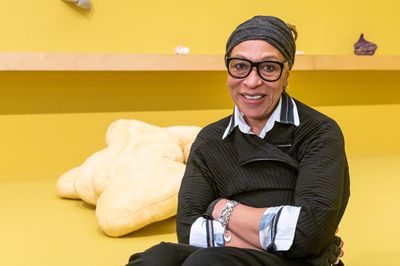
b. 1956, MontserratA Turner Prize–winning artist, Veronica Ryan OBE RA is a British sculptor best known for tactile assemblages and installations that transform and reference everyday objects—fruits, seeds, textiles and found containers—into poetic meditations.
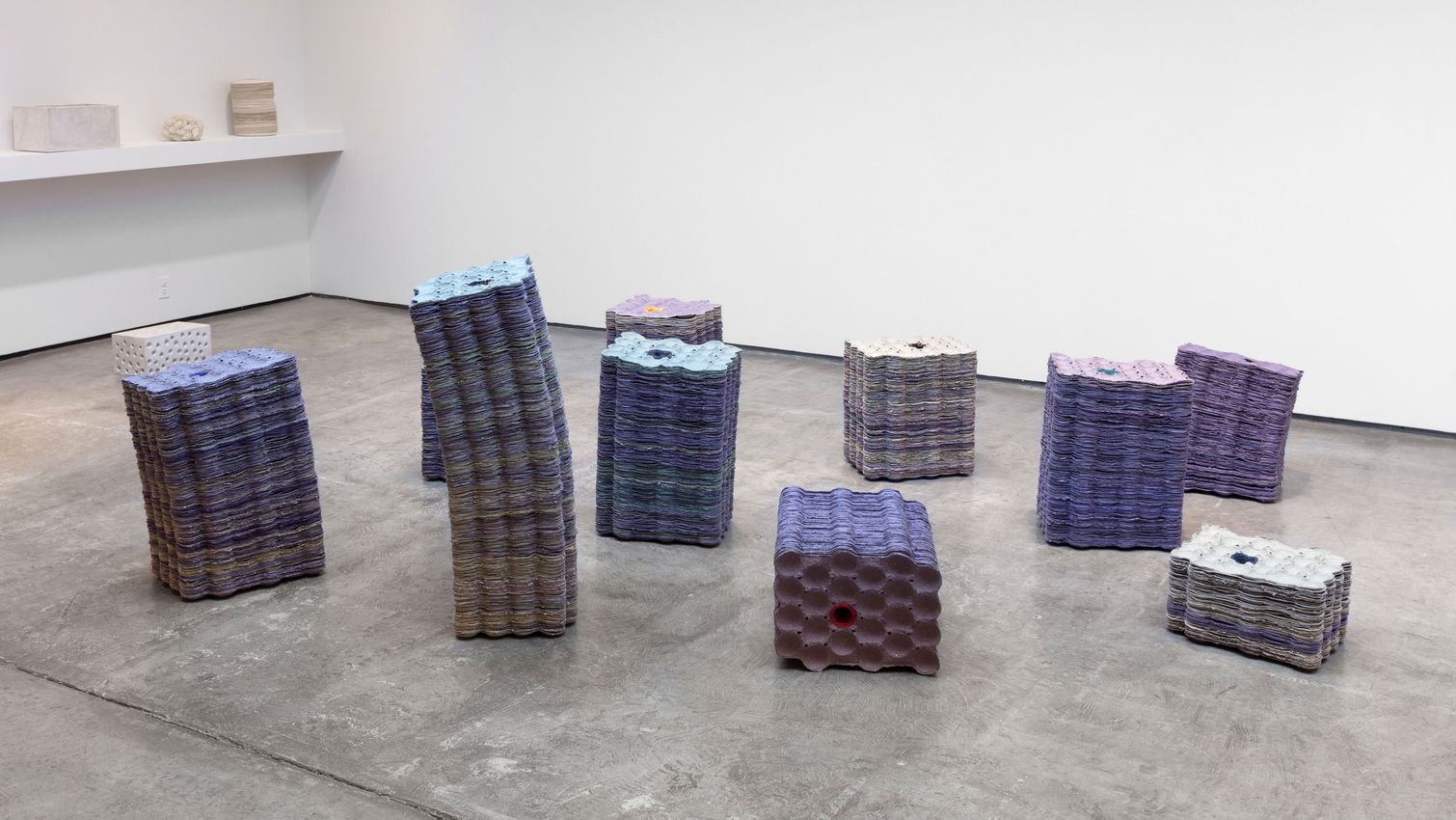
Working across sculpture, textiles and works on paper, Ryan often casts or wraps Caribbean produce, domestic packaging and medical supports into fragile, suspended configurations. Ryan’s recent highlights include the UK’s first permanent Windrush memorial in Hackney and the major survey Veronica Ryan: Multiple Conversations at Whitechapel Gallery (1 April–14 June 2026), which brings together more than four decades of work alongside new large-scale pieces such as Totem (2025–26). She has also developed a distinctive language of “unruly objects” in exhibitions at the Pulitzer Arts Foundation and Wexner Center for the Arts, and her work is represented in collections including Tate, the Brooklyn Museum and the Arts Council Collection.
Early life and Career
Born in 1956 in Plymouth, Montserrat, Ryan moved to England as an infant and grew up in Watford, where her mother’s sewing, quilting and repurposing of flour and sugar sacks quietly modelled how modest materials could be transformed and cherished. She went on to study at St Albans, Bath Academy of Art and the Slade School of Fine Art, before undertaking further study at the School of Oriental and African Studies, where she deepened her interest in non-Western art histories and the cultural lives of objects. In 1980 she travelled to Nigeria on the Boise Travelling Scholarship, immersing herself in Yoruba and other West African contexts where everyday things—from foodstuffs to bottles and textiles—serve as ritual offerings and containers of spiritual force, an experience that decisively shifted her thinking about sculpture.
Ryan came of age as an artist alongside the British Black Arts Movement of the 1980s. Invited by Lubaina Himid, she exhibited in key shows including Black Women Time Now at Battersea Arts Centre, London (1983), The Thin Black Line at the Institute of Contemporary Arts, London (1985), and From Two Worlds at Whitechapel Art Gallery, London, and the Fruitmarket Gallery, Edinburgh (1986), aligning her practice with wider anti-racist and postcolonial debates. A residency at Kettle’s Yard and Jesus College, Cambridge, in 1986–87 allowed her to test how vulnerable, stitched and cast forms might inhabit architectural space, and led to early solo exhibitions and curatorial projects that placed her work in dialogue with artists such as Zarina Bhimji and Mona Hatoum
Over subsequent decades Ryan developed a studio-based practice between the UK and, later, New York, threading her work around periods of teaching, caregiving and illness while continuing to refine a materially sensitive language of containers and enclosures. Drawing on Caribbean heritage, West African experiences and wider diasporic histories, she began to reframe sculpture as a site of psychological as well as ecological inquiry, attentive to how personal memory intersects with environmental change. Long working under the radar of the mainstream art world, she gained renewed institutional attention with the Freelands Award (2018), which enabled the large-scale survey Along a Spectrum at Spike Island, Bristol, in 2021 and laid the groundwork for her Turner Prize win.
Works, Materials and Methods
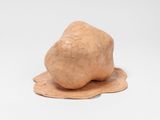
Ryan’s sculptures typically begin with modest, often perishable materials—fruit stones, seed pods, orange peel, nets, sacks, packaging and domestic textiles—that she casts in bronze, plaster or ceramic, wraps in thread and fabric, or suspends in nets and wire structures. These elements function as containers of memory, linked to Caribbean food cultures, migration routes and family histories, while also evoking wider systems of trade, extraction and ecological fragility. Works are frequently grouped, stacked or partially concealed, prompting viewers to consider what is protected, what is exposed and what is lost in processes of displacement and recollection.
A key example of her public work is the Hackney Windrush commission—Custard Apple (Annonaceae), Breadfruit (Moraceae) and Soursop (Annonaceae) (2021)—a trio of over-scaled bronze and marble fruits installed as the UK’s first permanent monument to honour the Windrush generation. Cast from Caribbean produce and carefully sited in public space, these sculptures monumentalise everyday foods while foregrounding histories of migration, resilience and contribution; the work received the 2022 Marsh Award for Excellence in Public Sculpture. In gallery contexts, Ryan often assembles trays, crates, cushions and medical supports with casts of fruit and plant forms, suggesting provisional systems of storage, rest and care.
Recent projects have highlighted her interest in “unruly” or “flamboyant” objects—plastic bottles, nets, teabags and yoghurt pots rendered in fragile or precious materials that resist fixed categorisation. In Homage (2023–24), orange peel and garden wire act as a wrapper for a small bronze sculpture, while What is left behind (2024) encases everyday containers and plastic tops in nets and crocheted cotton, turning each vessel into a carrier of multiple thoughts and overlapping realities. Multiple Conversations at Whitechapel Gallery extends this logic across more than 100 works, juxtaposing rediscovered 1980s pieces in plaster and beaten lead with new works such as the towering clay and plaster sculpture Totem (2025–26), derived from casts of stacked plastic bottles. Across these installations, Ryan halts objects on their passage from utility to discard, turning them into metaphors for consumption, interconnectedness and ongoing care.
Themes and Context
Ryan’s practice turns on themes of memory, trauma and repair, articulated through a recurring vocabulary of containers, seeds and enclosures that suggest vulnerability as much as protection. Foods and plants associated with Caribbean and wider diasporic communities recur as sculptural motifs, connecting intimate stories of family, migration and mourning with larger histories of empire, trade and ecological disruption. Her idea of residues, traces and deposits—the psychological sediment that experience leaves behind—underpins an approach in which sculpture gives form to what persists at the edges of consciousness and historical record.
She is particularly interested in how objects, like people and communities, are altered by their surroundings: corroded by rust or water, marked by dirt, or shaped by inherited habits, social expectations and structures of power. Containers—boxes, pouches, pockets—recur across her work as open-ended sites of possibility, both protective and exposing. Situated within postcolonial and Black British art histories, her practice resonates with feminist and diasporic approaches that mobilise everyday materials to confront structural violence while cultivating forms of care. An early encounter with Eva Hesse‘s work at Whitechapel in 1979 helped shape her sculptural vocabulary of fragility, repetition and the dynamic between control and contingency, while her sustained focus on environmental questions and botanical forms places her in dialogue with contemporary debates on climate crisis, biodiversity loss and the politics of the natural world.
Positioned within postcolonial and Black British art histories, Ryan’s work aligns with feminist and diasporic practices that mobilise everyday materials to confront structural violence and cultivate forms of care. An early encounter with Eva Hesse’s work at Whitechapel in 1979 helped shape her sculptural vocabulary of fragility, repetition and the push–pull between control and contingency. Her sustained attention to environmental questions and botanical forms, meanwhile, places her in active dialogue with contemporary debates on climate crisis, biodiversity loss and the politics of the natural world.
Exhibitions, Collections and Recognition
Over a four-decade career, Ryan has been the subject of numerous exhibitions and residencies. Key recent solo presentations include:
- Veronica Ryan: Multiple Conversations, Whitechapel Gallery, London (2026);
- Veronica Ryan: Unruly Objects, Pulitzer Arts Foundation, St Louis, and Wexner Center for the Arts, Columbus (2025–ongoing);
- Along a Spectrum, Spike Island, Bristol (2021).
Important group exhibitions include Whitney Biennial 2022: Quiet as It’s Kept, Whitney Museum of American Art, New York (6 April–5 September 2022); A Clearing in the Forest, Tate Modern, London (2022); and Breaking the Mould: Sculpture by Women since 1945, an Arts Council Collection touring show (2021–23).
Ryan’s work is held in major public collections, including Tate, the Brooklyn Museum, the Arts Council Collection, Contemporary Art Society, the Hepworth Wakefield, the Sainsbury Centre and the Weltkunst Collection at the Irish Museum of Modern Art. Her accolades include the Freelands Award (2018), a Pollock-Krasner Grant (2019) and the Turner Prize (2022), awarded for her Spike Island exhibition and the Hackney Windrush monument. She is an OBE and a Royal Academician, and lives and works between New York and the UK.
Veronica Ryan FAQs
What is Veronica Ryan best known for?
Veronica Ryan is best known for her sculptural assemblages and installations that transform fruits, seeds, textiles and found containers into meditations on memory, migration and the environment, as well as for the Hackney Windrush monument and her Turner Prize–winning practice. Her work often focuses on Caribbean flora and everyday objects, recast in bronze, plaster and textile to explore histories of displacement and care.
What themes does Veronica Ryan explore in her work?
Veronica Ryan’s work explores memory, trauma, repair and the legacies of colonialism through recurring motifs of containers, seeds and botanical forms. She links personal narratives of Caribbean heritage and migration to wider ecological and historical concerns, asking how everyday objects store emotional and political histories.
Why is Veronica Ryan’s practice significant today?
Veronica Ryan’s practice is significant for the way it brings together postcolonial, ecological and feminist perspectives in a materially sensitive sculptural language. At a time of renewed attention to the Windrush generation, racial justice and environmental crisis, her works offer nuanced reflections on how histories are carried—and sometimes repaired—through the most ordinary objects.
Where can I see Veronica Ryan’s work?
Veronica Ryan’s sculptures are in major collections including Tate, the Brooklyn Museum, the Arts Council Collection, Contemporary Art Society, the Hepworth Wakefield, the Sainsbury Centre and the Weltkunst Collection at IMMA. Current and upcoming opportunities include institutional surveys such as Veronica Ryan: Multiple Conversations at Whitechapel Gallery (2026).
What is Veronica Ryan’s Hackney Windrush monument about?
The Hackney monument—Custard Apple (Annonaceae), Breadfruit (Moraceae) and Soursop (Annonaceae)—uses enlarged Caribbean fruits cast in bronze and marble to honour the Windrush generation in London. By monumentalising these foods in public space, Ryan celebrates diasporic culture and acknowledges the complex histories of migration, labour and resilience tied to Britain’s Caribbean communities.
Ocula | 2026









Explore and Follow Artists Shaping Contemporary Art
A respected voice in contemporary art discourse.
Focusing on ambitious storytelling and insightful art-world commentary. Ocula Magazine publishes in-depth interviews, critical essays and timely analysis on the artists, exhibitions and ideas driving the global art world.
Learn more about Ocula Magazine
Showcasing the best of the art world.
Ocula partners with galleries from around the world to highlight their artists, artworks and exhibitions. Gallery membership is by application and invitation, with each member vetted by an independent panel.
Learn more about Ocula Membership
Specialises in the sale of major artworks.
Led by a team with deep ties to the world’s leading auction houses, galleries and collectors. Ocula’s advisory team offers bespoke services to high-net-worth clients from around the world who are looking to acquire the best of contemporary and modern art.
Learn more about our team and services