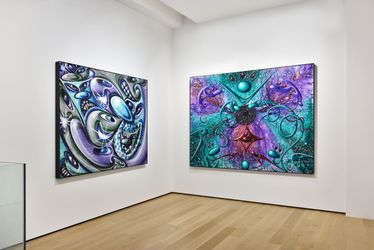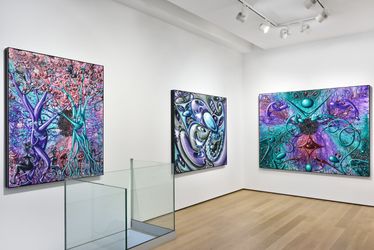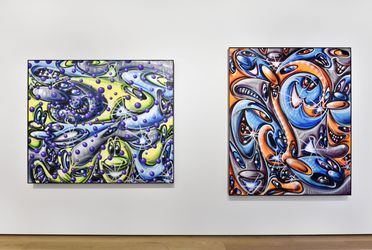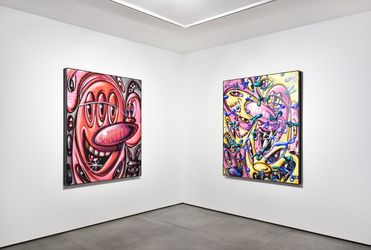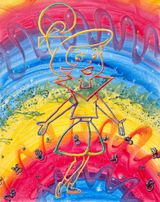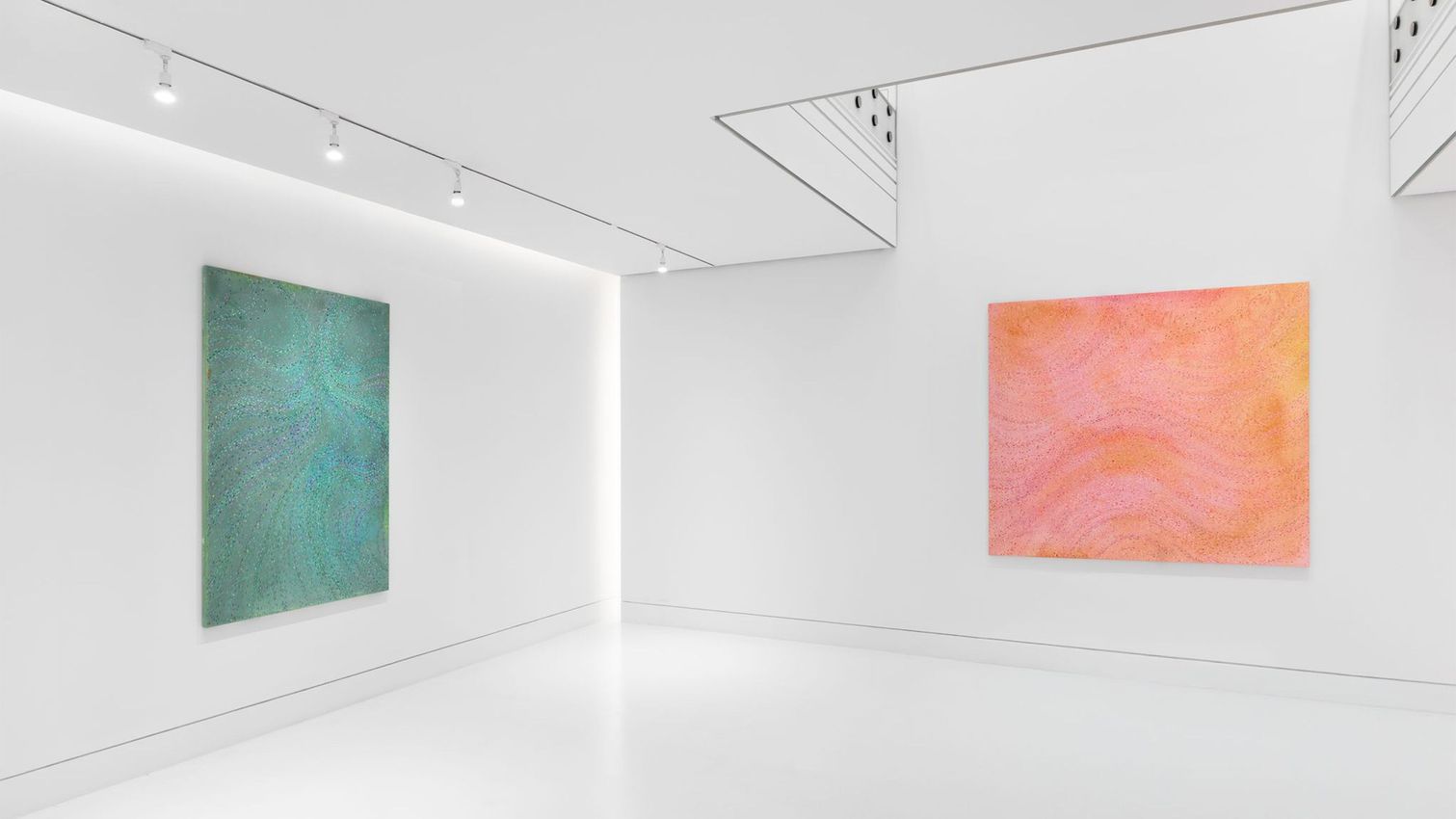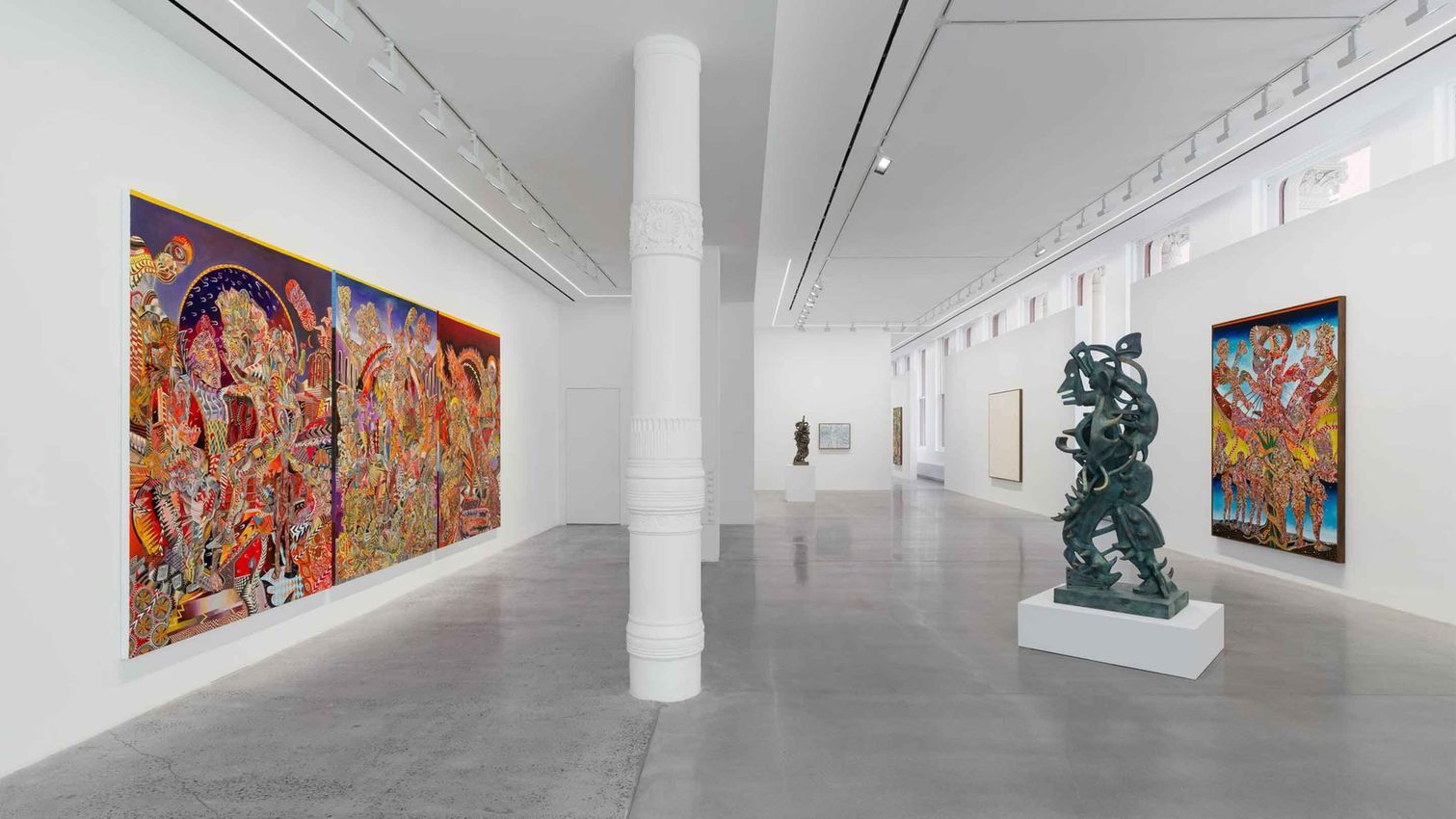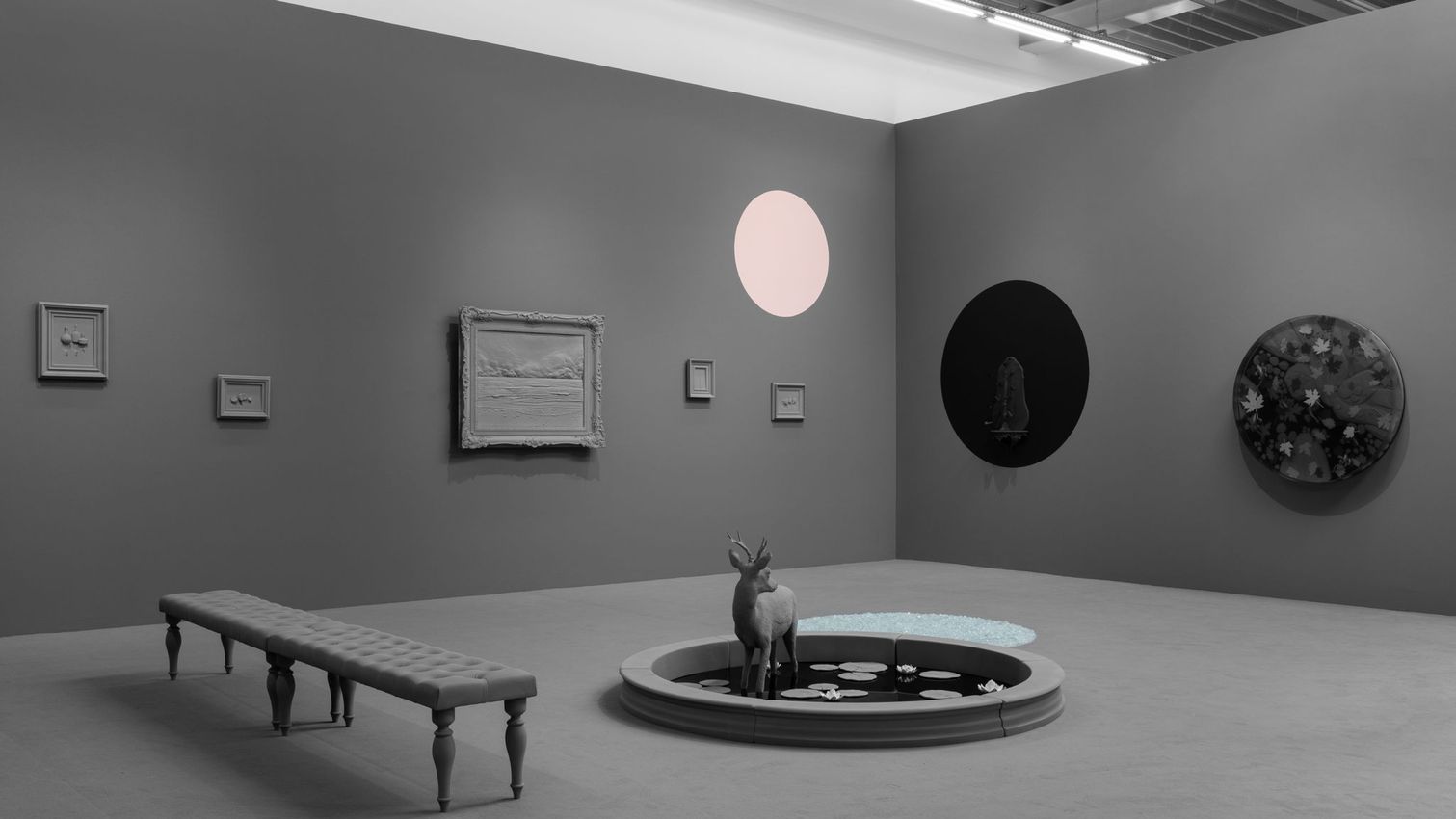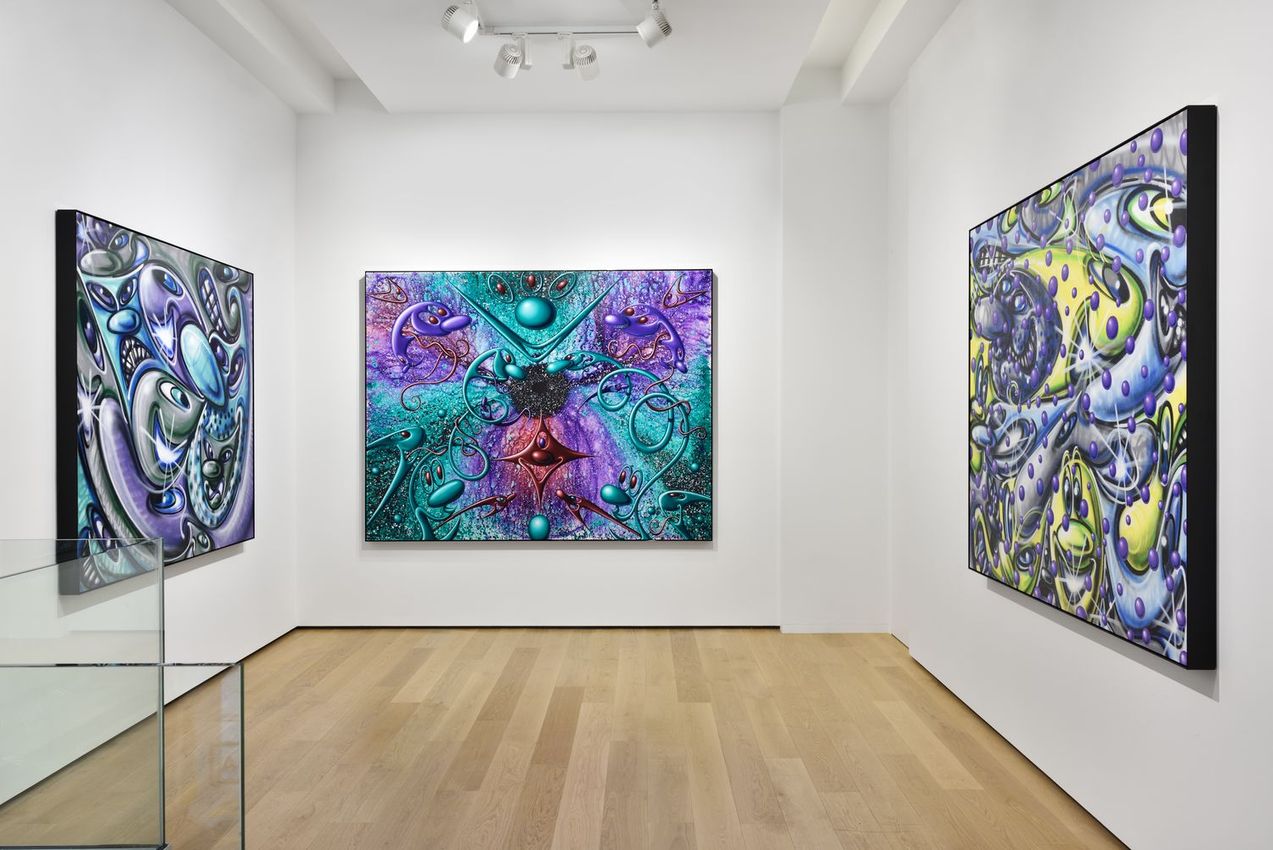
Due to the pandemic, Kenny Scharf will not be present for his second solo show at Almine Rech. However, as he continued to produce art in his Los Angeles studio in the middle of December, he said he was happy with the freshness of his new paintings. ‘It’s always very exciting for me to show work that’s so recent, and even though I can’t be there, the viewers will see how new it is,’ he said. Since the early 1980s, Kenny Scharf has been extremely productive and loves working on his art. Without thinking of subject matter ahead of time or restricted narrations, he develops a vocabulary that combines the influence of 1960s cartoons—particularly the Flintstones and the Jetsons—and psychedelic shapes resembling cells, bacteria, or even viruses (an interpretation that seems especially apt at the current time). During his first show at Almine Rech, which took place in September and October 2020 in New York, art critic Linda Yablonsky drew a parallel between the Covid years and the AIDS era. Back then, Kenny Scharf lived with Keith Haring, where Jean-Michel Basquiat often joined them to spend time together. He remembers it as a place of convening energies and a ping-pong game of ideas before the loss of his friends. Faced with tragedy, he decided that he would primarily show the whirlwind aspect of life, filled with bright colours. Whether they are cathartic, extending moments of ecstasy, or expressing gloom, his paintings take on his moods.
This shows why he has such a pressing need to fill them, in an endlessly repeating all-over effect. This term clearly calls to mind Jackson Pollock, of whom Kenny Scharf is a big fan. ‘He marked the beginning of the expansion of another space. All-over painting confirms the extension of a world. It’s a background I can use, and sometimes I even throw paint on the canvas. I also like the way every detail reveals itself as a little window onto a huge universe, which could escape outside the painting. I perceive my paintings as fragments of unlimited bewilderment.’ From the idea of the rhizome, a very visual concept of roots leading to others, we are thrust back into the history of American abstract expressionism, which still inspires artists today. In fact, Kenny Scharf digs even deeper for his inspiration, with reminiscences of Arshile Gorky or Jean Dubuffet, who represented their psychological state in very dense paintings. Since the exhibition is in Paris, potential connections to the French scene come to mind. This suggestion led Kenny Scharf to recall that his work was shown in the 1980s alongside that of François Boisrond, Robert Combas, Hervé Di Rosa, and the Frères Ripoulin, who were connected with the Figuration Libre movement and graffiti. Scharf remembers this as a pop-rock scene with which he had stylistic affinities, even if he hasn’t seen them in three decades.
Ultimately, the important thing is always to work and create. Today, for example, Scharf paints a mushroom in a wild forest filled with naked people. He is perhaps in a less playful mood. He feels more inclined to expand a somewhat surrealistic world where images connected to galaxies are combined with depictions that evoke viruses or are simply formal, verging on abstraction. There are fewer clearly established connections with identified or recognised characters. In this way, he pursues a joyful dystopia or a disillusioned utopia, fluctuating between various emotions. Often, in fact, strength flirts with brutality, the warm colours become acid, and the vanishing lines jostle us or carry us off to an unknown universe, led by figures with sardonic smiles. Kenny Scharf describes himself as a politically committed artist, especially in this year of the American election and popular uprisings. Thoughtfully, he concludes that ‘real life is always more intense’ (a subtle tribute to Robert Filliou?). He remains deeply filled with the energy of the West Coast, where he has lived for twenty years and where he was born. While Los Angeles seems to be inhabited by individuals who circulate in isolation in their cars, moments of rebellion show a population rising up as it finds a shared destiny. Kenny Scharf feels the vitality of the collective and the elation of being in the right place, which he will interpret, one way or another, in his art.
Text by Marie Maertens, December 2020. Courtesy Almine Rech.


Kenny Scharf (b. 1958, United States) is a renowned artist affiliated with the 1980’s East Village Art movement in New York. Alongside his mentor Andy Warhol, and contemporaries like Jean-Michel Basquiat and Keith Haring, Scharf developed a distinct and uniquely personal artistic style. References to popular culture reoccur throughout his works, such as appropriated cartoon characters from the Flintstones and Jetsons, as well as imagined anthropomorphic creatures. Through ecstatic compositions and a dazzling color palette, Scharf presents an immersive viewing experience that is both intimate and fresh. Scharf’s multifaceted practice—spanning painting, sculpture, installation work, murals, performance and fashion—reflects his dedication to the creation of dynamic forms of art that deconstruct existing artistic hierarchies, echoing the philosophy of Pop artists. Yet Scharf’s artistic significance expands beyond the art historical terrain of Pop Art; the artist instead coined the term ‘Pop Surrealist’ to describe his one-of-a-kind practice. His inclusion in the 1985 Whitney Biennial marked the start of his international phenomenon, a reputation that continues to thrive today.


Almine Rech opened its doors on April 1st, 1997 in the 13th arrondissement in Paris. The gallery was founded on an axis of California Minimal, Perceptual art and Conceptual art, representing artists such as James Turrell, John McCracken and Joseph Kosuth.

A respected voice in contemporary art discourse.
Focusing on ambitious storytelling and insightful art-world commentary. Ocula Magazine publishes in-depth interviews, critical essays and timely analysis on the artists, exhibitions and ideas driving the global art world.
Learn more about Ocula Magazine
Showcasing the best of the art world.
Ocula partners with galleries from around the world to highlight their artists, artworks and exhibitions. Gallery membership is by application and invitation, with each member vetted by an independent panel.
Learn more about Ocula Membership

Specialises in the sale of major artworks.
Led by a team with deep ties to the world’s leading auction houses, galleries and collectors. Ocula’s advisory team offers bespoke services to high-net-worth clients from around the world who are looking to acquire the best of contemporary and modern art.
Learn more about our team and services