

KENNY SCHARF
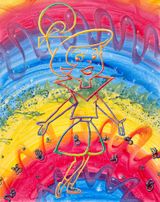
b. 1958, United StatesKenny Scharf came to prominence as part of the New York Downtown scene and the East Village Art movement of the 1980s yet has established a visual language that is entirely his own. His bright, colourful, gestural practice spans painting, sculpture, murals and installation, featuring cartoon-like figures (and the occasional appropriated character) and dynamic forms.
Early Years
Kenny Scharf was born in 1958 in Los Angeles. He has always seen faces in the objects around him (particularly the headlights and grilles of American cars) and was interested in cartoons from a young age, studying a book he found about how to draw them. “I don’t see [cartoons] as just for kids,” he said in 2025. “I look at [them] as a real communication, a universal language that transcends cultures and languages.” Scharf moved to New York City in 1978 and met Keith Haring and Jean-Michel Basquiat during his first week. Inspired by the city’s graffiti, and unable to gain gallery representation, Scharf, Haring and Basquiat made New York their canvas, working with graffiti artists. Scharf received his BFA from the School of Visual Arts in New York City in 1980, and the Times Square Show in the same year gave him a huge break.
Kenny Scharf: Artworks
Kenny Scharf’s Pop Surrealist art emerged from graffiti, placing blobs, faces and cartoon-like forms centre stage and breaking down boundaries between established ideas of “art” and popular culture. Inspired by space travel motifs from his 1960s LA childhood, as well as environmental concerns and the “background noise” of advertising, Scharf sometimes paints a utopian vision of the world, but also adds “evil” elements.
- Scharf has been inspired by the jungle since childhood. His Jungle Paintings were influenced by Rousseau’s tropical fantasies, as well as time he spent in Brazil during the early 1980s, in which he saw first-hand the impact of the clearing of the rainforests. Blues, greens and yellows dominate Junganity (2025), where flowers, spiders’ webs and intertwined stems morphing into human figures.
- The Cosmic Caverns series began in 1981 in a closet in the New York City apartment he shared with Keith Haring. Dark spaces are crammed with fluorescent items: everyday objects turned into cartoons, graffiti tags, and items found on the street. “I created this escapist environment out of the chaos,” he said. “It was my own little refuge from the outside world with this black light.”
- Scharf’s Dire Headlines paintings incorporate words taken from newspapers to discuss the ways human actions are impacting the environment. Speaking in 2026 about the combination of bright colours and serious messaging in the artworks, Scharf said he gave viewers a “choice” to read the information or look at the visual aspects and colours, adding: “I want people to pay attention [to the environmental destruction going on], but I don’t want to force it on them. You can simply enjoy the vibrant colours, or you can look deeper and recognise the serious issues beneath the surface. That’s exactly what the world we live in is like.”
Kenny Scharf: Select Exhibitions
Select Solo Exhibitions
- ShimiShimiKao, Nanzuka, Tokyo (2026)
- Jungle Jungle Jungle, Almine Rech, Brussels (2025)
- Kenny Scharf, The Brant Foundation, New York City (2024)
- Tout Suite, Almine Rech, Paris (2023)
- New! Now! Good!, Gallery Hyundai, Gangnam (2022)
- Kenny Scharf: Dystopian Painting, Almine Rech, New York City (2020)
- Kenny Scharf: Inner and Outer Space, Jeffrey Deitch, New York City (2017)
- Kenny Scharf: Born Again, Honor Fraser Gallery, Los Angeles (2015)
- Naturafutura, Paul Kasmin Gallery, New York City (2011)
- Kenny Scharf: NEW!, Paul Kasmin Gallery, New York City (2007)
- Kenny Scharf: Groovenian Drawings, Kantor Gallery, Los Angeles (2004)
- Kenny Scharf: Paintings 1990–1997, Cotthem Gallery_, Brussels (2003)
- Kenny Scharf: Hollywood Stars, Los Angeles Contemporary Exhibitions (2001)
- Heads and Small Paintings, Galerie Hans Mayer, Dusseldorf (1999)
- Kenny Scharf: Pop Surrealist, Salvador Dali Museum_, St Petersburg (1997)
- Kenny Scharf, Galerie 56 Budapest (1996)
- Kenny Scharf: Scharf-O-Rama 1978–1995, Museum of Art, Fort Lauderdale (1995)
- Kenny Scharf, Works on Paper , Galerie Burkhard R Eikelmann, Dusseldorf (1993)
- Kenny Scharf, Galeria Seno, Milan (1992)
- Kenny Scharf, Galerie Hans Mayer, Dusseldorf (1991)
- Kenny Scharf, Galerie Beaubourg, Paris (1990)
- Kenny Scharf, Michael Kohn Gallery, Los Angeles (1989)
- Kenny Scharf, Akira Ikeda Gallery, Tokyo (1988)
- Kenny Scharf, Tony Shafrazi Gallery, New York City (1987)
- Kenny Scharf, Akira Ikeda Gallery, Tokyo (1986)
- Kenny Scharf, Galerie Bruno Bischofberger, Zurich (1985)
- Kenny Scharf, Gagosian, Los Angeles (1984)
- Kenny Scharf, American Graffiti Gallery, Amsterdam (1983)
- Kenny Scharf, Fun Gallery, New York City (1982)
- Kenny Scharf: National Studio Artists, PS1 Contemporary Art Centre, New York City (1981)
- Kenny Scharf: Celebration of the Space Age, Club 57, New York City (1979)
Select Group Exhibitions
- X, Totah, New York City (2026)
- Multiverse, Baik Gallery Jakarta (2024)
- City as a Studio, Deitch Hong Kong (2023)
- Beyond the Streets, Brooklyn, New York City (2019)
- Fast Forward: Painting from the 1980s, Whitney Museum of American Art, New York City (2017)
- Virginia MOCA, Virginia Beach (2013)
- Thank You, Andy Warhol, Benrimon Contemporary, New York City (2012)
- Primary Flight, Art Basel Miami (2009)
- Surrealism Then and Now, Paul Kasmin Gallery, New York City (2006)
- Splat, Boom, Pow, Contemporary Arts Museum, Houston (2003)
- Made in the USA 1970–2000, Ludwig Galerie, Oberhausen (2002)
- Art and Provocation: Images from Rebels, Boulder Museum of Contemporary Art (1997)
- New Figuration, Tucson Museum of Art (1996)
- Art, Design and Barbie, Liberty Street Gallery, New York City (1995)
- 1982–1983: Ten Years After, Tony Shafrazi Gallery, New York City (1993)
- Balade de l’Amour Halle de l’Uniondes arts Decoratifs, Palais de Louvre, Paris (1992)
- American Art of the 1980s, Palazzo delle Albere, Trento (1991)
- The Last Decade: American Artists of the 1980s, Tony Shafrazi Gallery, New York City (1990)
- The Studio American Collection, Witkacy Theatre, Zakopane (1989)
- Figure a Subject: Revival of Figuration Since 1975, Whitney Museum, New York City (1988)
- Comic Iconoclasm, Institute of Contemporary Art, London (1987)
- Cincinnati, Cohn Gallery, Rio de Janeiro (1986)
- Whitney Biennial, Whitney Museum of American Art (1985)
- Aperto 84, Venice Biennale (1984)
- The Comic Art Show, Whitney Museum of American Art, New York City (1983)
- The Times Square Show, New York City (1981)
Further Reading
- Kenny Scharf’s official website
- Kenny Scharf’s Instagram
- Artist profile page at Almine Rech
- Interview with Time Out Tokyo (2026)
Kenny Scharf FAQs
What are Kenny Scharf’s techniques?
Inspired by his graffiti background, Scharf’s work has an immediacy influenced by taking risks around what comes next. His large-scale and public projects are mostly planned, but in his painting practice he rarely makes preliminary sketches, saying in 2026: “I prefer not knowing exactly where things are headed”.
Has Kenny Scharf painted faces on cars?
Scharf’s Karbombz series (2013–2024) saw him spray more than 260 vehicles with faces, characters and bright colours. Envisaged as a way of bringing art on to the streets and breaking down the boundaries between apparent “high art” and street culture. The project began in Mobile, Alabama, when he was creating a mural and a passer-by asked him to paint their car.
What was Club 57?
Club 57 was an influential nightclub that began in 1978 in the basement of the Holy Cross Polish National Church in New York’s East Village. Artists and music-scene kids programmed events including exhibitions, monster-movie screenings and dance parties. Kenny Scharf created videos and multimedia pieces that captured the essence and atmosphere of the era and venue. The 2018 MoMA exhibition Club 57: Film, Performance, and Art in the East Village, 1978–1983 included Scharf’s videos.
Ocula




Explore Kenny Scharf's Exhibitions







Explore and Follow Artists Shaping Contemporary Art
A respected voice in contemporary art discourse.
Focusing on ambitious storytelling and insightful art-world commentary. Ocula Magazine publishes in-depth interviews, critical essays and timely analysis on the artists, exhibitions and ideas driving the global art world.
Learn more about Ocula Magazine
Showcasing the best of the art world.
Ocula partners with galleries from around the world to highlight their artists, artworks and exhibitions. Gallery membership is by application and invitation, with each member vetted by an independent panel.
Learn more about Ocula Membership
Specialises in the sale of major artworks.
Led by a team with deep ties to the world’s leading auction houses, galleries and collectors. Ocula’s advisory team offers bespoke services to high-net-worth clients from around the world who are looking to acquire the best of contemporary and modern art.
Learn more about our team and services