



Anat Ebgi is pleased to announce Tammi Campbell: As Long As It Lasts on view at 372 Broadway from May 3 through June 15. This is Campbell’s second solo exhibition with the gallery and presents new paintings and sculptures. An opening reception will take place on Friday, May 3 from 5—8 pm. Curator and writer, Linda Norden will join the artist for a walk-through of the exhibition at 5pm.
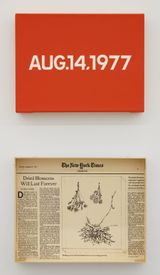
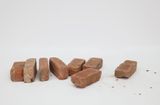
Pushing her practice of replication, wrapping, desire, and deception, Campbell again dons the art historical canon as armature and challenge for As Long As It Lasts. For the first time she presents a diminutive and suggestively re-scaled Lawrence Weiner, the ‘unmade’ date paintings of On Kawara, and a fallen column of stacked Empire Bricks by Carl Andre. Taking from her decentred feminist lens perspective, Campbell’s work notes how totemic male artists dominate institutional, collection, and market narratives despite decades of powerful waves of decolonisation and feminist critique.
Starting with an extensive research period bordering on forensic, she dives deeply into the materials and processes of the artist she decides to appropriate. Her ‘recreations’ of Kawara’s Today series anticipate the city where he was originally traveling based on available data in catalogues and archives. Then making her best guess, Campbell fills in only the unaccounted for dates when Kawara did not complete a painting. Her paintings are, of course, paintings. The newspapers lining the boxes are also entirely constructed of paint, and the boxes, though made from a white matboard substrate, have been painted to recreate the look and texture of book board that Kawara used to contain his date paintings.
Campbell’s expression rests between several moving points. The gesture of selection, our recognition of these works and their original contexts; the viewer’s suspended state of anticipation waiting for the work to be unmasked; and the caveat that the entire work is a trompe l’oeil illusion. She withholds and repackages the readymade of Modernism itself.
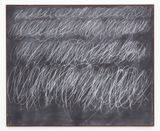
Her technical ability to simulate packing materials, including bubble wrap, tape, and cardboard, and now for the first time sheets of foam, through ingenious combinations of acrylic paints and mediums is alchemical. Each element is obsessively considered. Campbell will go as far as mimicking processes of time, foxing, and sun fading before she proceeds to the final step: the wrapping. Baldessari’s Pure Beauty, Warhol’s Double Elvis, and Ruscha’s text drawings are now held in plastic and swaddled in foam sarcophaguses. Transformation too, is continuously in play. She reverses course with Twombly’s oil and white wax crayon “chalkboard” painting, rendering her replication in actual chalk on blackboard.
Campbell’s appropriative practice comes out of a lineage of artists, such as Sturtevant, Sherri Levine, and Louise Lawler, who have employed appropriation to compelling ends. There is a nod to institutional critique in the desire to literally ‘package up’ and put away these works into storage to make room for women or lesser recognised artists, while simultaneously unable to escape the visibility of the canon. Cheekily, Campbell’s works raises questions about institutional structures, the canon, and systems of invisible labor used to validate those histories.
Tammi Campbell (b. 1974, Calgary, Alberta) received her BFA from the University of Saskatchewan, Saskatoon. Recent solo exhibitions include Exactly Wrong, MAKI Gallery, Tokyo; Boring Art, Anat Ebgi, Los Angeles, CA; and On View, Blouin Division, Montréal, QC. Campbell has also exhibited her work across Canada and the U.S. including Arsenal, New York, NY; Gavlak, Los Angeles, CA; Remai Modern, Saskatoon, SK; Vancouver Art Gallery, Vancouver, B.C.; and the Galerie de l’UQAM, Montréal, QC. She participated in the Canadian Biennale 2014 at the National Gallery of Canada, Ottawa, ON, as well as the 30th International Symposium of Contemporary Art of Baie-St-Paul. Campbell lives and works in Montréal, Quebec.
Tammi Campbell’s method for penetrating the male-dominated Modernist and Minimalist canons hinges on an enormous amount of research that allows her to technically and truthfully replicate each work. The results of which are perfect stand-ins for their respective originals. Her visible additives, whether bubble wrap, tape, or leaving some element undone, tends to generate both ‘a-ha’ excitement and confusion. A closer look at these paintings show that the protective bubble wrap and tape are in fact an illusion—trompe l’oeil painting taken to its hyperrealistic extreme. The materials cast completely from acrylic paint medium suspend viewers in a perpetual state of anticipation and prevents us from entering a true work of art.


A respected voice in contemporary art discourse.
Focusing on ambitious storytelling and insightful art-world commentary. Ocula Magazine publishes in-depth interviews, critical essays and timely analysis on the artists, exhibitions and ideas driving the global art world.
Learn more about Ocula Magazine
Showcasing the best of the art world.
Ocula partners with galleries from around the world to highlight their artists, artworks and exhibitions. Gallery membership is by application and invitation, with each member vetted by an independent panel.
Learn more about Ocula Membership

Specialises in the sale of major artworks.
Led by a team with deep ties to the world’s leading auction houses, galleries and collectors. Ocula’s advisory team offers bespoke services to high-net-worth clients from around the world who are looking to acquire the best of contemporary and modern art.
Learn more about our team and services