





NICOLE EISENMAN
b. 1965, FranceNew York-based artist Nicole Eisenman (b. 1965) is a leading figure in contemporary figurative painting and sculpture, known for addressing gender, sexuality, race, labour, violence, and inequality with raw emotion and dark humour. The artist’s work spans painting, drawing, printmaking, and sculpture, and is recognised for its blend of historical references, queer politics, pop culture and satirical social observation.
She is a MacArthur Foundation Fellow and was inducted into the American Academy of Arts and Letters in 2018. Her work has been included in numerous important solo and group exhibitions, including in the Venice Biennale and the Whitney Biennial. The artist’s solo exhibition What Happened at the Museum Brandhorst, Munich, Germany (2023), travelled to Whitechapel Gallery, London, United Kingdom (2023) and MCA Chicago, Chicago, IL (2024).
Early life and education
Nicole Eisenman was born in Verdun, France, and grew up in the suburban setting of Scarsdale, New York. She studied fine art at the Rhode Island School of Design, spending a formative year in Rome. After graduating in 1987, Eisenman moved to New York City, becoming a central figure in the art scene, experimenting across media and further developing a distinctive figurative style.
Practice and key artworks
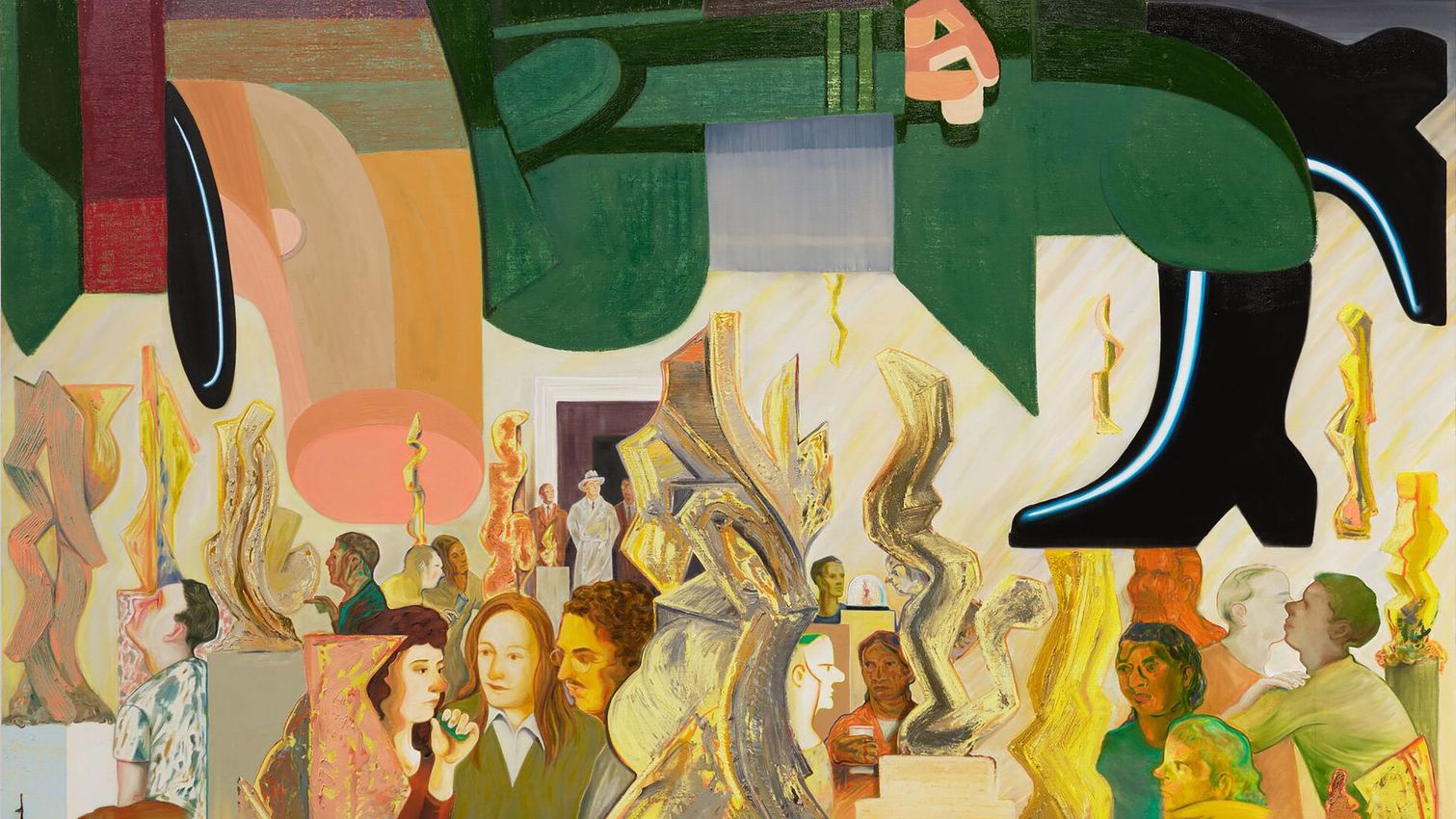
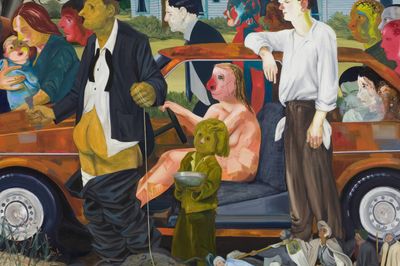
Eisenman’s work draws on art history, comics, pornography, advertising, and popular culture to explore feminism, queer life, and the politics of everyday experience. She works across ink, gouache, oil and acrylic paint, printmaking, and sculpture, often staging crowded scenes in which allegorical and archetypal figures coexist with intimate portraits of friends, lovers, and selves. Her oeuvre is distinguished by its interplay between contemporary subject matter and art historical influences.
A breakthrough came with Self-Portrait with Exploded Whitney (1995), an imposing mural shown at the 1995 Whitney Biennial that depicts the artist painting on a lone wall amid the rubble of the Marcel Breuer building.
In the 2000s they developed her well-known ‘Beer Garden’ paintings, including Biergarten at Night (2007), in which groups of contemporary drinkers—many of them her friends—are shown socialising in Brooklyn’s beer gardens. Rendered in acidic, unnatural colours that evoke both fauvism and impressionist social tableaux, for example Pierre-Auguste Renoir’s 1876 painting, Bal du moulin de la Galette, the works touch on contemporary social alienation.
From the late 2000s, Eisenman expanded beyond large crowd scenes into smaller, often humorous, psychologically charged paintings such as Going Down River on the USS J-Bone of an Ass (2017) and Morning Affirmations (2018), in which she depicts a bald eagle looking in a mirror while brushing itself, most assuredly telling itself affirmations to start its day. Works like Destiny Riding Her Bike (2020) further exemplify an interest in narrative, showing a cartoonish collision between a girl on a bicycle and a man on a ladder in a dreamlike, saturated palette, which Eisenman has noted as relating to her own romantic relationships.
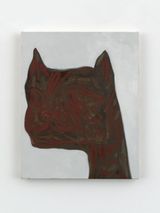
Eisenman’s ‘Head’ paintings and sculptures focus on close-up, constructed faces that appear to nod to Constructivism and modernist abstraction. Works such as Sun in My Eye on the Beach (2019), Head with Hat (Tiff) (2022), and Edie (The Destroyer) (2022) reduce faces and even animal portraits to interlocking planes of colour, balancing humour with psychological intensity.
Sculpture and public art
Alongside painting, Eisenman has developed a significant sculptural practice. Early mask-based sculptures gave way to ambitious figurative installations, including Procession (2019), conceived for the Whitney Biennial. This multi-figure outdoor work stages a group of allegorical walkers and stragglers, including a monumental figure dragging a cart, alluding to Western art history while undermining traditional heroic monuments.
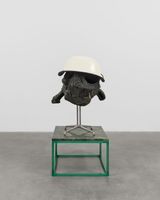
In the gallery, Eisenman has also produced large-scale sculptural environments such as Maker’s Muck (2022), shown in a solo exhibition at Hauser & Wirth New York. The work presents a hulking plaster figure hunched over a pottery wheel, surrounded by small sculptures in varying states of completion, proposing an absurd, vulnerable vision of artistic labour. Eisenman has also made metal and composite busts, including Econ Prof (2019), Goblin (2020), and Sailor with Cig #1 (2021), which rework the conventions of the commemorative portrait into playful, ambivalent characters.
Public Commissions
Public commissions have become an important part of Eisenman’s practice. Sketch for a Fountain (2017), created for Skulptur Projekte Münster, parodies the tradition of male statuary in public fountains by presenting a group of lounging, urinating, and reclining figures that reclaim public space for queer and female bodies. In 2021, Eisenman was shortlisted for London’s Fourth Plinth commission in Trafalgar Square.
In 2024 Eisenman was commissioned by Madison Square Park Conservancy, New York, to create a major outdoor project, The Fixed Crane (2024), featuring a toppled industrial crane embellished with handmade sculptural objects. The work signified an exploration of the 20th-century concept of the ‘readymade’, created in 1916 by Dada artist Marcel Duchamp to elevate everyday, mass-produced objects to the status of an artwork, pushing the boundaries of her work in figuration.
Awards, recognition, and influence
Eisenman has received major recognition throughout their career, including a Guggenheim Fellowship (1996), the Carnegie Prize (2013), and a MacArthur Foundation Fellowship (2015). They won the 2020 Suzanne Deal Booth/FLAG Art Foundation Prize and was inducted into the American Academy of Arts and Letters in 2018. In 2019, they participated in the 58th Venice Biennale, further consolidating her international profile.
Eisenman’s work is included in numerous museum collections and is frequently cited in art-historical and critical discussions of contemporary figurative painting, queer art, and politically engaged realism. Eisenman’s influence extends across generations of artists interested in narrative, identity, and the social body, and seeking to explore current directions in figurative and queer contemporary art.
Exhibitions
Nicole Eisenman has been the subject of both solo and group exhibitions internationally, with an increasing number of institutional surveys and retrospectives.
Key solo exhibitions include:
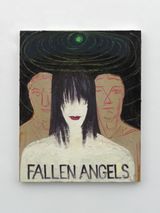
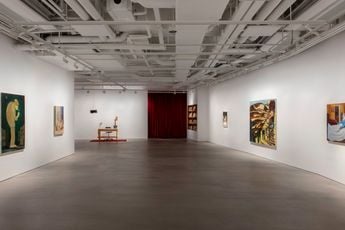
- Fallen Angels, Hauser & Wirth Hong Kong (2026), Eisenman’s first solo exhibition in Asia.
- STY, 52 Walker, David Zwirner, New York (2025).
- Nicole Eisenman: What Happened, Museum Brandhorst, Munich (2021–22); Whitechapel Gallery, London (2023–24); Museum of Contemporary Art Chicago (2024), a major touring retrospective spanning painting, sculpture, and works on paper.
- Nicole Eisenman and the Moderns. Heads, Kisses, Battles, Fondation Vincent van Gogh Arles, Arles (2022).
- Nicole Eisenman: Giant Without a Body, Astrup Fearnley Museum of Modern Art, Oslo (2021).
- Dear Nemesis, Nicole Eisenman 1993–2013, Contemporary Art Museum St. Louis, Missouri (2014).
- Nicole Eisenman, Le Plateau – FRAC Île-de-France, Paris (2007).
Select group exhibitions include:
- This Is Not America’s Flag, The Broad, Los Angeles (2022).
- Noise! Frans Hals, Otherwise, Frans Hals Museum, Haarlem (2018).
- The Eighth Square: Gender, Life, and Desire in Art Since 1960, Museum Ludwig, Cologne (2006).
These and other projects ensure that Nicole Eisenman remains a central figure in contemporary painting, queer art, and critical figurative practices.
Nicole Eisenman’s Instagram can be found here.
Nicole Eisenman FAQs
Who is Nicole Eisenman?
Nicole Eisenman (born 1965) is a French‑born American contemporary artist known for figurative painting and sculpture that address gender, sexuality, politics, and everyday life with dark humour.
What kind of art does Nicole Eisenman make?
Nicole Eisenman makes figurative paintings, drawings, prints, and sculptures that combine art‑historical references, comics, and popular culture with queer and feminist perspectives.
What is Nicole Eisenman best known for?
Nicole Eisenman is best known for large narrative paintings, ‘beer garden’ scenes, psychologically charged ‘head’ paintings, and major sculptural installations and public fountain works.
What are Nicole Eisenman’s main themes?
Nicole Eisenman’s art explores gender and sexuality, queer identity, labour and class, community, friendship, and the absurdities and vulnerabilities of contemporary life.
What is distinctive about Nicole Eisenman’s style?
Nicole Eisenman’s style combines expressive, sometimes distorted figuration, vivid and unnatural colour, cartoon and caricature elements, and references to Renaissance, expressionism, and social realism.
Where was Nicole Eisenman born and where do they live?
Nicole Eisenman was born in Verdun, France, grew up in Scarsdale, New York, and lives and works in New York City.****
Does Nicole Eisenman make sculpture as well as painting?
Yes. Nicole Eisenman has a major sculptural practice that includes masks, busts, multi‑figure installations, public fountains, and outdoor commissions.
Why was Nicole Eisenman involved in controversy around the Whitney Biennial?
In 2019, Nicole Eisenman was one of several artists who asked the Whitney Museum of American Art to withdraw their work from the Whitney Biennial in protest against board vice‑chair Warren Kanders, whose company manufactured tear gas used against protesters and migrants. This high‑profile boycott drew intense debate about museum ethics, corporate sponsorship, and the political responsibilities of artists and institutions.
What happened with Nicole Eisenman’s Skulptur Projekte Münster fountain?
Nicole Eisenman’s public sculpture Sketch for a Fountain (2017), created for Skulptur Projekte Münster, was vandalised, including the partial decapitation of one of its figures, in what organisers described as an act of hostility toward the work’s queer-coded, non‑normative bodies in public space. The incident sparked discussion about censorship, the vulnerability of public art, and backlash against queer representation in civic environments.
Has Nicole Eisenman faced backlash over political views?
Yes. Eisenman has been publicly critical of state violence and militarism, including protesting museum ties to arms manufacturers and speaking out on Palestine and Gaza. Reports around her Chicago retrospective noted that some collectors hesitated to support the show because of her views, highlighting how political speech can influence funding and institutional support.****
How has Eisenman responded to controversy and criticism?
Nicole Eisenman has generally embraced open debate, using withdrawals, public letters, and interviews to clarify her positions on institutional ethics and human-rights issues. She has also spoken about accepting that public art, especially queer and political work, may attract vandalism or backlash, and sees these reactions as part of the broader conversation her work is meant to provoke.
Why is Nicole Eisenman important in contemporary art?
Nicole Eisenman is regarded as one of the most influential contemporary figurative artists, shaping debates around queer art, feminist art, and politically engaged realism.
Where can I see Nicole Eisenman’s work?
Nicole Eisenman’s work can be seen in major museum collections, touring survey exhibitions, gallery shows in Europe and the United States, and permanent or temporary public art installations.
How does Nicole Eisenman use humour in their work?
****Eisenman uses dark humour, satire, and absurd situations to address serious subjects such as violence, inequality, and social anxiety, making complex themes more accessible.
How does Nicole Eisenman relate to queer and feminist art history?
Nicole Eisenman is central to queer and feminist contemporary art, reimagining historical genres like allegory, portraiture, and history painting through queer, non‑normative bodies and communities.
Which galleries represent Nicole Eisenman?
Nicole Eisenman is represented by leading international contemporary art galleries, which organise solo exhibitions, publish catalogues, and place works in museum and private collections.
Ocula | 2026









Explore Nicole Eisenman's Exhibitions






Nicole Eisenman in Ocula Magazine







Explore and Follow Artists Shaping Contemporary Art
A respected voice in contemporary art discourse.
Focusing on ambitious storytelling and insightful art-world commentary. Ocula Magazine publishes in-depth interviews, critical essays and timely analysis on the artists, exhibitions and ideas driving the global art world.
Learn more about Ocula Magazine
Showcasing the best of the art world.
Ocula partners with galleries from around the world to highlight their artists, artworks and exhibitions. Gallery membership is by application and invitation, with each member vetted by an independent panel.
Learn more about Ocula Membership
Specialises in the sale of major artworks.
Led by a team with deep ties to the world’s leading auction houses, galleries and collectors. Ocula’s advisory team offers bespoke services to high-net-worth clients from around the world who are looking to acquire the best of contemporary and modern art.
Learn more about our team and services