Press Release

The present exhibition of new works by Sopheap may elicit a double take from those familiar with his older ones. Through pieces such as Silence (2005), Cycle (2007), Compound (2011), and Morning Glory (2012), Pich introduced an artistic language that felt simultaneously fresh in its sculptural deployment of the grid (instead of mass) to indicate volume, yet traditional in its employment of materials like rattan and bamboo, common to crafts in Cambodia. That it frequently drew on subject matter from local history and culture (e.g., Buddha, but also local plants) further reinforced the sense of rootedness in place. This double duality of being contemporary and traditional, global and local, was fully on view at Pich’s breakthrough 2013 exhibition at the Metropolitan Museum of Art in New York, Cambodian Rattan: the Sculpture of Sopheap Pich, which presented him as the “first” contemporary artist from the country, but nevertheless situated him regionally, in craft and tradition.

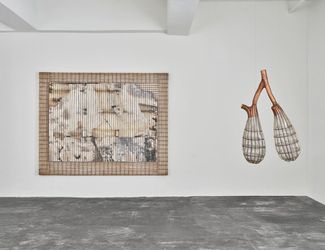
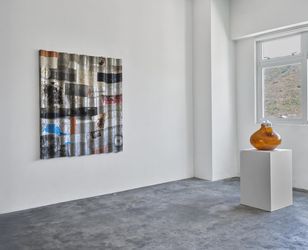
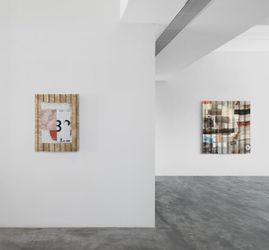
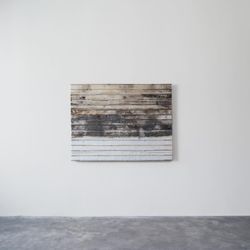
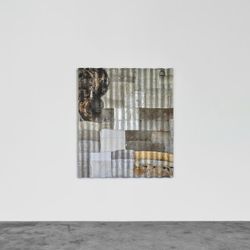
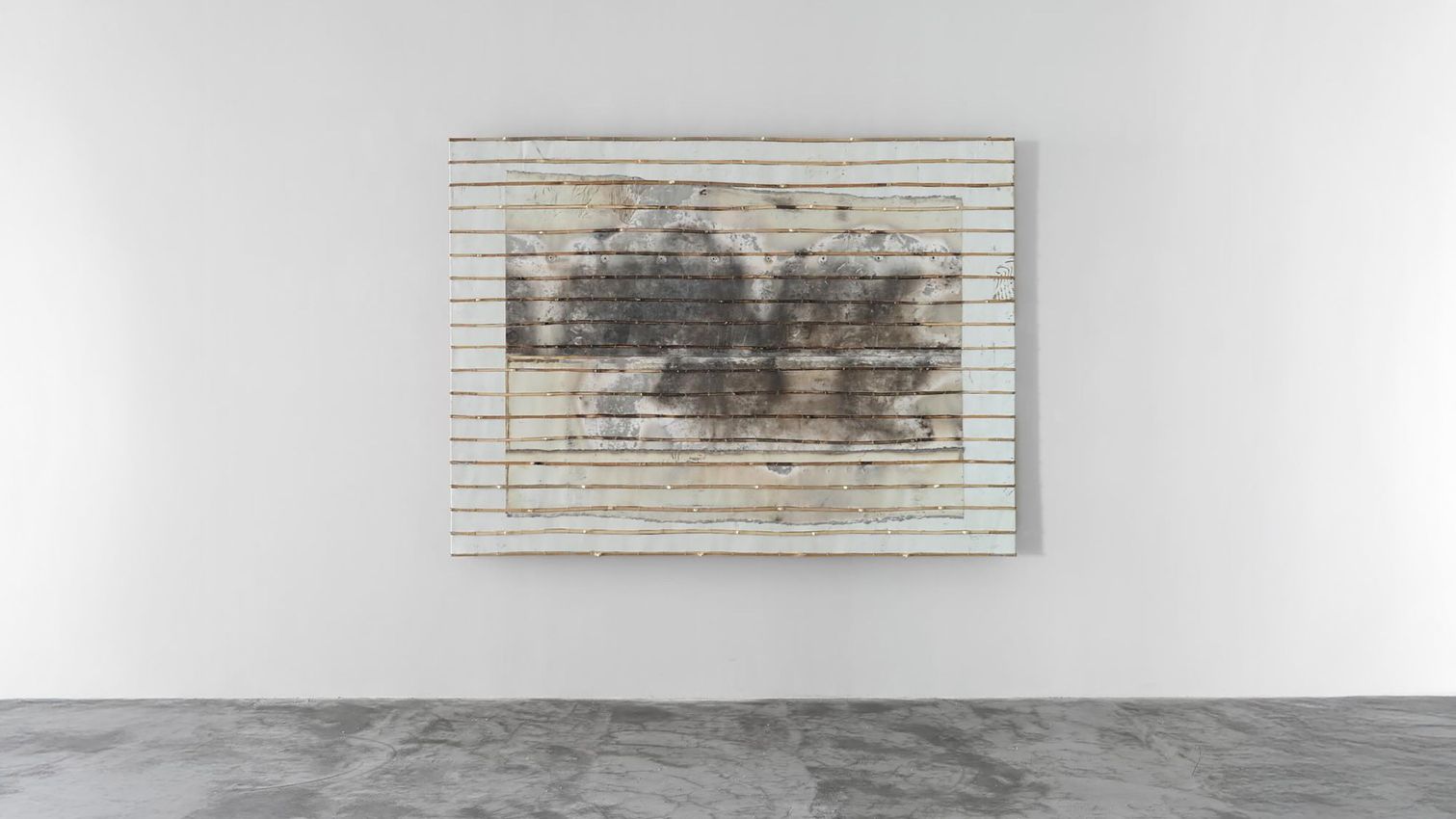
In Pich’s latest works, while bamboo continues to be present, it is repurposed metal that predominates, and gives the exhibition a modern, urban feel. Thus, Herons, despite its avian connotations, is a distinctly industrial assemblage of alloys, mostly parts from pots and pans (with some of their circular bottoms visible). Similarly, Jantar Mantar consists of an entirely metallic plane, riveted and corrugated like the tin that clads warehouses or makeshift housing, with even a handle left in. And in After On, a patchwork of different pieces that include large swathes of buffalo hide that pays homage to conceptual artist On Kawara, the incompleteness of the central found signage suggests some roadside view seen from a rapid drive-by.

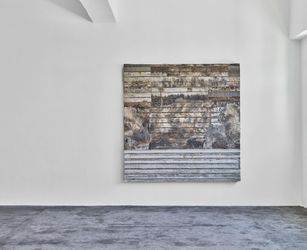
Along with the switch from virgin plant fibers to scrap aluminum and steel, Pich could also seem to be moving from sculpture and volume to surface and texture. After the Harvest, for instance, achieves its impact through a simple variation of tone and texture in its tripartite structure: the plaster-smooth matte white band at top, the orange peel texture of the black stucco embossed aluminum of the middle register, and the weathered, scrapped, and burnt surface of the lower third together yield an intriguing study in contrasts.

The concentration on two-dimensional surface sometimes even results in something like a picture, albeit a somewhat abstract one. Thus, a triangular summit-like white and black form in one work inspired Pich to name it Kamikochi, after the snowy alpine mountain in Japan that he visited just before the pandemic. Other horizontal works in the group, including Dream River, Wind-Tossed Waves, and The Flatlands, all bear poetic, even romantic, titles that explicitly invoke landscapes.

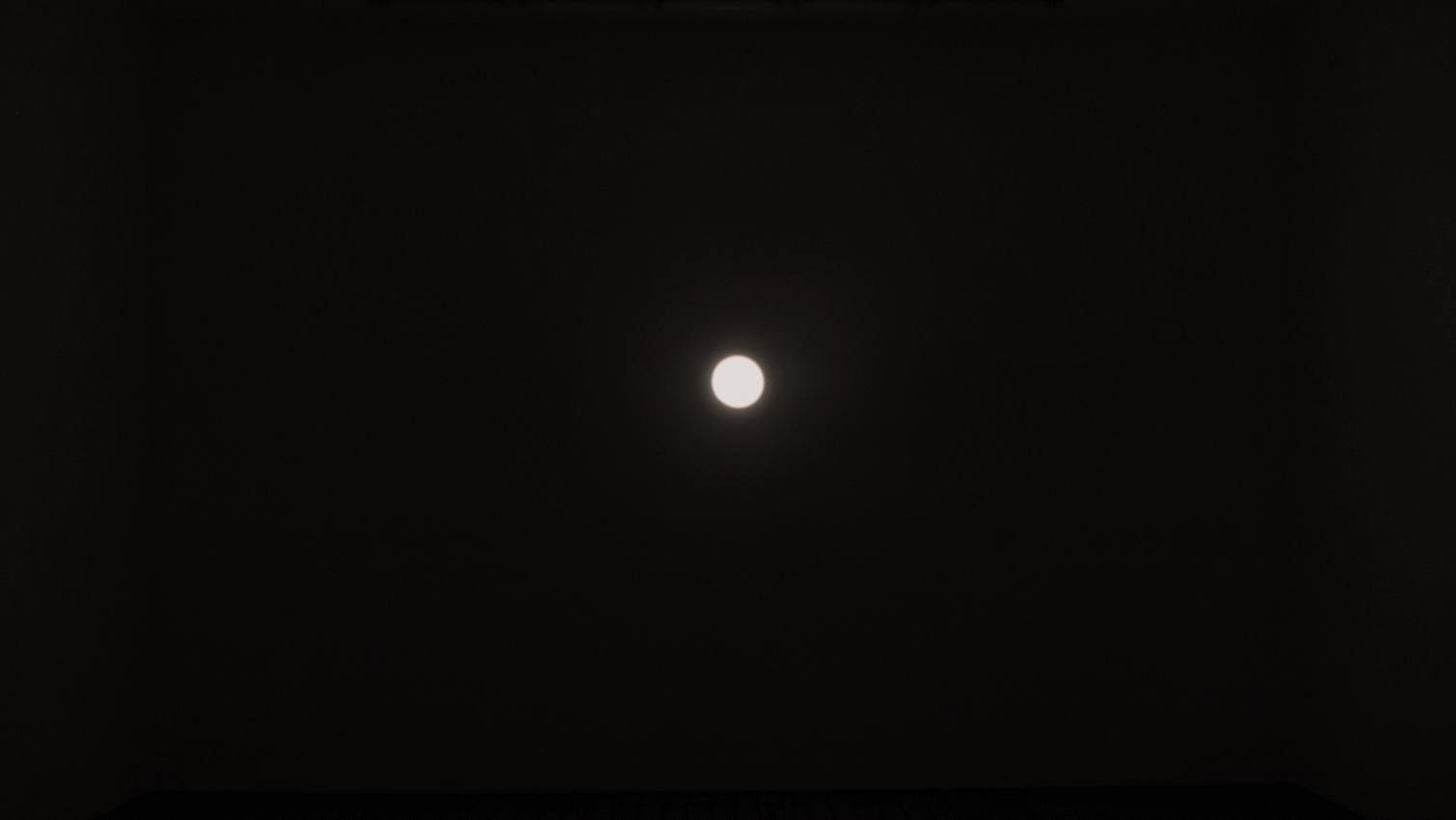
However, Empty Screen (Fade) gives pause to the idea that Pich has traded in sculpting with organic materials in favor of constructing abstract industrial pictures, emphasizing instead the continuities between the metallic and the woven, the sculptural and the pictorial. Pich initially made it in 2015, as one of a series of low-relief wall-mounted woven grids. He revisited it more recently, filling its central area—the “empty screen”—with strips of aluminum, which come into focus as a skyscape through the appearance of a horizon line. Its transformation stands as a reminder that if Pich’s works now can be seen as paintings done “in another way,” they were already noted for their “graphic character” early on, with his sculptures considered a kind of three-dimensional drawing. Pich revisits this approach to space through line in Silent Restraint (2025), a re-envisioning of the artist’s first sculpture, of a set of lungs, with the addition of blown glass to manifest the air between the bamboo.

Rather than a departure, then, it would be more accurate to see the recent pieces as part of the evolution of the artist’s practice, which itself is in ongoing dialogue with Phnom Penh, Pich’s home since 2002. In other words, just as the artist’s original turn from picture-making (his MFA is in painting, and, he was inspired to become an artist as a child by seeing a neighbor’s painting) to sculpting with rattan and bamboo emerged out of his return to Cambodia, and resourcefully engaging with vernacular materials that were abundant and familiar to communities there, instead of any a priori interest in craft, so his current use of scrap metal reflects the material’s ubiquity in a developing city that is being rapidly remade through the influx of foreign investment, and far less rural than when he arrived. That is to say, even if they are no longer made of rattan and bamboo, and now gesture to Japan, India, France, and other places, the sculptures of Sopheap Pich still serve as portraits of Cambodia, but with the image that emerges one less tied to past traditions than a present and future in flux.

1. Pamela Corey, “The ‘First’ Cambodian Contemporary Artist,” Udaya: Journal of Khmer Studies, 12 (2015), pp. 61-94.

2. Unless otherwise indicated, all artworks date to 2024 or 2025.

3. Pich refers to making painting “in a different way, my way” in the video, “WHAT Artist Interview: Sopheap Pich” (2024). Thanks to the artist for sharing an advanced copy.

Text by John Tain, curator and art historian

Read More

Installation Views

About the Artist

Sopheap Pich was born in 1971 in Battambang, Cambodia. In 1979, when the Vietnamese invasion led to the ousting of the Khmer Rouge regime, he fled with his family to Thailand, spending four years in refugee camps before immigrating to the United States. Memories of traveling vast distances on foot and witnessing the devastation of war—broken bodies, ravaged landscapes, abandoned artillery, and ruined buildings—underpin his sculptural practice. While Pich studied painting, earning a BFA from the University of Massachusetts, Amherst (1995), and an MFA from the School of the Art Institute of Chicago (1999), he turned his attention to sculpture after returning to Cambodia in 2002. In 2003, he established the artist group Saklapel and launched the acclaimed exhibition Visual Art Open (2005) in the Cambodian capital Phnom Penh. He made his first sculpture Silence, an interconnected pair of lung-shaped forms woven from rattan, in 2004. Pich also cofounded the alternative organization Sala Artspace, Phnom Penh (2006—07), which hosted a series of residencies.

View Artist Profile

Also Exhibiting

About the Gallery

View Gallery Profile
Address
21F, Coda Designer Centre
62, Wong Chuk Hang Road
Entrance via Yip Fat Street (next to Ovolo Hotel)
Hong Kong
Hong Kong
Opening Hours
Tuesday – Saturday
11am – 7pm
(1)
Hong Kong 21F, Coda Designer Centre, 62, Wong Chuk Hang Road
Axel Vervoordt Gallery
21F, Coda Designer Centre, 62, Wong Chuk Hang Road, Entrance via Yip Fat Street (next to Ovolo Hotel), Hong Kong, Hong Kong

Opening hours
Tuesday – Saturday
11am – 7pm
The art world in focus