With Life Face on Gold, Buchmann Galerie is pleased to announce Tatsuo Miyajima’s (b. 1957 in Tokyo) eleventh solo exhibition at the gallery.
For over thirty years, Tatsuo Miyajima has explored existential questions concerning the nature and perception of time and space, working at the intersection of technology, the digital realm, and art. Miyajima’s multifaceted oeuvre has had a profound impact on contemporary art and he is considered one of the most important Japanese artists of international renown. His work is often associated with and exhibited in connection with Lee Ufan or On Kawara, including in the highly acclaimed exhibition STARS: Six Contemporary Artists from Japan to the World at the Mori Art Museum in Tokyo in 2020, which, in addition to Tatsuo Miyajima and Lee Ufan, also featured Yayoi Kusama, Takashi Murakami, Yoshitomo Nara, and Hiroshi Sugimoto.
Early in his career, the artist established three ideas that serve as the central guiding principles of his work: “keep changing,” “connect with everything,” and “continue forever.” They form the conceptual basis for the often-monumental installations, sculptures, and performances, as well as his body of drawings. Miyajima is thus describing the essence of time in relation to all living things. This is translated visually in the artist’s works as numbers and series of numbers—metaphors for life and impermanence. Number sequences run from 1 to 9 or from 9 to 1 and are repeated continuously in a cycle, as a kind of journey from life to death, whose finality is symbolised by the number “0” or the zero point, which never appears in Miyajima’s work as a number, but as a visual gap or blank space.
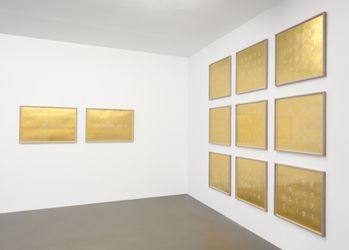
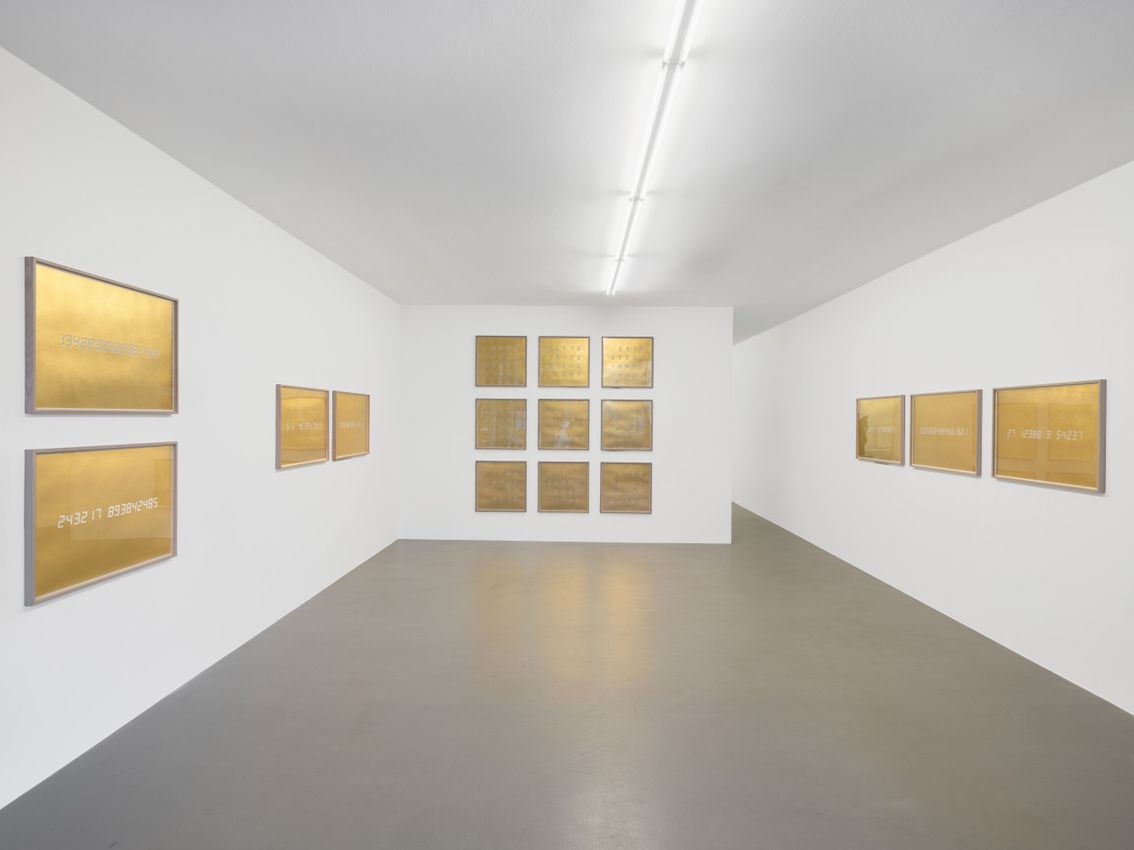
The exhibition in the Buchmann Box is the first presentation in Europe of the series Life Face on Gold, which comprises a total of forty works in two different formats.
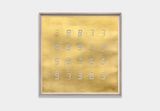
Miyajima applied gold leaf to the entire surface of large-format, rigid paper, which was then repeatedly embossed with the number eight—designed by the artist to resemble an LED number—in a horizontal row of numbers or in five columns of numbers.
In a final step, an individual sequence of numbers between 1 and 9 was precisely screen printed in white ink over the embossed eights. Since the number zero is not visualised, a blank space or implied number appears in some places in the sequence of numbers.
The full-surface gilding of the ground references Western and Eastern cultural history, as an opening of the image onto a metaphysical or even sacred world. The rational aspect of counting appears to be suspended. Also contributing to this effect is the installation aspect of the works, which reflect a sublime, gold-drenched light depending on lighting conditions. The number sequences are determined by the artist’s intuitive impulse when creating the work and do not follow any mathematical or coded sequence.
The exploration of numbers, counting, and space was also the basis of the groundbreaking work Mega Death, with which Miyajima represented Japan at the 49th Venice Biennale in 2001. The monumental, room-scale installation, addressing the transience of life and collective experience of death, consisted of 2,400 blue LED displays showing numbers counting backwards from 9 to 1 in endless cycles. At irregular intervals, all of the number displays would suddenly switch off, plunging the room into total darkness, symbolising a moment of “collective extinction” and leaving viewers disoriented. But then things came quickly back to life: the individual LEDs would begin counting again starting with the number one (1). Mega Death is a meditative reflection on mortality, memory, and renewal.
Tatsuo Miyajima’s exploration of concepts of time, its (un)predictability, and cultural and existential dimensions are also the subject of the iconic LED installation Region 200, which measures over eight meters. Several years ago, the Buchmann Galerie facilitated the acquisition of this work for the collection of the M+ Museum in Hong Kong. _Region 200 _is currently on display in the exhibition Shanshui: Echoes and Signals, alongside works by Isamo Noguchi and Lee Ufan, among others.
One of the key insights that Tatsuo Miyajima gained from nature is that humanity is not invincible. After the severe natural disasters in Japan and a global pandemic, he stressed in an interview that reflecting on the fundamental values of life is necessary:
“With the development of science and technology, we humans succumb to the illusion that we can do anything and try to manipulate nature as we please. But nature and the universe behave in unpredictable ways,” said Miyajima.
Works of the artist are represented in the collections of the Tate Gallery, London; the Bavarian State Painting Collections, Munich; La Caixa, Barcelona; the Deste Foundation, Athens; the Museum of Contemporary Art Chicago; the Museum of Contemporary Art Tokyo; the Leeum, Seoul; the Kunstmuseum Bern; and the M+ in Hong Kong.
In recent years, solo exhibitions of the artist have been held at the Minsheng Museum, Shanghai; the Chiba City Museum in Chiba, Japan; Skulpturenpark Waldfrieden, Wuppertal; the Santa Barbara Museum of Art; and the EMMA Museum in Espoo, Finland.

Tatsuo Miyajima achieved international recognition for his works incorporating flashing light-emitting diodes (LEDs). Since the Japanese artist began working with LEDs in 1987, he has developed a distinctive body of work that is now synonymous with the artist.
The gallery was founded in 1975 by Elena and Felix Buchmann in St. Gallen, Switzerland. Between 1983 and 1998 the gallery was located in Basel next to the Museum of Contemporary Art; today the gallery is located in Lugano, CH.

A respected voice in contemporary art discourse.
Focusing on ambitious storytelling and insightful art-world commentary. Ocula Magazine publishes in-depth interviews, critical essays and timely analysis on the artists, exhibitions and ideas driving the global art world.
Learn more about Ocula Magazine
Showcasing the best of the art world.
Ocula partners with galleries from around the world to highlight their artists, artworks and exhibitions. Gallery membership is by application and invitation, with each member vetted by an independent panel.
Learn more about Ocula Membership

Specialises in the sale of major artworks.
Led by a team with deep ties to the world’s leading auction houses, galleries and collectors. Ocula’s advisory team offers bespoke services to high-net-worth clients from around the world who are looking to acquire the best of contemporary and modern art.
Learn more about our team and services