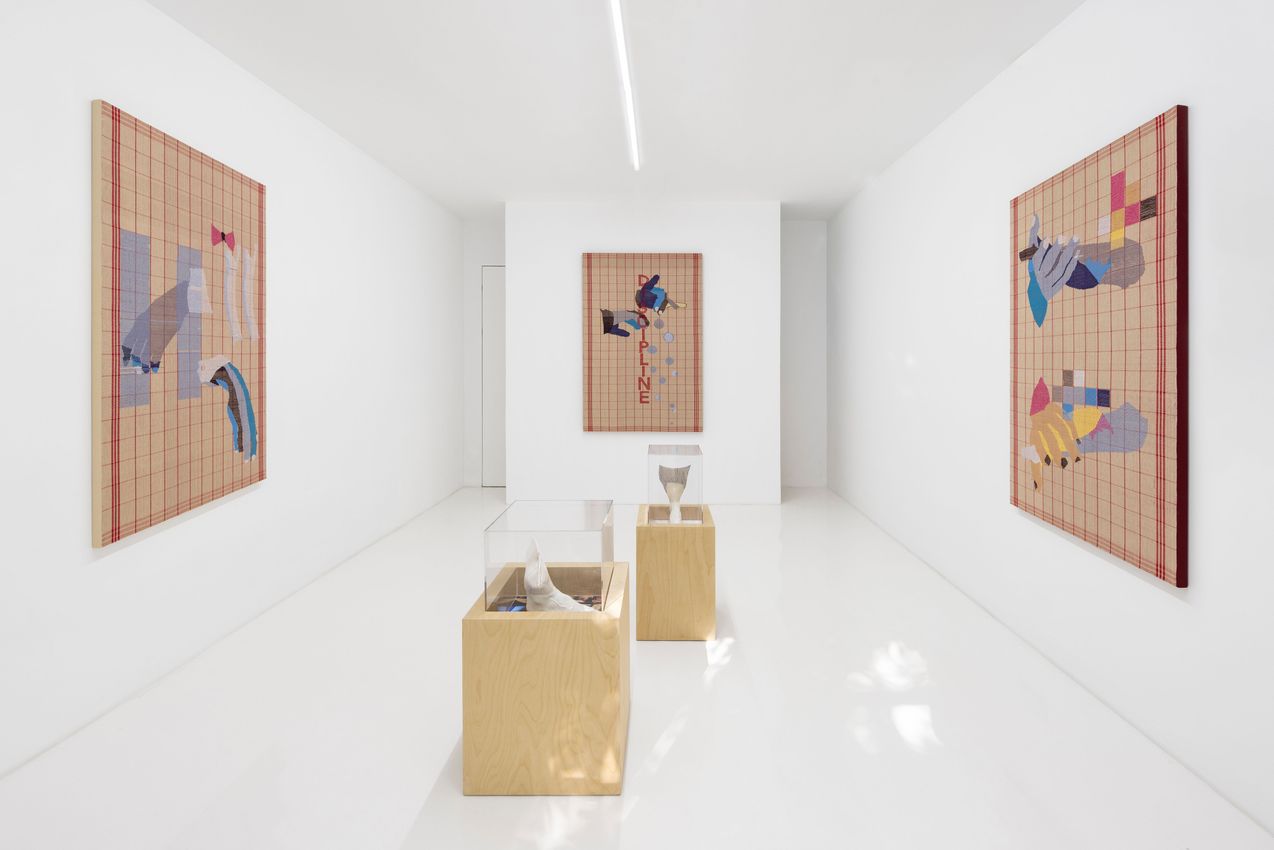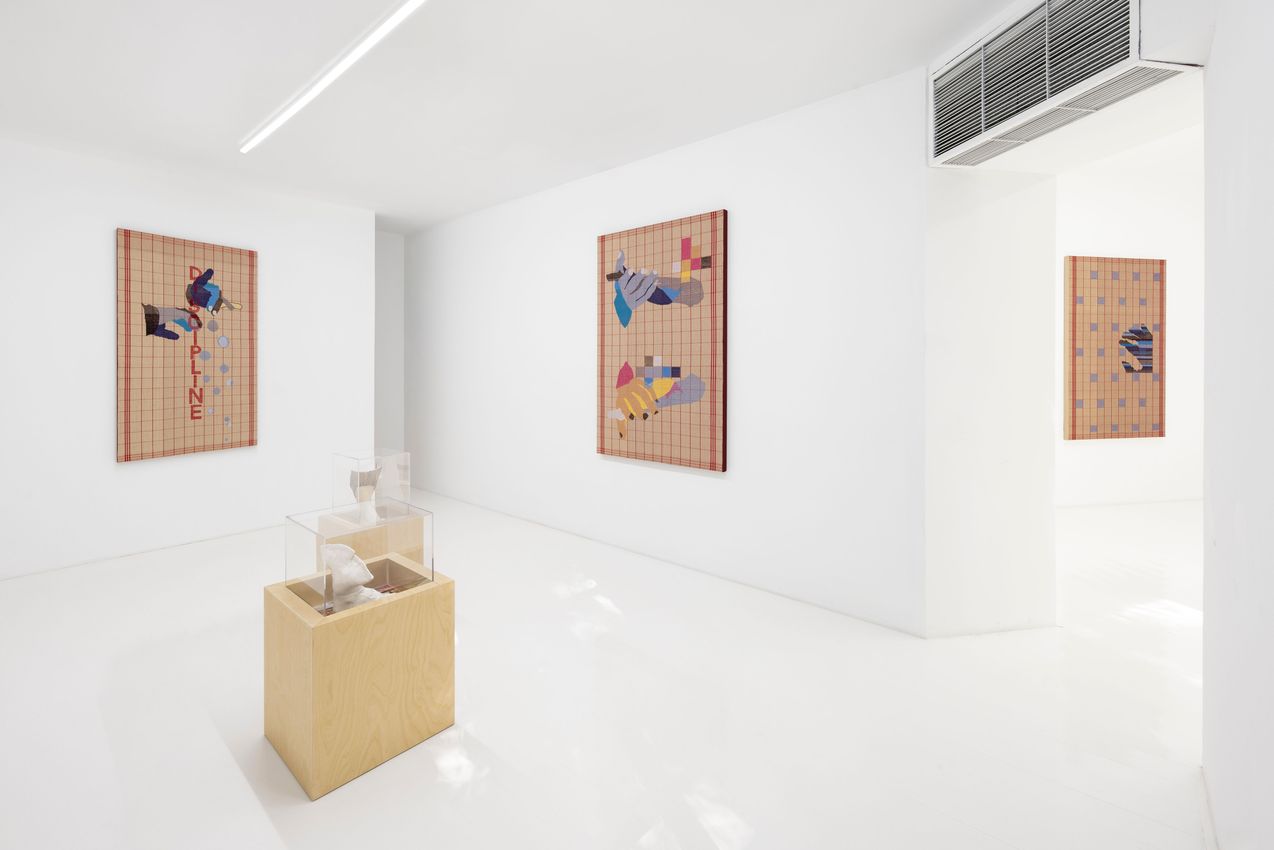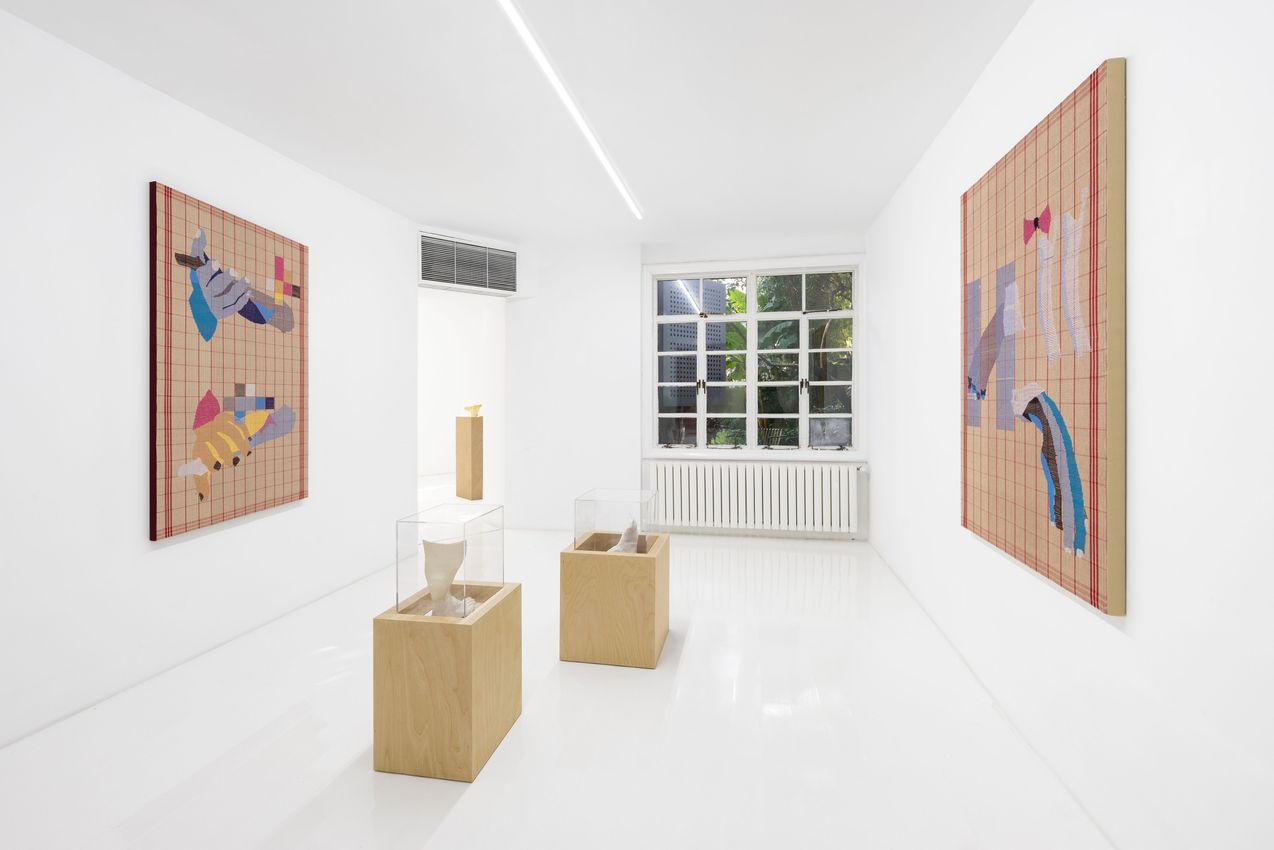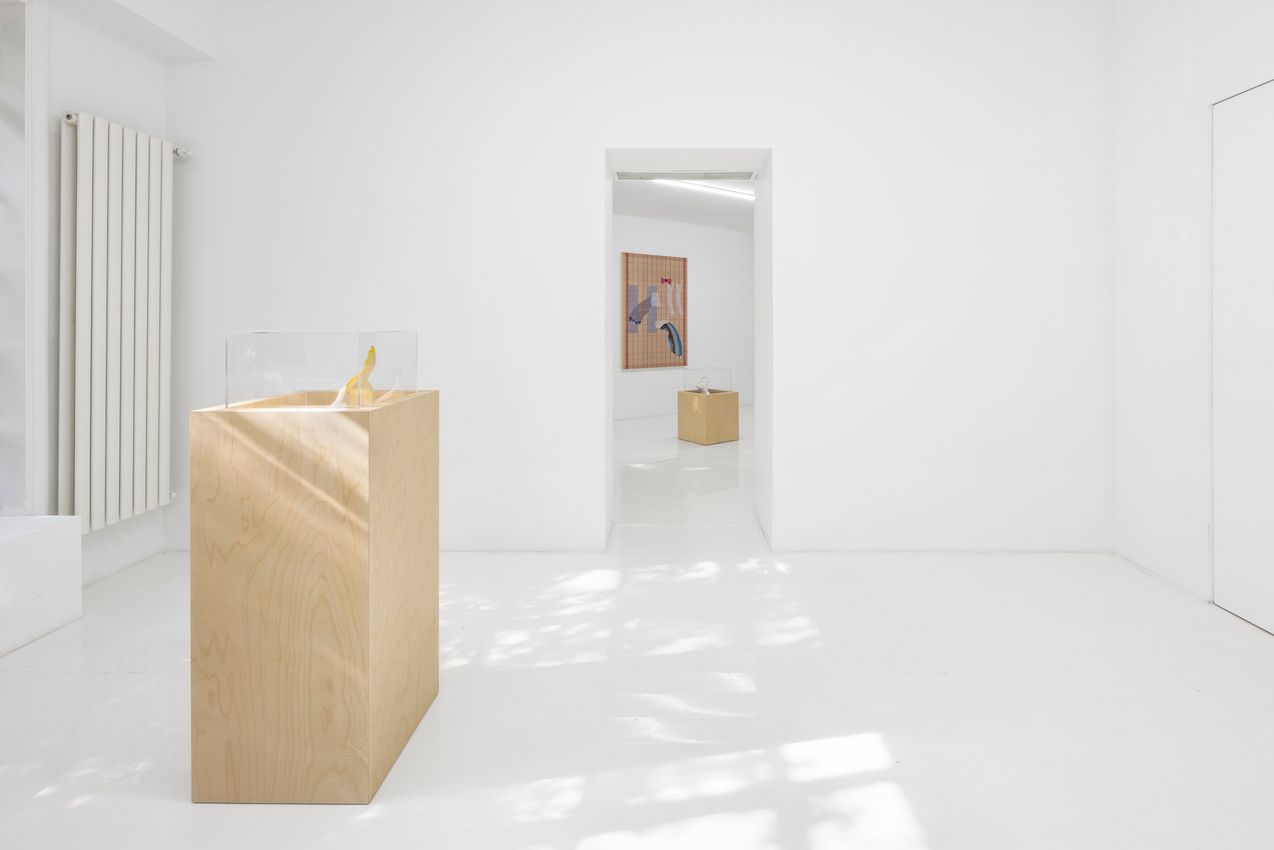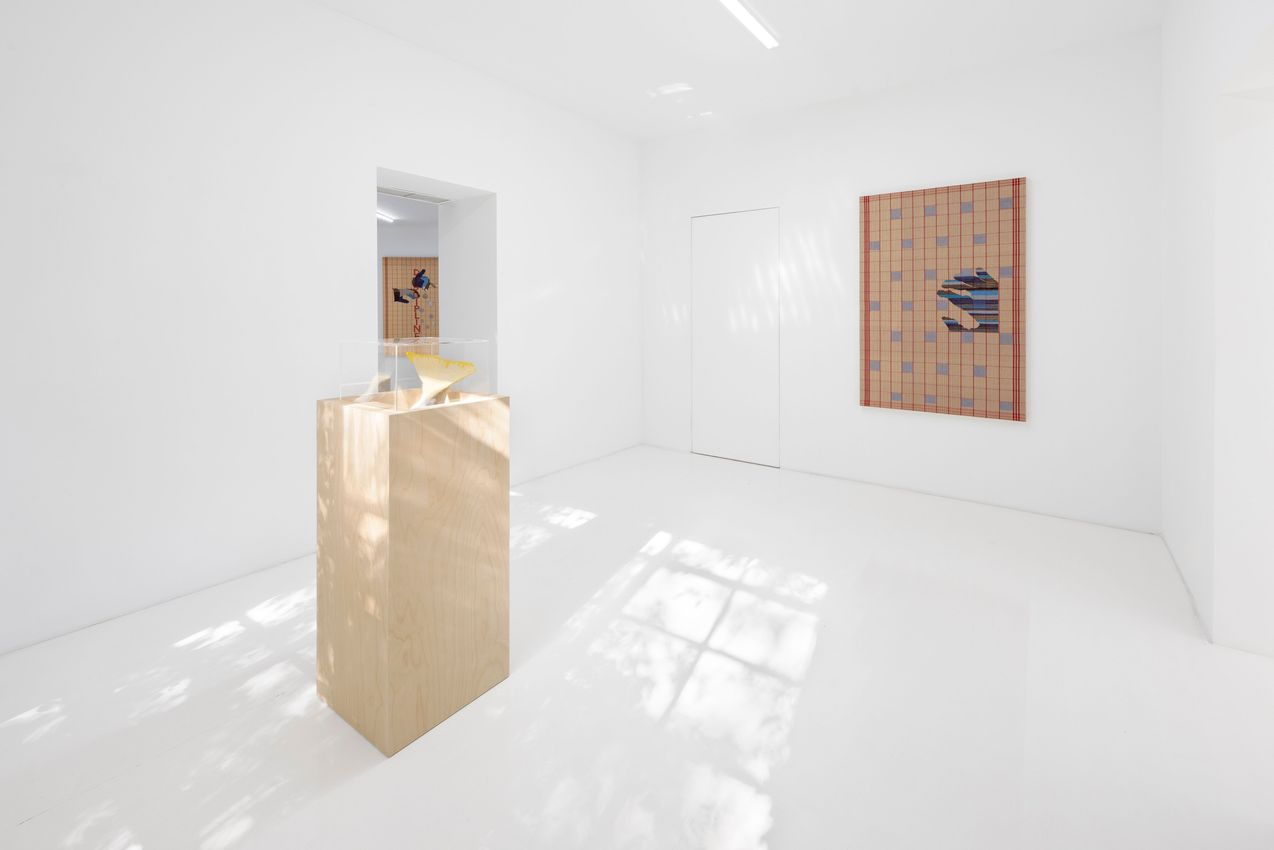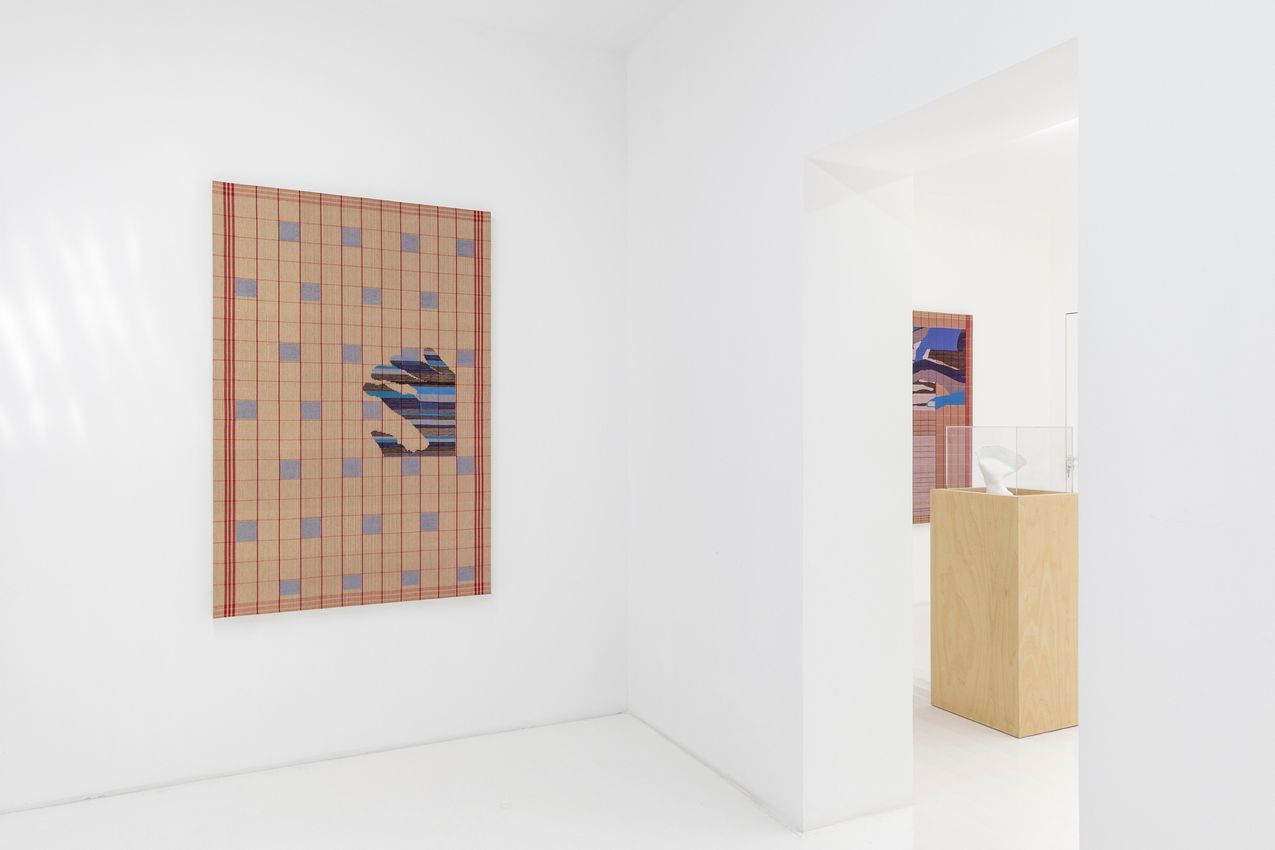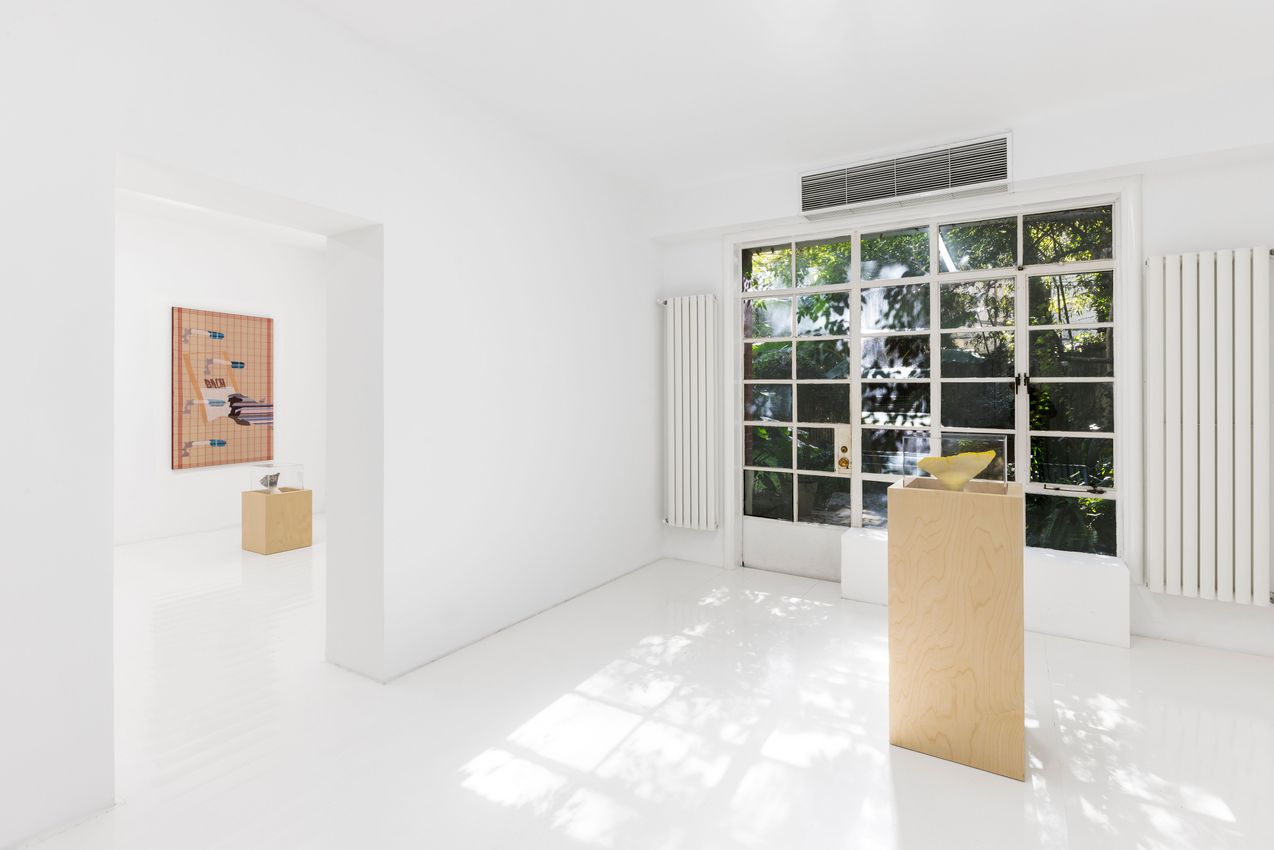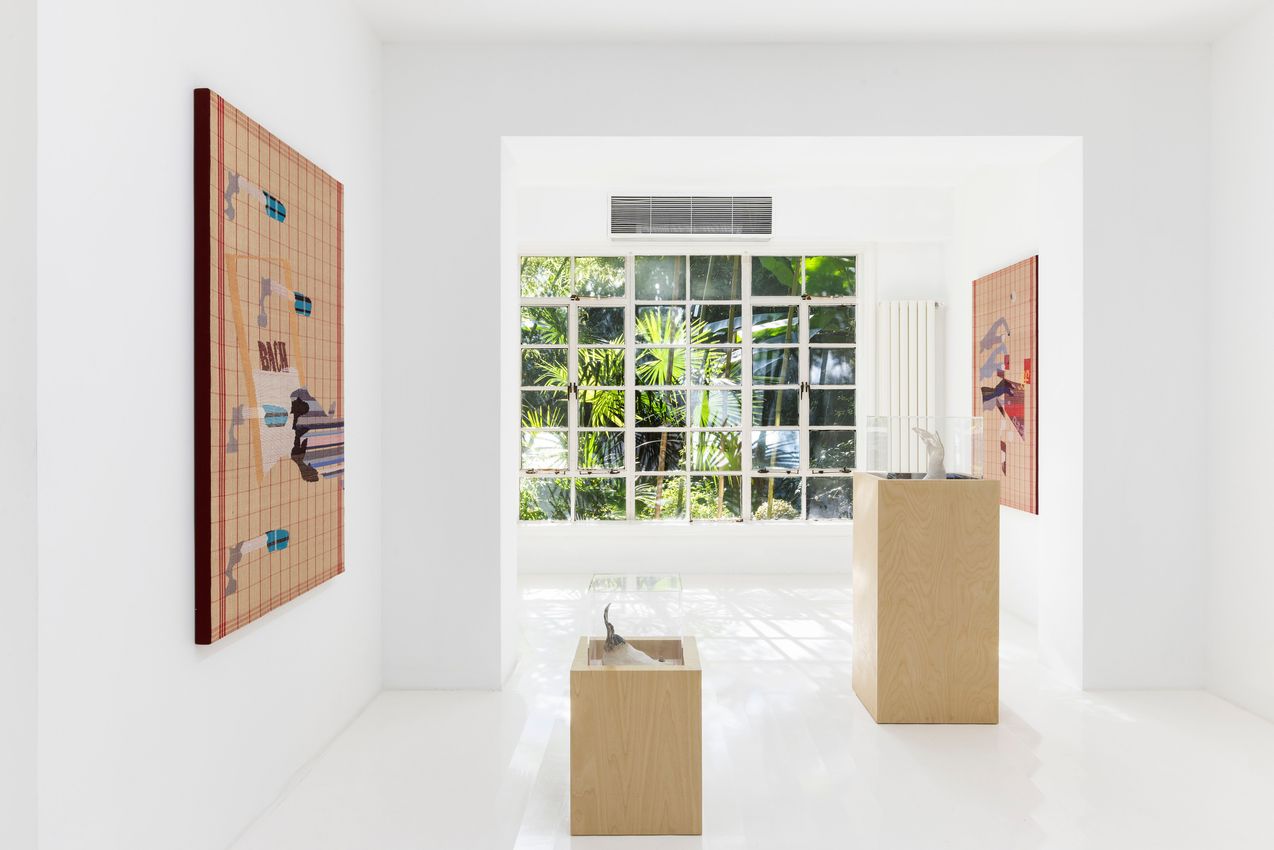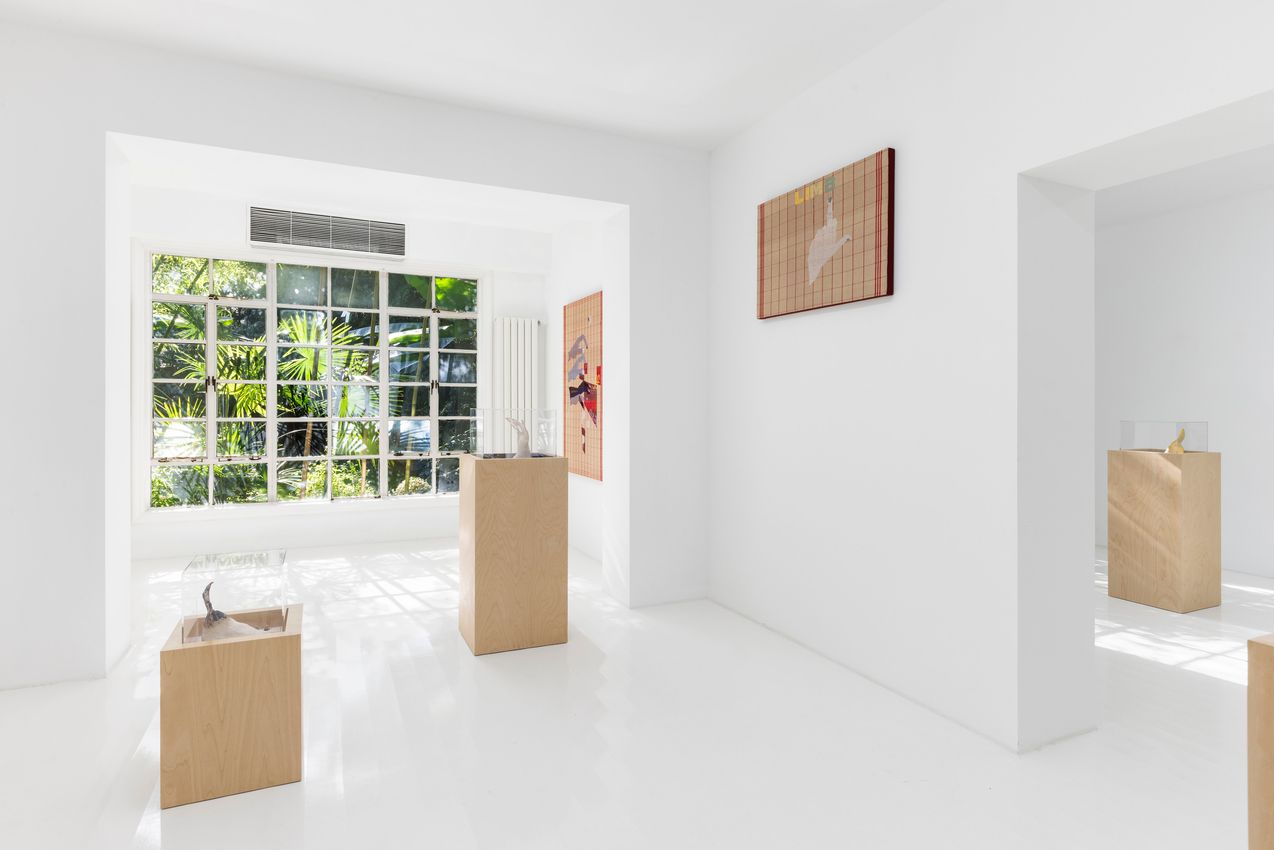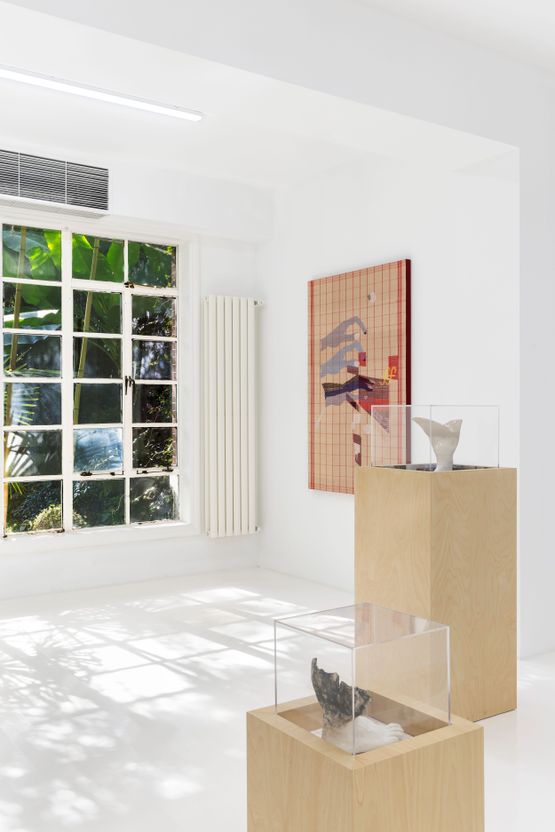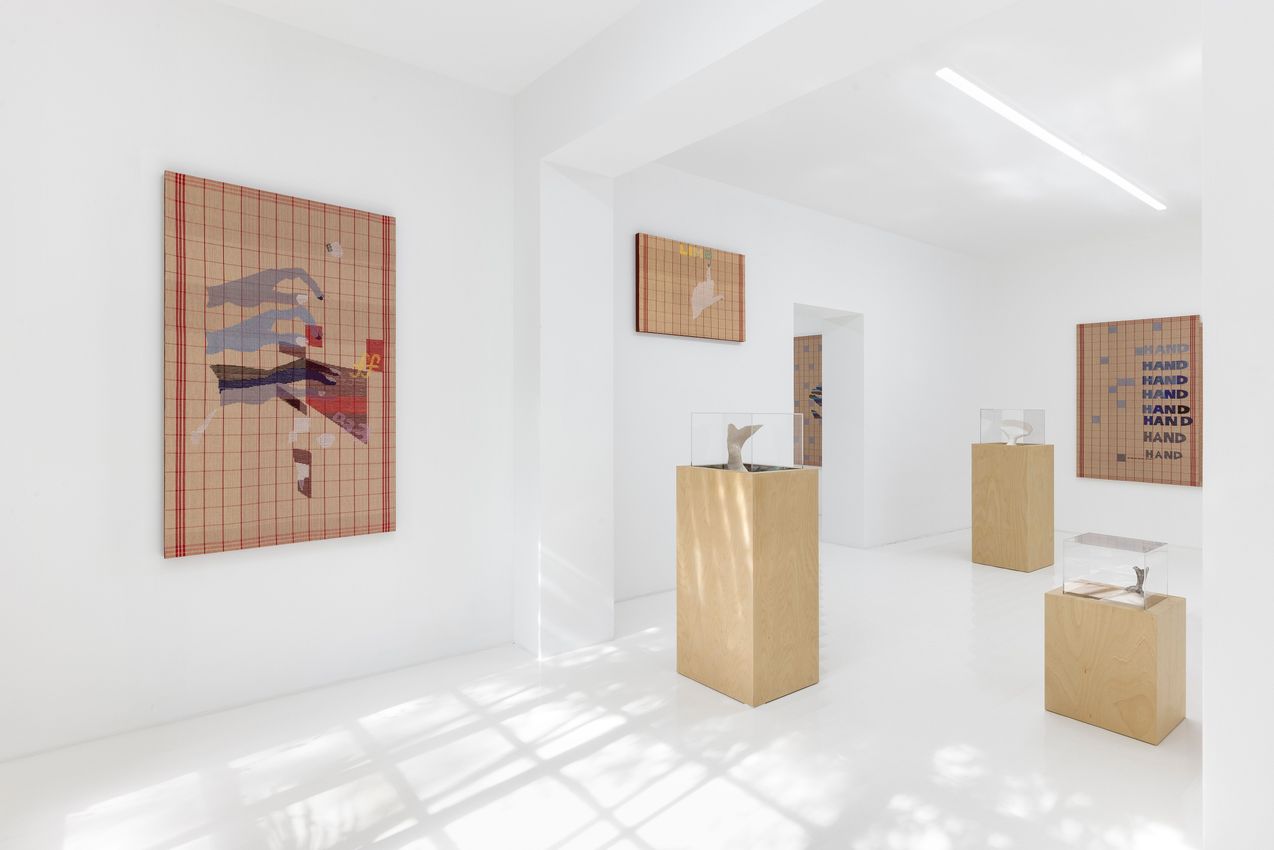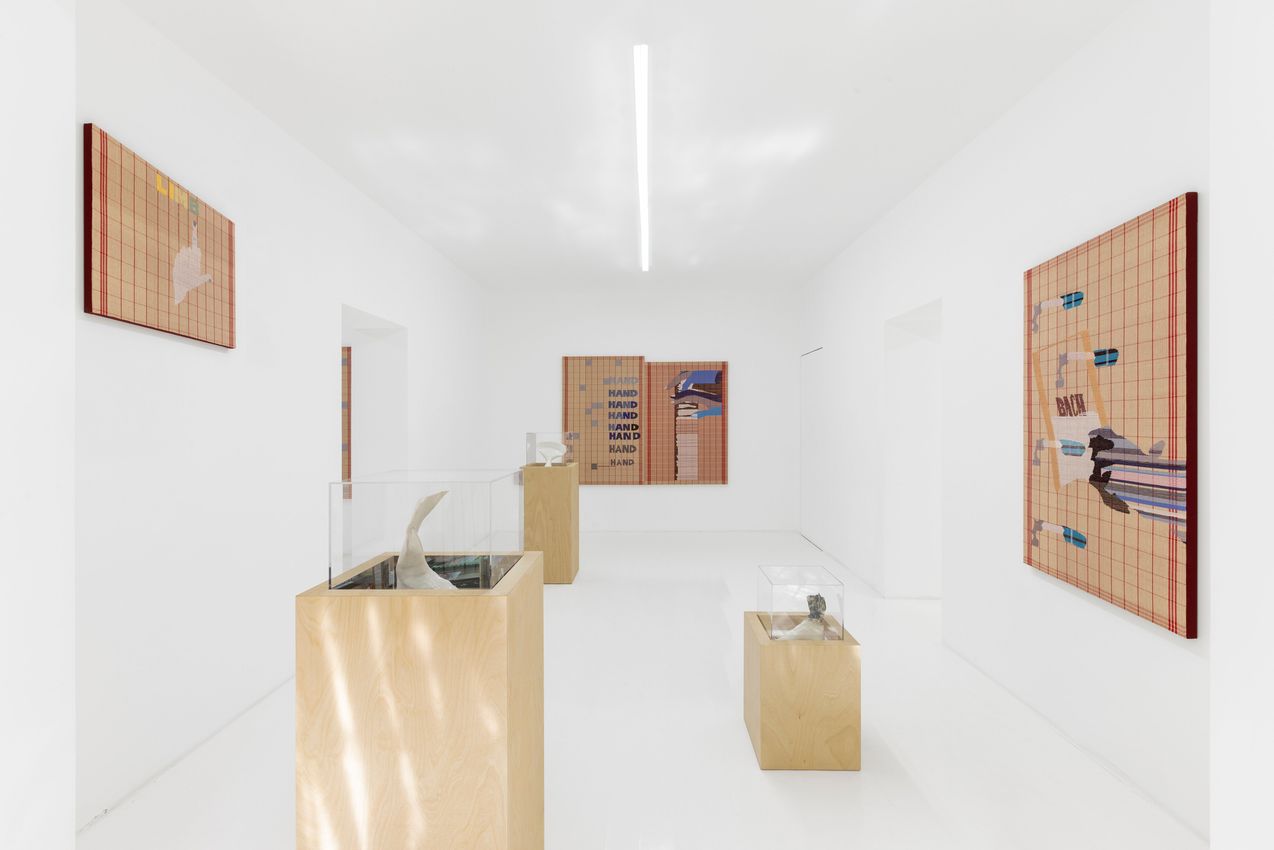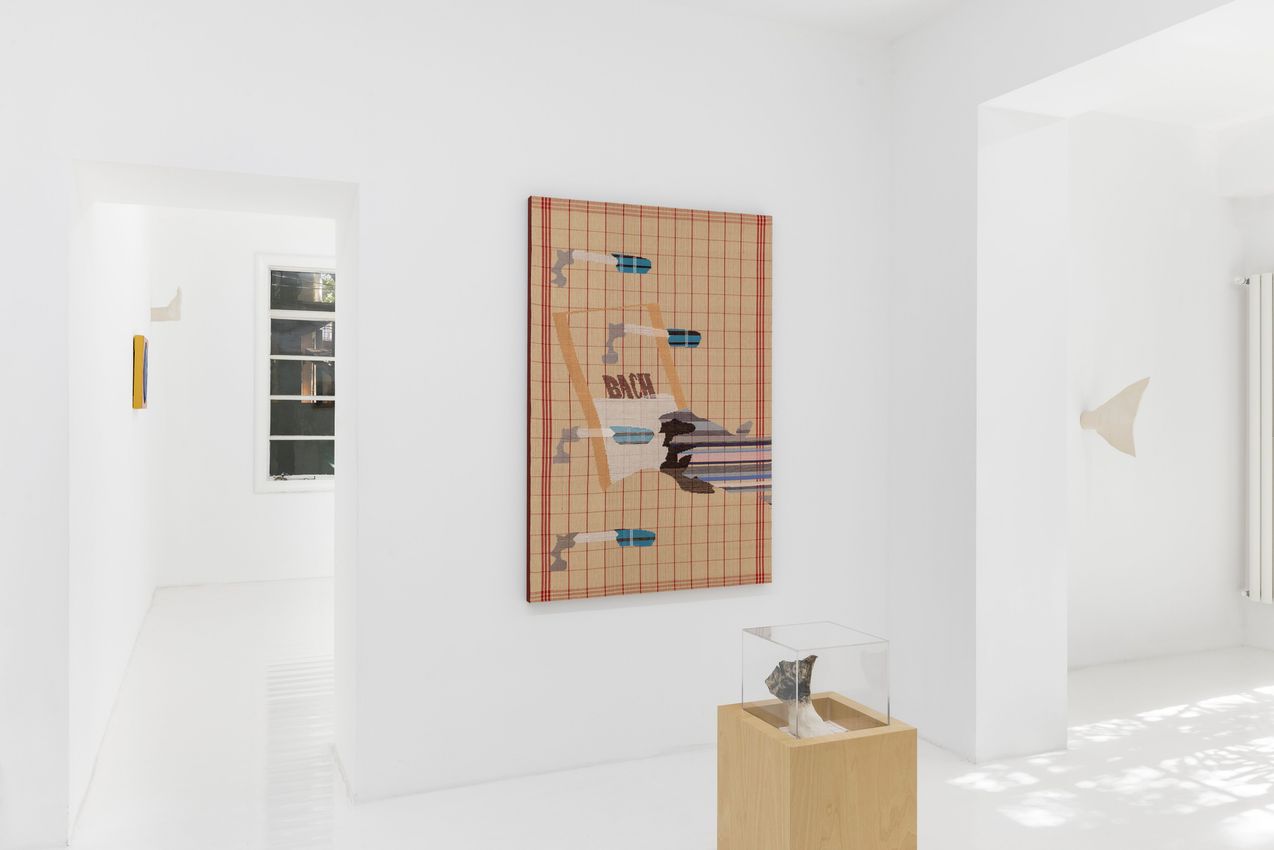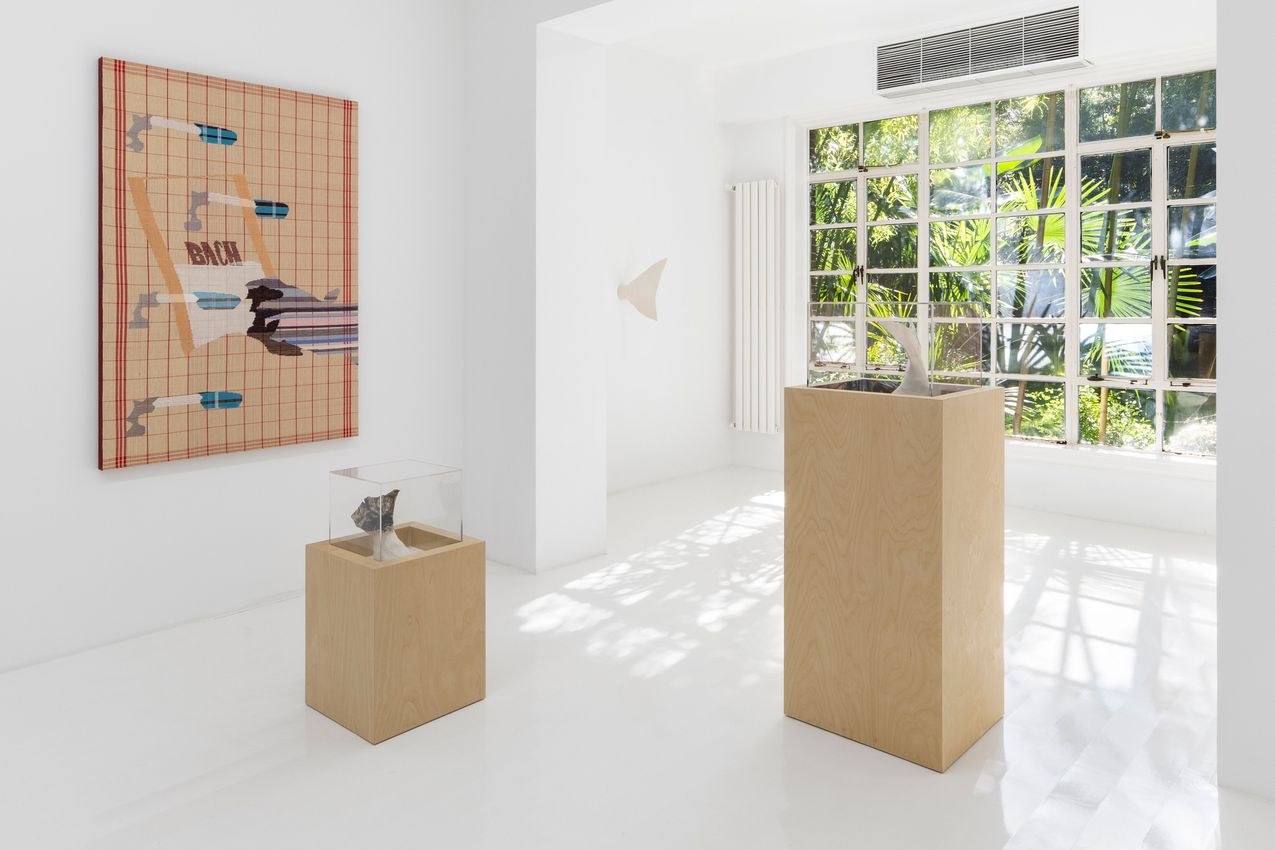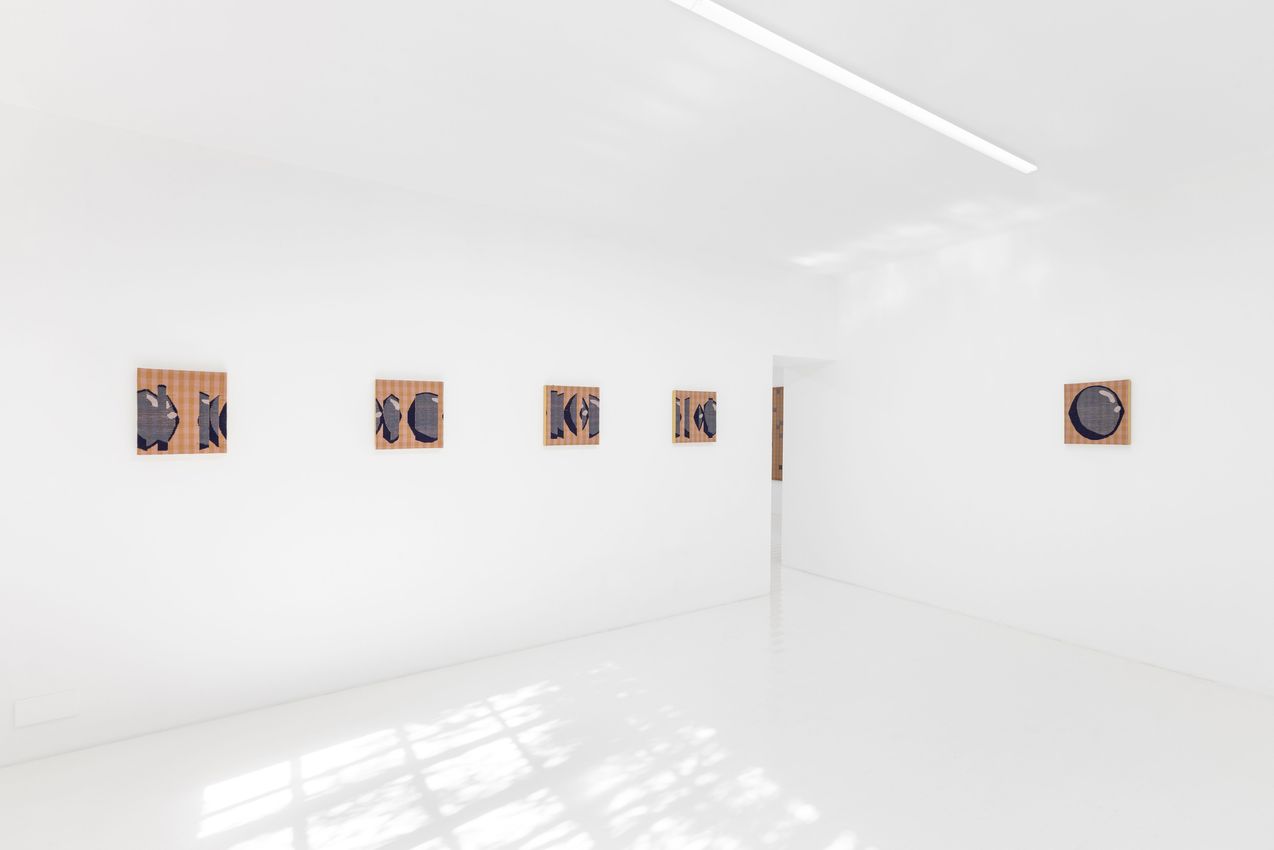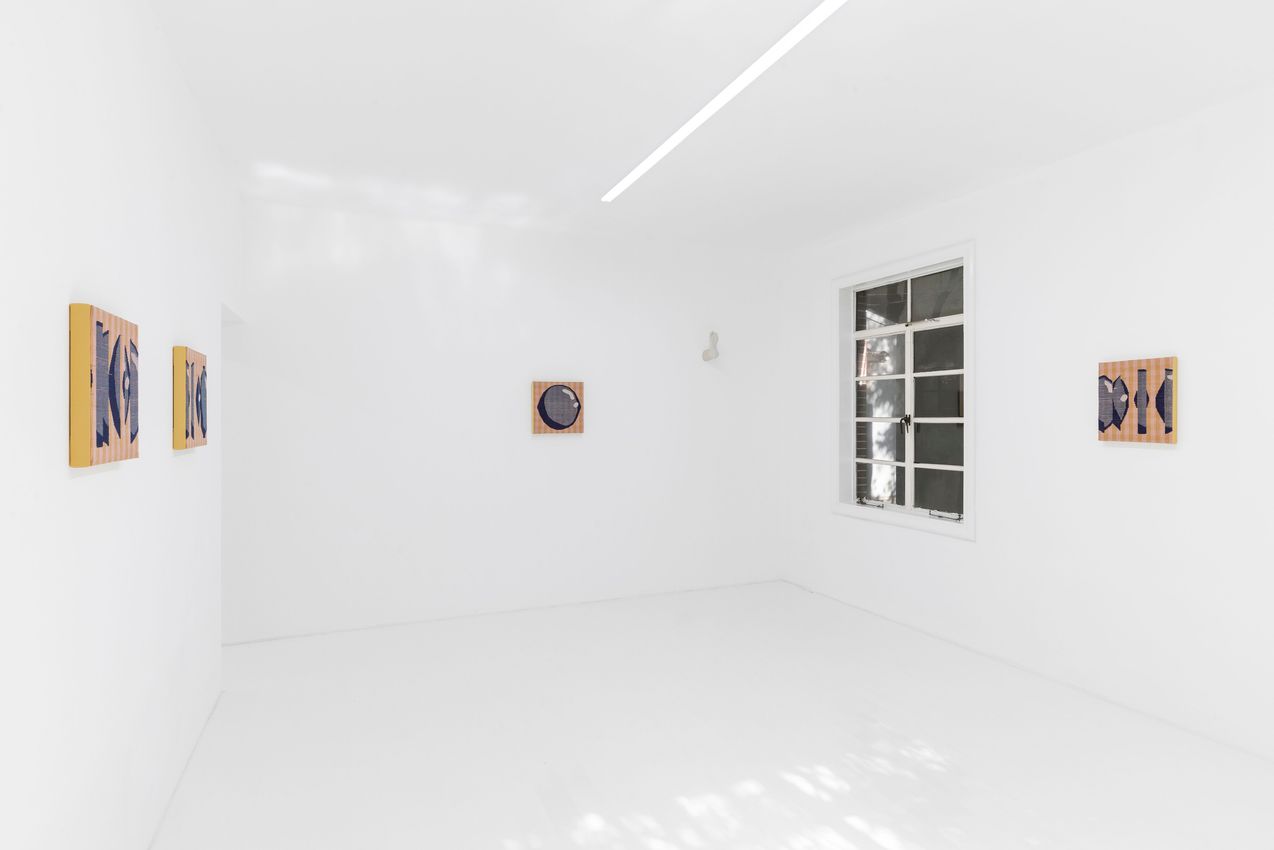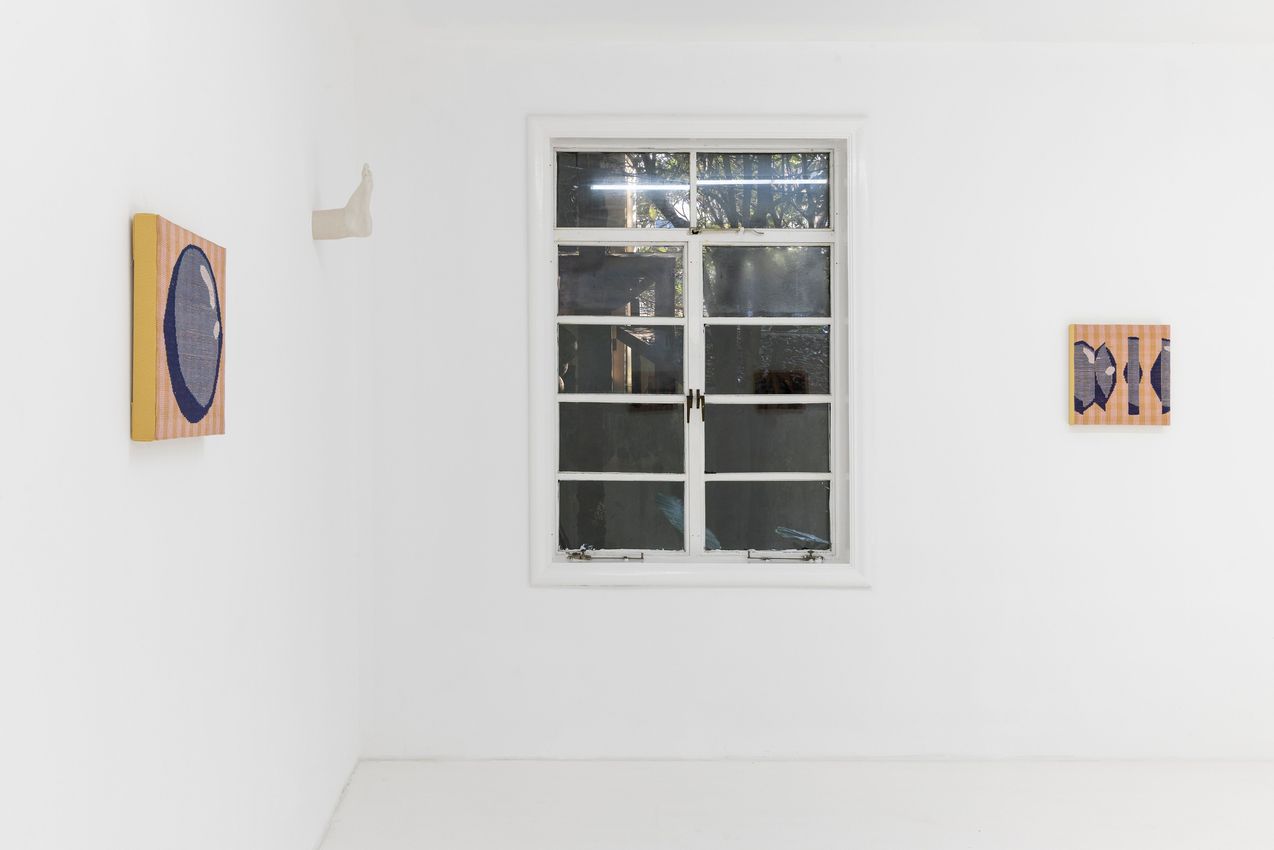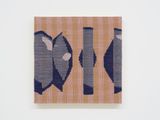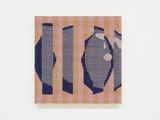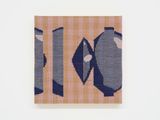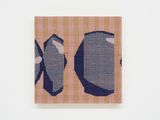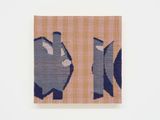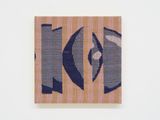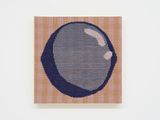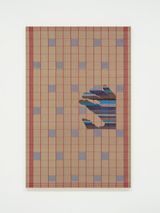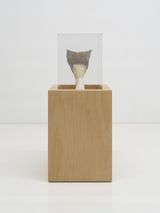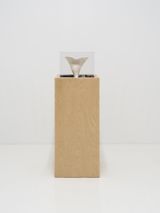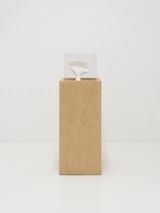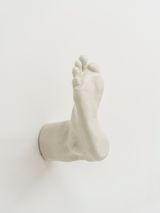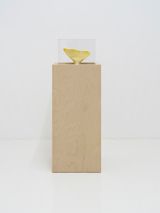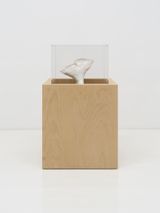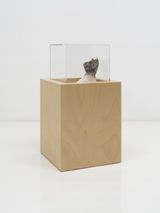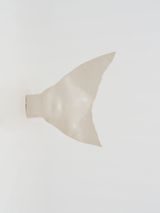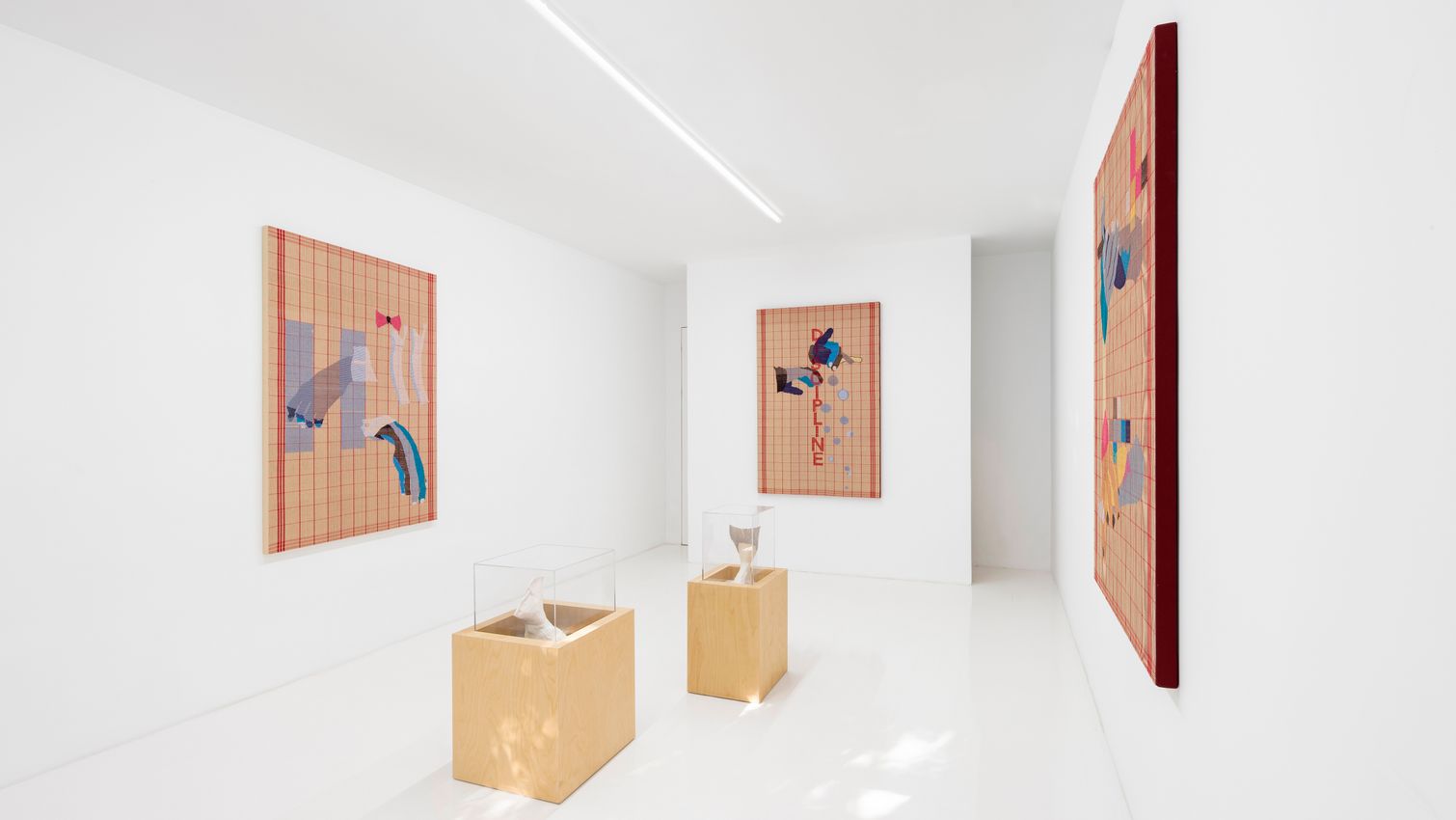
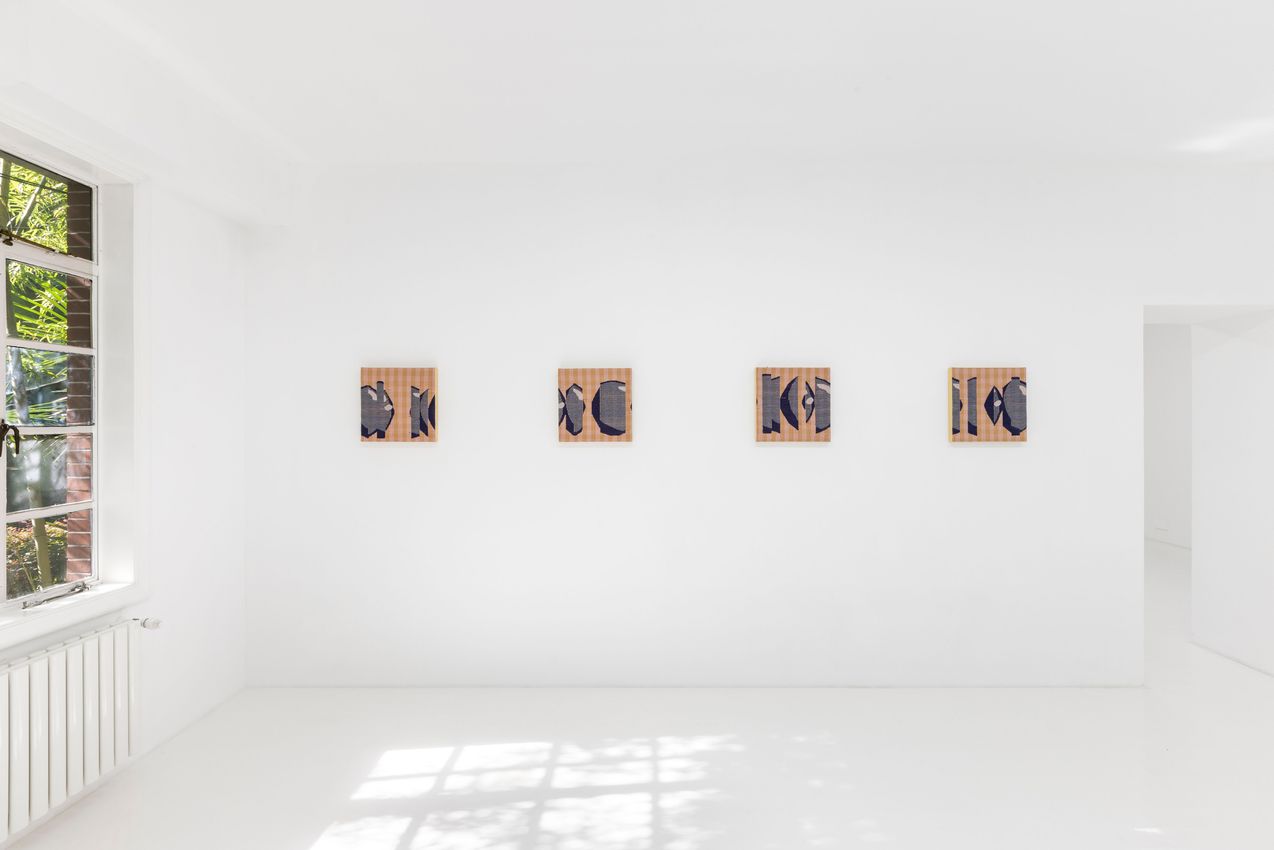
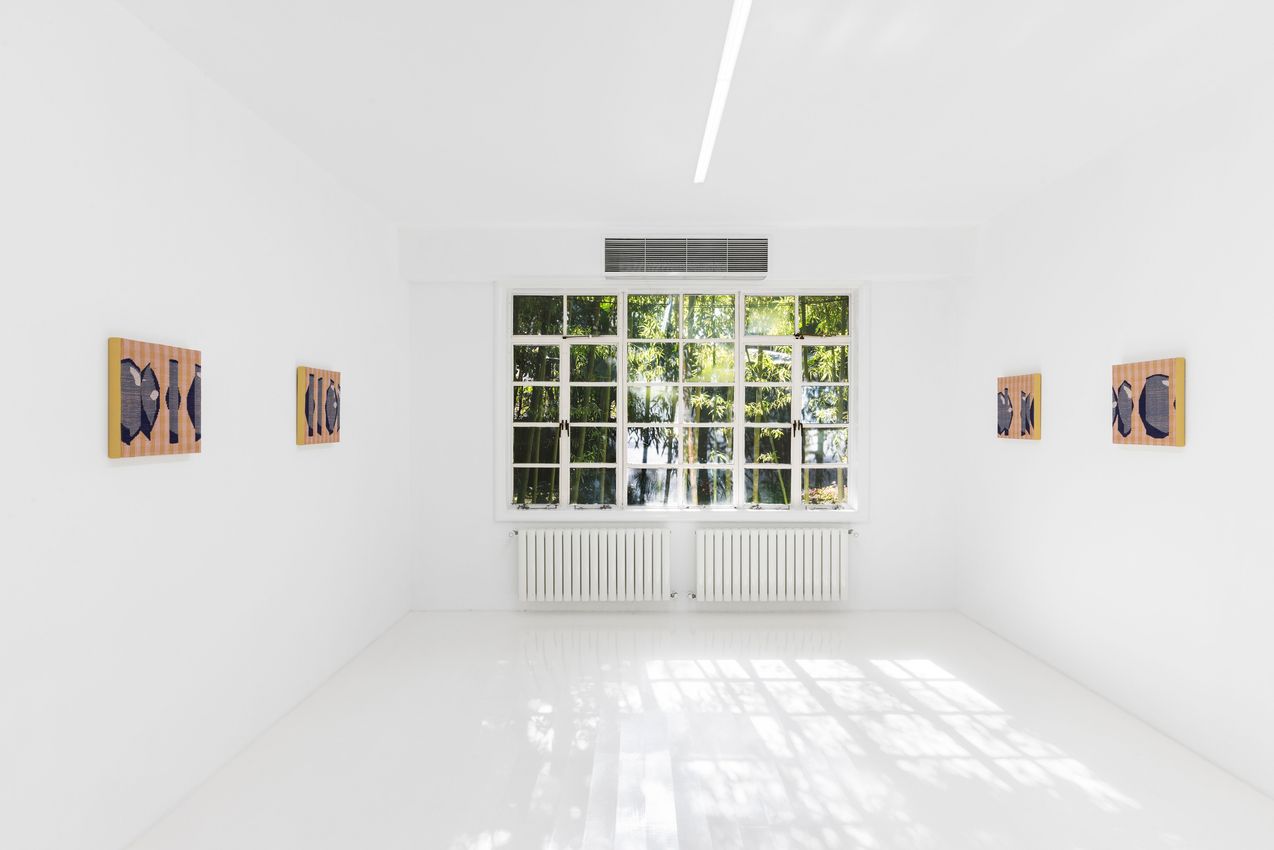
Capsule is pleased to present New York-based artist Miranda Fengyuan Zhang’s second solo exhibition at the gallery Perpetual Temptation, on view from November 8 to December 24, 2025. The exhibition marks Zhang’s first official foray into sculpture, featuring a suite of ceramic works modelled after a large right foot with a truncated big toe. Cast from the body of one of the artist’s acquaintances, each sculpture fuses a human foot with a fish’s tail. The surreal amalgams, partially submerged in the bases of custom-built vitrines, inflect the other works on view with allegory. Faced with two sets of weavings haunted by the recurring image of a blue bubble, which appears in varying guises—small and matte, large and shiny, pixelated, or fragmented—one recalls the bubbles into which Hans Christian Anderson’s little mermaid dissolves after suffering acute pain in her feet while walking on dry land. The works in which the bubble appears fragmented suggest an impossibility: the film holding the pocket of air has been sliced into ribbons, but the edges of the ribbons still trace a curve, like the mind clinging to the memory of a phantom limb.
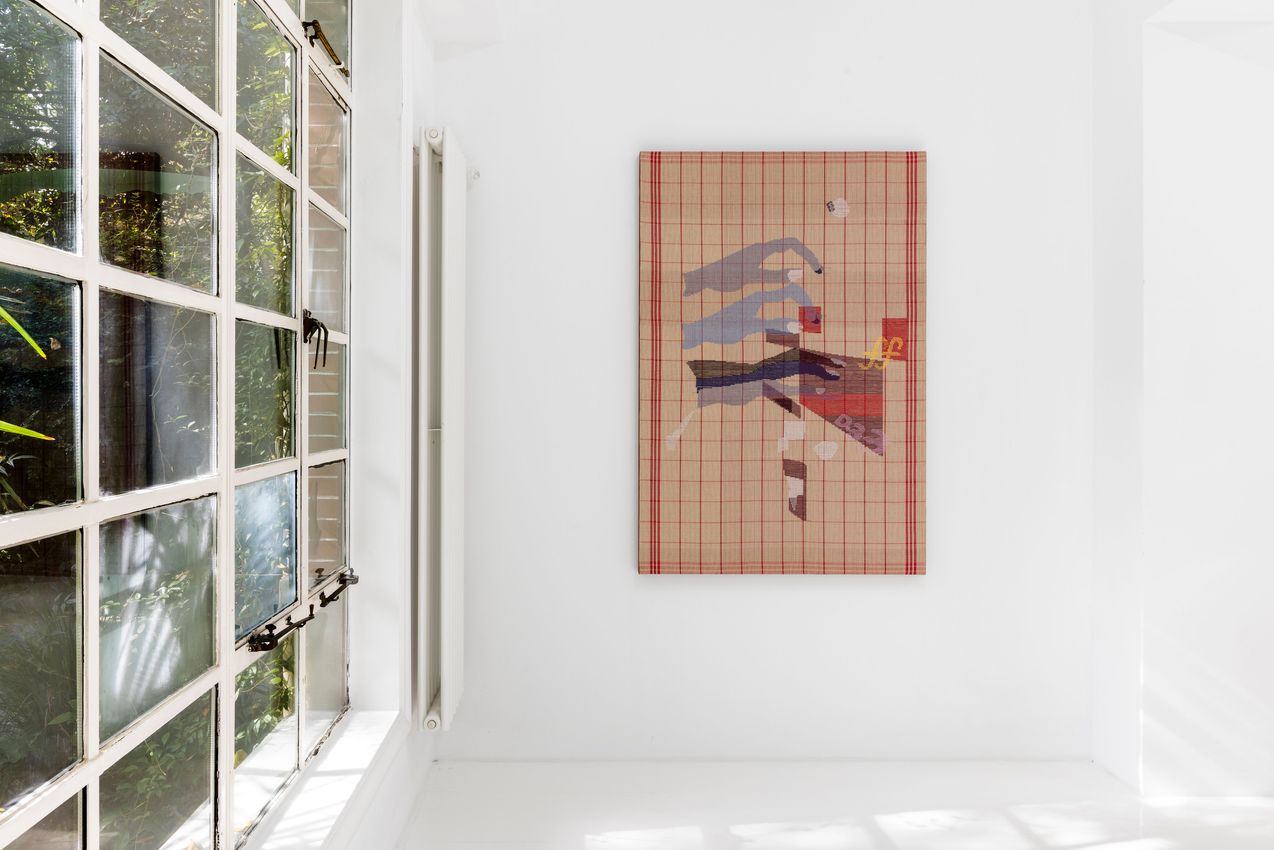
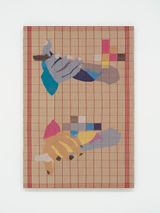
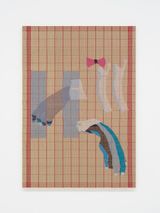
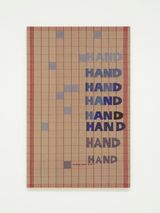
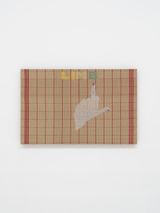
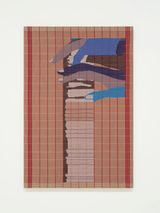
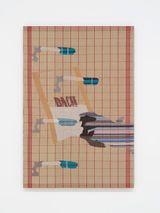
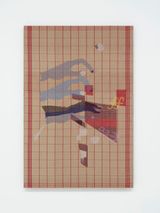
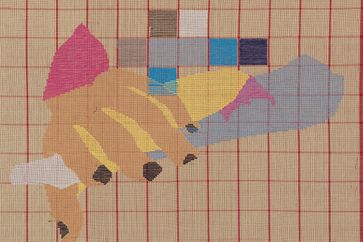
Zhang devotes almost religious attention to the anomalous foot, transforming it into a votive offering, a fetish in the spiritual sense. By contrast, her woven depictions of hands – flattened as they are into broad, Matisse-like colour planes—show little reverence. Nimble fingers used to weave textiles, play musical instruments, and perform mundane tasks between sprints of creative labor are not venerated so much as they appear exploited as instruments of work. In HANDS (all works 2025), a set of hands is labeled “HAND”; this unsettling redundancy evokes the kinds of categorisation and assessment that streamline worker exploitation in capitalist societies. In LIMB, a raised middle finger seems fed up with the status quo; meanwhile, the drained shell of another hand clings to the surface of Em. Glenn Holding Hands Posing depicts a tender power struggle between two hands: in the upper portion of the composition, one cups the other shown in profile; below, the hands inver—the cupped hand presses down on its counterpart’s upturned palm, as if it’s won an arm-wrestling match.
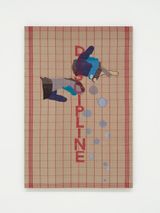
One of Zhang’s weavings reads, “DISCIPLINE,” evoking, again, a sense of regulation, both externally and internally imposed. At first blush, the pair of hands held aloft here resembles a puppet master’s. On closer inspection, the hands are actually those of a pianist. The left hand is crossing over the right to ring a key on the other side. These hands are modelled after those of the late Canadian pianist Glenn Gould (1932–1982), Zhang’s longtime muse. They come from a black-and-white photograph in which the maverick musician leans over his keys in a white, faintly checkered shirt that echoes the gridded grounds of Zhang’s weavings. Weaving and piano-playing are comparable in certain respects: both rely on a system of taut fibers, and both are creative acts that can be mechanized (see, for instance, the power loom and the player piano). Photographed mid-recital, hard at work, Gould flashes a broad, enigmatic smile.
Gestures without implements become dance. Images of emptied hands—think: the soldier in Auguste Rodin’s L’âge d’airain (1877) without his spear—hold sway over the collective imagination partly because of their ambiguity and partly because so many relics from antiquity are themselves incomplete, and we have been taught to see these fragments as beautiful—even ideal—forms. The Doryphoros of Polykleitos is missing his weapon, the Venus de Milo her arms, the Niké of Samothrace her head, too. Then there is the Miletus torso, the beloved object in Rainer Maria Rilke’s 1908 sonnet “Archaic Torso of Apollo,” which registers the broken sculpture’s “curved breast” and “placid hips” for want of its “legendary head / with eyes like ripening fruit.”
Rilke wrote this poem after spending a year working as Rodin’s private secretary in a suburb of Paris. The two men had met in 1902, shortly after which the young and then-obscure poet published a monograph on the older, celebrated artist. Their working relationship inspired Rilke to want to change his writing style; he started to consider his own early works, in the words of poet Mark Doty, “airy” and “disembodied,” compared to the “highly physicalised forms” conceived by the maker of Le Penseur (1904) and Iris, messagère des Dieux (1891–94). But Rilke was dismissed suddenly from his post by the notoriously temperamental sculptor. The encomium to the Miletus torso, tinctured by this recent rejection, ends with the oft-quoted lines, ”[H]ere there is no place / that does not see you. You must change your life.” The volta is said to represent the speaker’s realization, upon beholding the ancient torso, that he must make himself worthy of the beautiful and erotically charged fragment, which seems also to be the tension that lies at the heart of Zhang’s material investigations. One is left to wonder how this will be accomplished: through greater control and disciplined action, or through total surrender to the temptations of form and flesh?
Text by Jenny Wu. Courtesy Capsule, Shanghai.
Miranda Fengyuan Zhang (Shanghai, China, 1993, lives and works in New York City) embraces cultures and ties them together using fragments of wools. The concept of “recycling” what is considered abandoned is inspired by her grandmother, who, during difficult times, unraveled jumpers to knit new ones, creating interesting shapes and unexpected color palette, which goes beyond the idea of recycling, and speaks of parental love and the connection between external and internal beauty. In her work Zhang creates semi-abstract gardens, vaguely concrete landscapes, animal silhouettes, tranquil rivers and layers of colorful mountains, celebrating the mythology of life and nature.

Established in late 2016 by Italian gallerist and long-time influential figure of the Shanghai art scene Enrico Polato, Capsule Shanghai is a self-described ‘gallery and art laboratory’ based in Shanghai’s central Xuhui District. Situated on the first floor of a picturesque 1930s garden house in the idyllic greenery of the former French Concession, the gallery works primarily with emerging Chinese and international artists who push the boundaries of contemporary art. Its special focus has been on artists who have personally and professionally migrated between regions, creating unique trans-national and trans-regional links.
A respected voice in contemporary art discourse.
Focusing on ambitious storytelling and insightful art-world commentary. Ocula Magazine publishes in-depth interviews, critical essays and timely analysis on the artists, exhibitions and ideas driving the global art world.
Learn more about Ocula Magazine
Showcasing the best of the art world.
Ocula partners with galleries from around the world to highlight their artists, artworks and exhibitions. Gallery membership is by application and invitation, with each member vetted by an independent panel.
Learn more about Ocula Membership

Specialises in the sale of major artworks.
Led by a team with deep ties to the world’s leading auction houses, galleries and collectors. Ocula’s advisory team offers bespoke services to high-net-worth clients from around the world who are looking to acquire the best of contemporary and modern art.
Learn more about our team and services