The artist is marking his return with an explosive show made up of oil paintings on canvas and paper as well as a large installation exploring the question of play in human societies.
Born in 1970 in GDR, Norbert Bisky has spent the last 25 years delving into the notion of political utopia, looking at its practical ambiguities and the importance of the ideology. The fall of the Berlin wall in 1989 and his discovery of the West led him to choose a career as an artist. He has since built an exuberant and engaged art practice on what was both a historical and personal upheaval.
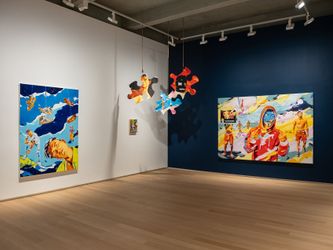
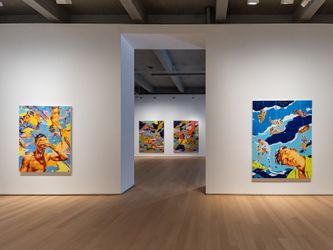
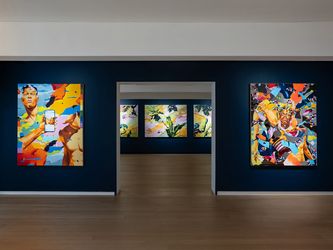
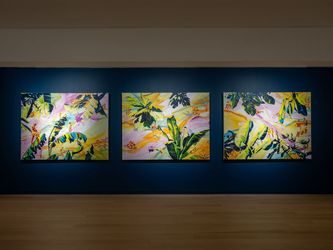
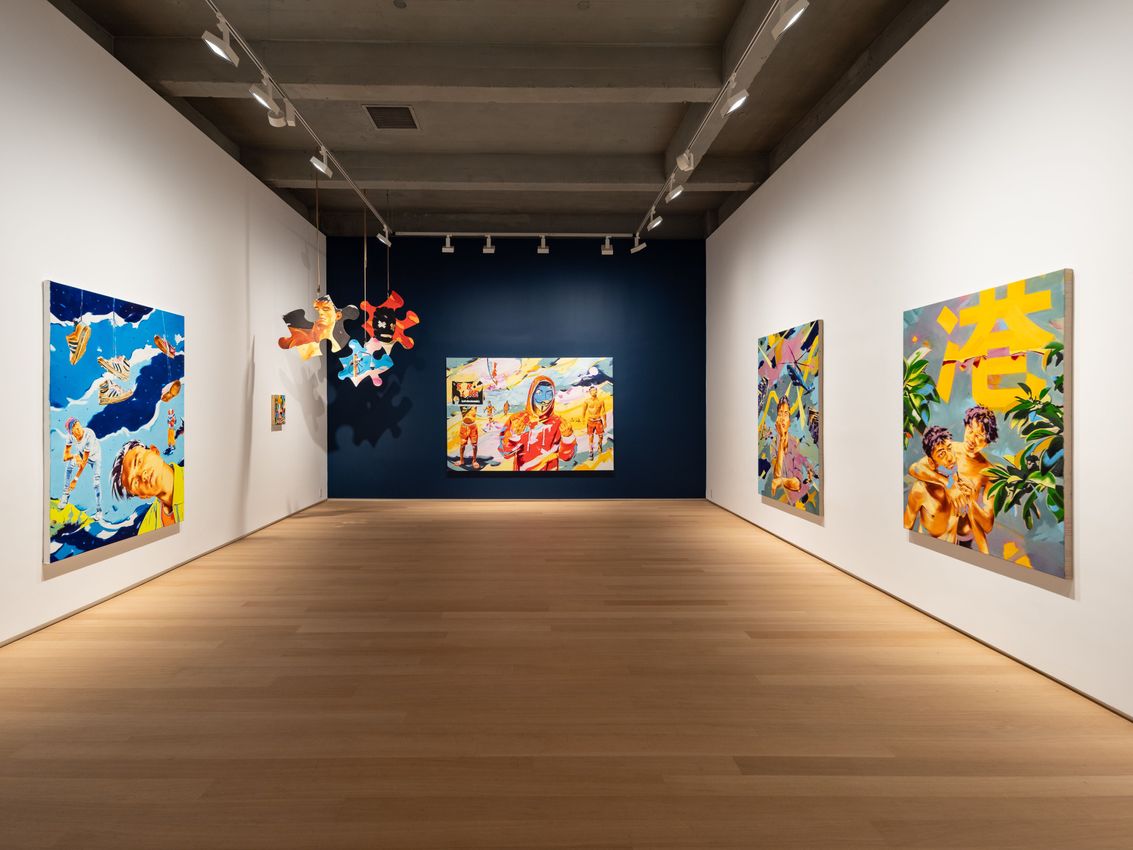
The series of oils on canvas with their shimmering colours, almost unbearably vivid, are rooted in the socialist realism of his childhood as well as the codes of contemporary hedonism. Ludology is based on the work of Dutch historian and cultural theorist Johan Huizinga, who contrasts Homo Faber, rational and focused on progress, with Homo Ludens, a being governed by the characteristics of play. Ludology is Bisky’s interpretation of play philosophy, lifting the curtain on the ambiguity of a society obsessed with perfection and idleness.
Each painting can be understood in two different ways: is the troop of boys in protective overalls the sign of coming catastrophe or a nod to a fetishist performance? Is the clown who keeps tight hold of a bouquet of balloons going to a birthday party or playing the main part in a horror film? Does the plane wreck testify to a war zone or is it part of the decor at a desert rave party?
At the heart of the gallery, several large pieces of a puzzle made of plywood and painted on both sides are arranged as an installation symbolising this double-edged narrative. What Bisky does here, including with the style and pictorial codes of the work, is to link the radical subjectivity of expressionism to the idealised realism of propaganda art and the glossy aesthetics of advertising. He also draws an explicit link between the urban world and lush tropical nature, pornography and political activism. ‘More and more in my work I play with signs and symbols, which have become key elements of my art over the last decade,’ he explains. ‘I create a dialogue between them and arrange them in my new collages so they represent an ambivalent vision of the world around us, permanently swinging between utopia and disenchantment.’
Press release courtesy Templon


Norbert Bisky was born in 1970 in Leipzig, Germany. His treatment of landscapes and exploration of the portrait and narrative structure place him firmly in the tradition of great European painting. But Norbert Bisky’s experiments with breaking down forms and with blocks of colour also place him on the borderline of abstract art. His figurative style of painting, conjuring up the socialist realism he experienced as a child in GDR, suggests both hedonism and chaos in its contemporary form.


A respected voice in contemporary art discourse.
Focusing on ambitious storytelling and insightful art-world commentary. Ocula Magazine publishes in-depth interviews, critical essays and timely analysis on the artists, exhibitions and ideas driving the global art world.
Learn more about Ocula Magazine
Showcasing the best of the art world.
Ocula partners with galleries from around the world to highlight their artists, artworks and exhibitions. Gallery membership is by application and invitation, with each member vetted by an independent panel.
Learn more about Ocula Membership

Specialises in the sale of major artworks.
Led by a team with deep ties to the world’s leading auction houses, galleries and collectors. Ocula’s advisory team offers bespoke services to high-net-worth clients from around the world who are looking to acquire the best of contemporary and modern art.
Learn more about our team and services