David Kordansky Gallery is pleased to present Magic, Mystery & Legerdemain, the gallery’s first solo exhibition event by Derek Fordjour. Taking its title from the magician Black Herman’s 1938 autobiographical book Black Herman’s Secrets of Magic, Mystery and Legerdemain, the show provides a multifaceted forum in which Fordjour explores magic as it relates to power, race, and a myriad of illusions throughout American history. Magic, Mystery & Legerdemain will be on view March 26 through May 7, 2022, with magic performances by Kenrick ICE McDonald occurring daily at 2 PM Tuesdays through Saturdays during the run of the show. An opening reception will take place on Saturday, March 26 from 6 to 8 PM, with the magic performance occurring at 7 PM.
In his wide-ranging practice—which encompasses painting, sculpture, and performance—Derek Fordjour grapples with the many strata of artmaking on physical, conceptual, and straightforwardly human terms alike. Magic, Mystery & Legerdemain is a multisensory experience that comprises various elements and highlights the multidisciplinary nature of Fordjour’s work. It includes sculptures and paintings constructed using the artist’s signature collage technique; an architectural installation featuring a live performer at the gallery’s entryway; and a live magic show that will be staged daily. Both the object- and performance-based works on view allude to the use of magic to restructure stories, myths, and folklore across a range of cultures and diasporas. Fordjour employs magic—and specifically, the life of Black Herman—as a living metaphor in which the wilful suspension of disbelief is alternately seen as a privilege afforded to some, a luxury unavailable to others, or a necessary mode of survival.
In his largest painting to date, Fordjour begins a new series mapping of the Black diaspora by rendering images of ceremonial processions; in this instance, portraying rituals specific to descendants of enslaved peoples in Salvador, Brazil. The painting depicts a Carnival parade that forms part of an annual festival in which traditions of Afro-Brazilian folklore, music, and dance are celebrated. The sheer scale of the painting requires viewers to take it in, panel by panel, conjuring the experience of witnessing an actual procession in real time. Across from the mural is an installation of sculptural interventions including kinetic, totem-like, and electrical works. Magic is shown here as a way of seeing the world—indeed, a way of life—in which the ceremonial power of cultural traditions establishes connections to the past as well as visions of a more liberated future.
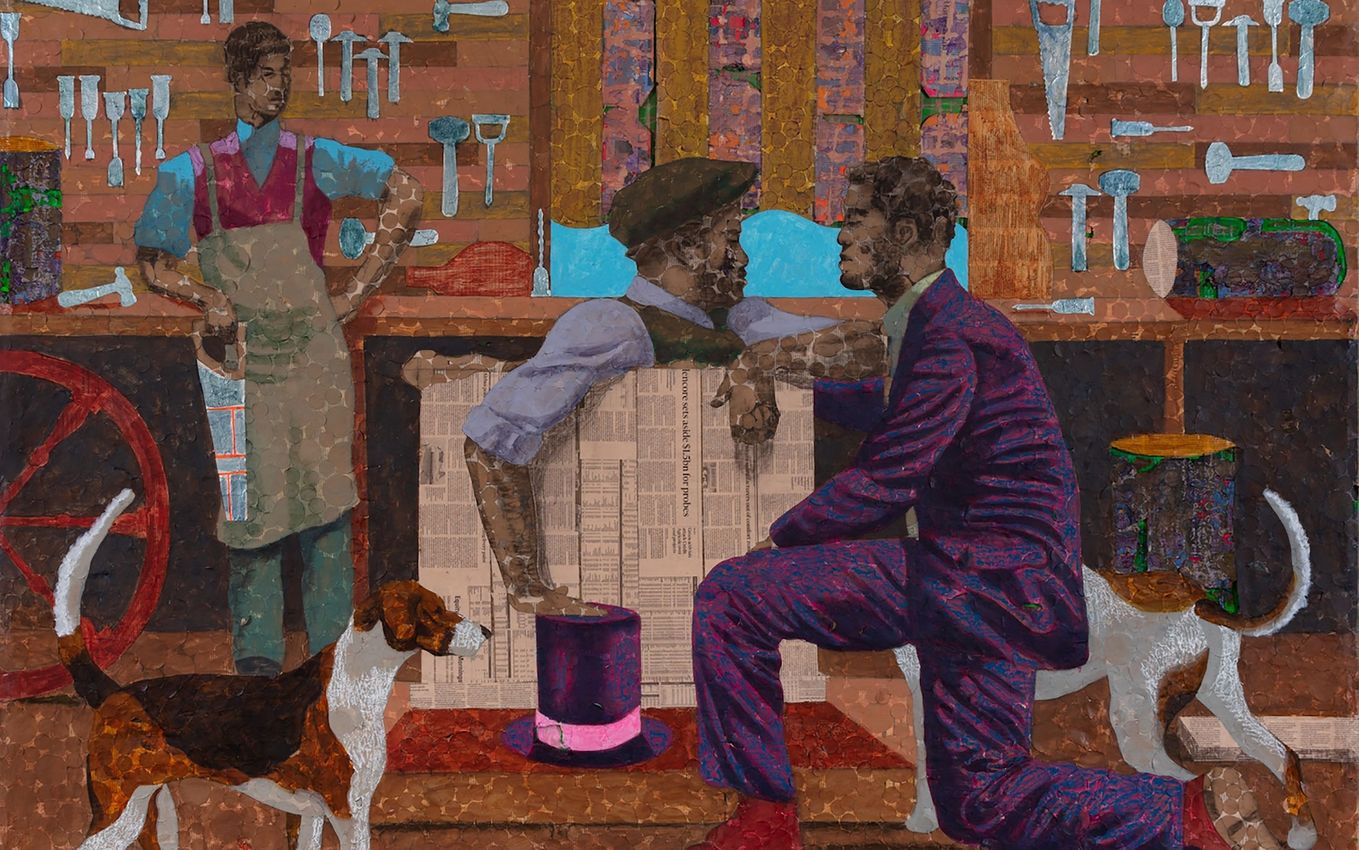
Other paintings on view feature images of figures drawn from periods that range from the early nineteenth century to the 1990s. Cargo, for example, is an atmospheric portrait of magician and former enslaved person Henry Box Brown, who, in 1849, mailed himself in a wooden crate to abolitionists in Philadelphia using the United States Postal Service. While other visual representations of Box Brown show him successfully emerging from the crate in the company of white abolitionists, Fordjour underscores another, perhaps more decisive, phase during the leadup to the journey, which required intensive planning and allyship. He depicts James C.A. Smith, a free Black man, taking a knee while locked-eye-to-eye with Box Brown, who is settling into the box with one hand resting on his top hat, foreshadowing his later career in England touring with an anti-slavery panorama and performing as a magician and showman. Fordjour’s exuberant visual materiality gives added rise to otherwise ambient scenes of interaction and conversation. It also allows Fordjour to show how trickery and disappearance can function as necessary tools for survival, both within the arts and without.
Experiences of deception and disorientation depicted in the paintings and sculptures become actualised for viewers as they navigate the architectural installation and daily magic performance that anchor the exhibition. Outside a structure that resembles the types of venues in which Black Herman would have performed his traveling stage show, a live performer acts as a door tending usher. Within the space, meanwhile, Los Angeles-based magician Kenrick ICE McDonald will present well-honed theatrical magic he has perfected over the course of a decades-long career. In collaboration with artist/director Numa Perrier, Fordjour creates a multi-sensory theatrical show reminiscent of vaudevillian era performances tinged with light camp, kitsch, and a live organist. The experience further advances Fordjour’s interest in power, narrative, rituals, and performance, allowing for full immersion in the mystery, humor, and pathos of a popular art form whose roots extend beyond the domain of visual art. At the same time, it underscores his interest in posing questions about magic’s ability to distort reality—or accurately represent a reality that is already distorted—and to explore the blurry space between belief and authenticity.
Derek Fordjour (b. 1974, Memphis, Tennessee) was recently selected by The Museum of Contemporary Art, Los Angeles (MOCA) to inaugurate its new outdoor art series, Building Art, with a monumental artwork spanning over 5,400 square feet, Sonic Boom, opening March 28, 2022. Other recent solo exhibitions include the Pond Society, Shanghai (2021) and Contemporary Art Museum St. Louis (2020). In 2018, commissions for the Whitney Museum of American Art Billboard Project and the Metropolitan Transit Authority Arts & Design program resulted in major public projects in New York. Recent group exhibitions include The Slipstream: Reflection, Resilience, and Resistance in the Art of Our Time, Brooklyn Museum, New York (2021); Present Generations: Creating the Scantland Collection of the Columbus Museum of Art, Columbus Museum of Art, Ohio (2021); 100 Drawings from Now, The Drawing Center, New York (2020); and Plumb Line, the California African American Museum, Los Angeles (2019). His work is in the permanent collections of institutions including the Whitney Museum of American Art, New York; Dallas Museum of Art; Pérez Art Museum Miami; Los Angeles County Museum of Art; Brooklyn Museum, New York; Museum of Contemporary Art Chicago; and The Studio Museum in Harlem, New York. Fordjour served as the 2020 Alex Katz Chair of Painting at The Cooper Union, New York, and serves on the faculty at the Yale University School of Art, New Haven, Connecticut as a core critic. Fordjour lives and works in New York.
Derek Fordjour is a Memphis-born, New York–based artist whose layered paintings, sculptures, and installations follow Black performance, sport, music, and social ritual across the field of contemporary life. Working through collage-based painting and immersive exhibition formats, he renders the textures of the Black American experience, from stadiums and parades to churches, nightclubs, and city streets.


David Kordansky Gallery is one of the most dynamic venues for contemporary art, and is internationally regarded as a leading gallery of its generation.

A respected voice in contemporary art discourse.
Focusing on ambitious storytelling and insightful art-world commentary. Ocula Magazine publishes in-depth interviews, critical essays and timely analysis on the artists, exhibitions and ideas driving the global art world.
Learn more about Ocula Magazine
Showcasing the best of the art world.
Ocula partners with galleries from around the world to highlight their artists, artworks and exhibitions. Gallery membership is by application and invitation, with each member vetted by an independent panel.
Learn more about Ocula Membership

Specialises in the sale of major artworks.
Led by a team with deep ties to the world’s leading auction houses, galleries and collectors. Ocula’s advisory team offers bespoke services to high-net-worth clients from around the world who are looking to acquire the best of contemporary and modern art.
Learn more about our team and services