



BRICE MARDEN
1938-2023, United StatesBrice Marden was a pioneering contemporary artist best known for his lyrical abstractions that evolved from austere minimalism to gestural calligraphic forms inspired by Asian art and landscape.
Early Years
Born in Bronxville, New York in 1938, Brice Marden was raised in nearby Briarcliff Manor. He earned a BFA from Boston University in 1961 and an MFA from Yale School of Art in 1963, where he studied alongside artists like Chuck Close and Richard Serra. The rigorous academic training and exposure to abstract expressionism, combined with time spent in Europe, particularly Paris and Rome, would leave a lasting imprint on his visual language.
Marden lived and worked in New York and Hydra, Greece with his wife Helen Marden. The island’s luminosity and stark forms would notably influence his palette and approach to light, shadow, and surface.
Early Minimalism (1960s)
In the 1960s, Brice Marden emerged as a key figure in post-minimalist contemporary art with his quietly radical monochrome paintings. Works like The Dylan Painting (1966) demonstrate his early use of oil and beeswax, creating matte, nuanced surfaces that rejected the expressive gesturalism of Abstract Expressionism in favour of restraint. Influenced by Jasper Johns and ancient icons, Marden developed a muted palette of greys, ochres, and off-whites. These paintings are contemplative and tactile, their simplicity concealing an intense materiality and depth. The surface, layered and hand-worked, conveys a meditative presence, inviting viewers to slow down and experience the artwork as both object and image.
Grove Group and Hydra Series (1971–1979)
Created during his time living on the Greek island of Hydra, the Grove Group (1972–1976) and Hydra (1971–1979) series mark a subtle shift in Marden’s practice. These works, often executed in multipart panels, reflect his deepening sensitivity to light, rhythm, and landscape. The luminous quality of the Mediterranean and the island’s austere beauty significantly influenced his palette and composition. Encaustic painting continued to be his medium of choice, yielding soft, waxy surfaces rich with nuance. Rather than depicting the environment, Marden absorbed its visual and emotional resonance, translating it into a refined exploration of balance and variation. These artworks evoke silence and stillness, revealing his mastery of tone and texture.
Calligraphic Turn: Cold Mountain Series (1988–1991)
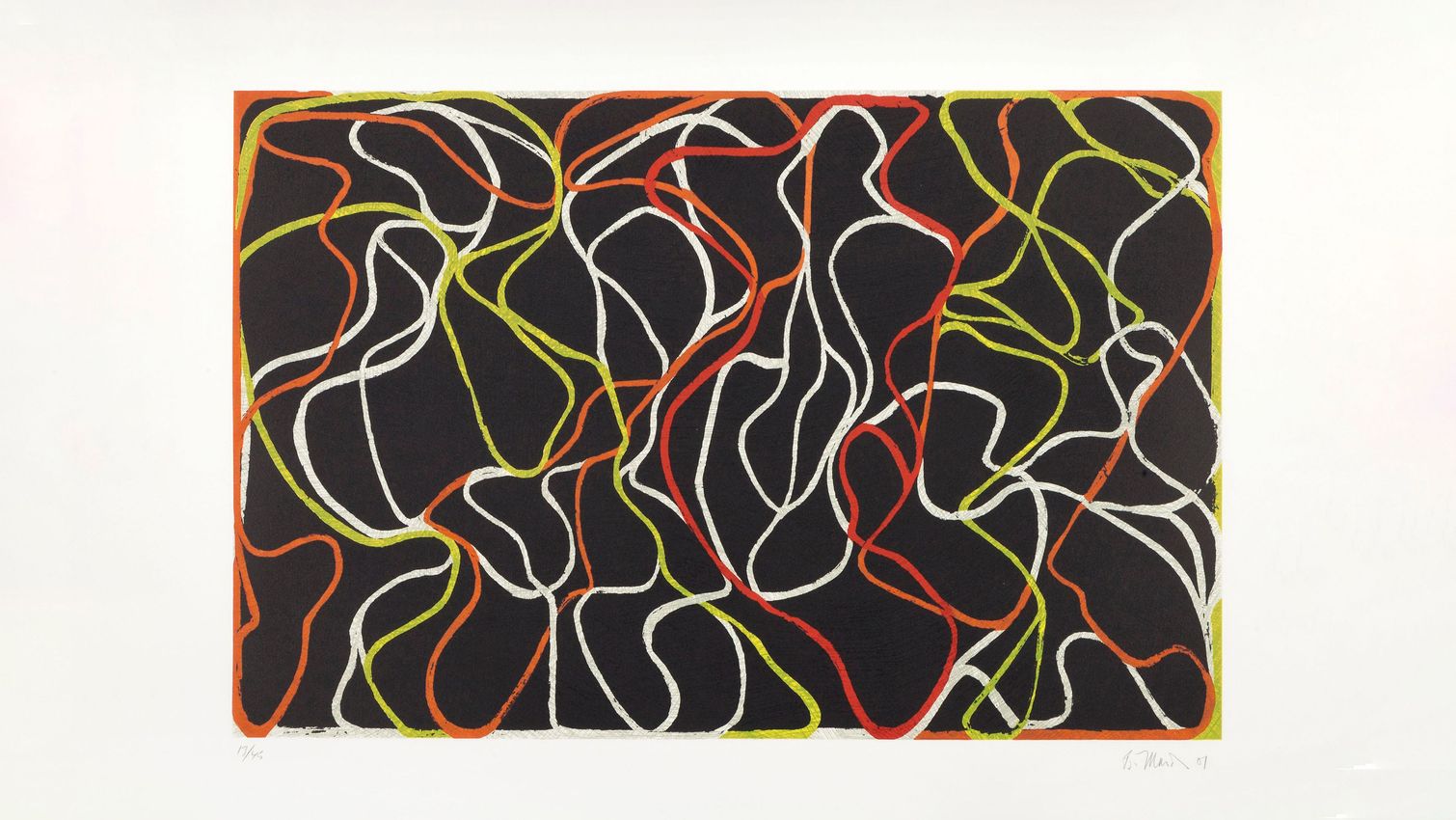
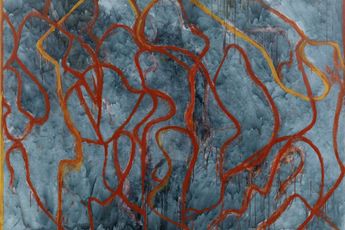
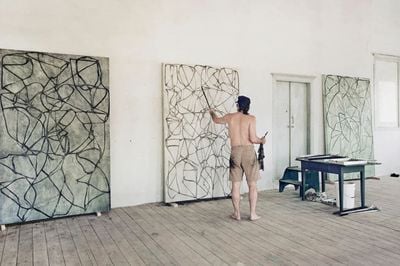
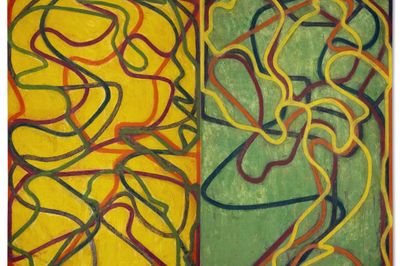
The Cold Mountain series (1988–1991) represents a profound evolution in Marden’s visual language. Inspired by the Tang dynasty poet Han Shan and Eastern calligraphy, these large-scale works introduced fluid, looping lines that appear to float or drift across the canvas. Having travelled to Thailand, India, and China in the 1980s, Marden drew deeply from these traditions, combining gestural spontaneity with structured abstraction. The result is a striking contrast to his earlier work: where his monochromes were reserved and minimal, Cold Mountain paintings pulse with movement and spiritual searching. This series signalled a new openness in his approach—merging poetry, drawing, and painting into a single dynamic expression.
Late Works and Plane Image Series (1990s–2020s)
From the 1990s until his death in 2023, Marden continued to explore gestural abstraction while reflecting on his past compositions. The Propitious Garden of Plane Image (2000–2006), a suite of six monumental panels, exemplifies this mature phase. In these works, interlacing lines unfurl across luminous fields of colour, evoking vines, roots, or script. The titles often allude to metaphysical themes, while the compositions reference both nature and writing. Marden’s return to colour was bolder, and his engagement with drawing became more pronounced. His final decades saw a deepened spirituality and refinement, as he continued probing the possibilities of mark-making, composition, and the meditative act of painting.
Public Commissions
- Window Study No. 4 (1985), stained glass design for Basel Cathedral, Switzerland
- Untitled (2015), monumental painting for the lobby of the new Whitney Museum of American Art, New York
Awards and Accolades
- Awarded the Praemium Imperiale for Painting, Japan Art Association, 2000
- Elected to the American Academy of Arts and Letters, 1991
- Represented the United States at the 41st Venice Biennale in 1984
Exhibitions
Brice Marden has been the subject of both solo exhibitions and group exhibitions at important institutions. A selection of important exhibitions are provided below.
Solo Exhibitions
- Brice Marden and Greek Antiquity, Museum of Cycladic Art, Athens (2022)
- Brice Marden: Inner Space, Kunstmuseum Basel, Switzerland (2022)
- Brice Marden: Morocco. Yves Saint Laurent Museum, Marrakech (2019)
- Brice Marden: A Retrospective of Paintings and Drawings. Museum of Modern Art, New York, NY; traveled to San Francisco Museum of Modern Art, CA; Hamburger Bahnhof, Berlin (2006)
- Brice Marden: A Retrospective of Paintings and Drawings, Museum of Modern Art, New York (2006)
- Brice Marden: Works on Paper, 1964–2001. Istituto Nazionale per la Grafica, Rome, Italy; traveled to Archivio di Stato in the Royal Palace, Turin, Italy; Westfälisches Landesmuseum für Kunst und Kulturgeschichte, Munich (2001)
Group Exhibitions
- America Will Be! Surveying the Contemporary Landscape, Dallas Museum of Art, Dallas (2019)
- Beyond words: the calligraphic traditions of Asia, Art Gallery of New South Wales, Sydney (2016)
- America Is Hard to See, Whitney Museum of American Art, New York (2015)
- The Forever Now: Contemporary Painting in an Atemporal World, Museum of Modern Art, New York (2014)
- Multiplicity, Smithsonian American Art Museum, Washington (2011)
- 41st Venice Biennale, United States Pavilion, Venice (1984)
- Documenta 5, Kassel, Germany (1972)
Critical Reception
Marden’s practice has been featured in leading publications including I__nterview Magazine, The Art Newspaper, and The New York Times.
Brice Marden FAQs
Did Brice and Helen Marden ever work together?
While Brice Marden and his wife Helen Harrington Marden were both artists, they pursued independent artistic practices. However, their creative lives were deeply intertwined. Helen, known for her vibrant, abstract paintings, shared with Brice a passion for colour, light, and travel—particularly their time on Hydra, Greece, which influenced them both. Though they did not formally collaborate on artworks, their shared environments and mutual respect created a space of creative exchange. Helen’s intuitive use of colour and Brice’s restrained formalism represent distinct yet complementary approaches, and their long marriage reflected an ongoing dialogue between two individual yet harmoniously aligned artistic visions.
What was Brice Marden’s relationship to Hydra?
Hydra, the Greek island where Brice Marden maintained a home and studio from the 1970s onward, played a profound role in his life and work. Drawn to its stark beauty, whitewashed architecture, and shimmering Aegean light, Marden found Hydra a place of both retreat and inspiration. The island influenced many key artworks, including the Hydra series (1971–1979), where light, surface, and rhythm became central motifs. The natural serenity and historical aura of Hydra resonated with Marden’s sensibilities, allowing him to explore themes of memory, silence, and place. It became a sanctuary for quiet observation and sustained artistic experimentation across decades.
How did Brice Marden influence contemporary art?
Brice Marden profoundly shaped the evolution of contemporary art through his commitment to abstraction and formal integrity. Emerging in the 1960s, he bridged the gap between Abstract Expressionism and Minimalism, rejecting grand gestures in favour of subtle, meditative surfaces. His shift to calligraphic line work in the 1980s demonstrated a fearless reinvention of his style, introducing Eastern aesthetics and poetry into Western abstraction. Marden’s synthesis of restraint and intuition inspired generations of artists to embrace hybridity and personal symbolism. His legacy lies in the quiet power of his artworks, which demonstrate how disciplined formalism can also be deeply lyrical and transcendent.
Ocula | 2025


Explore Brice Marden's Exhibitions












Explore and Follow Artists Shaping Contemporary Art
A respected voice in contemporary art discourse.
Focusing on ambitious storytelling and insightful art-world commentary. Ocula Magazine publishes in-depth interviews, critical essays and timely analysis on the artists, exhibitions and ideas driving the global art world.
Learn more about Ocula Magazine
Showcasing the best of the art world.
Ocula partners with galleries from around the world to highlight their artists, artworks and exhibitions. Gallery membership is by application and invitation, with each member vetted by an independent panel.
Learn more about Ocula Membership
Specialises in the sale of major artworks.
Led by a team with deep ties to the world’s leading auction houses, galleries and collectors. Ocula’s advisory team offers bespoke services to high-net-worth clients from around the world who are looking to acquire the best of contemporary and modern art.
Learn more about our team and services