




PHILIP GUSTON
1913-1980, CanadaPhilip Guston stands among the most influential and controversial painters of the 20th century, celebrated for his fearless confrontation with personal, political, and social turmoil. Across a career spanning five decades, Guston evolved from social realism and muralism to lyrical abstraction before making a radical, and now legendary, return to figuration in his later years. His art—emotionally charged, morally unflinching, and deeply human—has shaped generations of contemporary painters.
Early Life and Education
Born Philip Goldstein in Montreal in 1913, Guston was the child of Jewish immigrants who fled persecution in Ukraine. The family moved to Los Angeles in 1919, where his early encounters with racism and social violence shaped his lifelong preoccupation with injustice and moral conflict. Although he briefly attended Otis Art Institute, he was largely self-taught, immersed in the work of Renaissance painters and Mexican muralists such as Diego Rivera, and by the mid-1930s he was active in leftist circles, painting politically charged murals for the WPA and other organisations.
From Social Realism to Abstraction and Back
Guston’s early murals for the Queensbridge Housing Project and the Social Security Building in Washington, D.C. depicted the struggles and dignity of everyday workers. Works like Bombardment (1937), responding to the Spanish Civil War, and the Cyclopean paintings of the early 1940s signalled a shift from direct social realism to a more symbolic, psychological mode.
By the late 1940s and 1950s, Guston emerged as a central figure in the New York School, contributing to the rise of Abstract Expressionism with lyrical abstractions celebrated for their delicate brushwork, nuanced colour, and poetic sensibility. Disillusioned with what he saw as abstraction’s detachment from lived reality, he came to view it as ‘a lie’ and ‘a sham’, setting the stage for his dramatic return to figuration at the end of the 1960s.
Hooded figures and late figuration
In 1968–79, Guston developed the raw, cartoon-like figuration that defines his most famous late works, including The Studio (1969), Bad Habits (1970), and Riding Around (1969). In these paintings, hooded figures resembling Ku Klux Klan members perform banal activities, functioning as allegories of complicity, violence, and self-scrutiny; Guston described them as self-portraits, insisting that he saw himself ‘behind the hood’. At the same time, he produced the satirical Poor Richard drawings targeting President Richard Nixon and his administration, revealing a caustic political wit alongside his moral seriousness.
Intimacy, marriage, and ‘Life with P.’
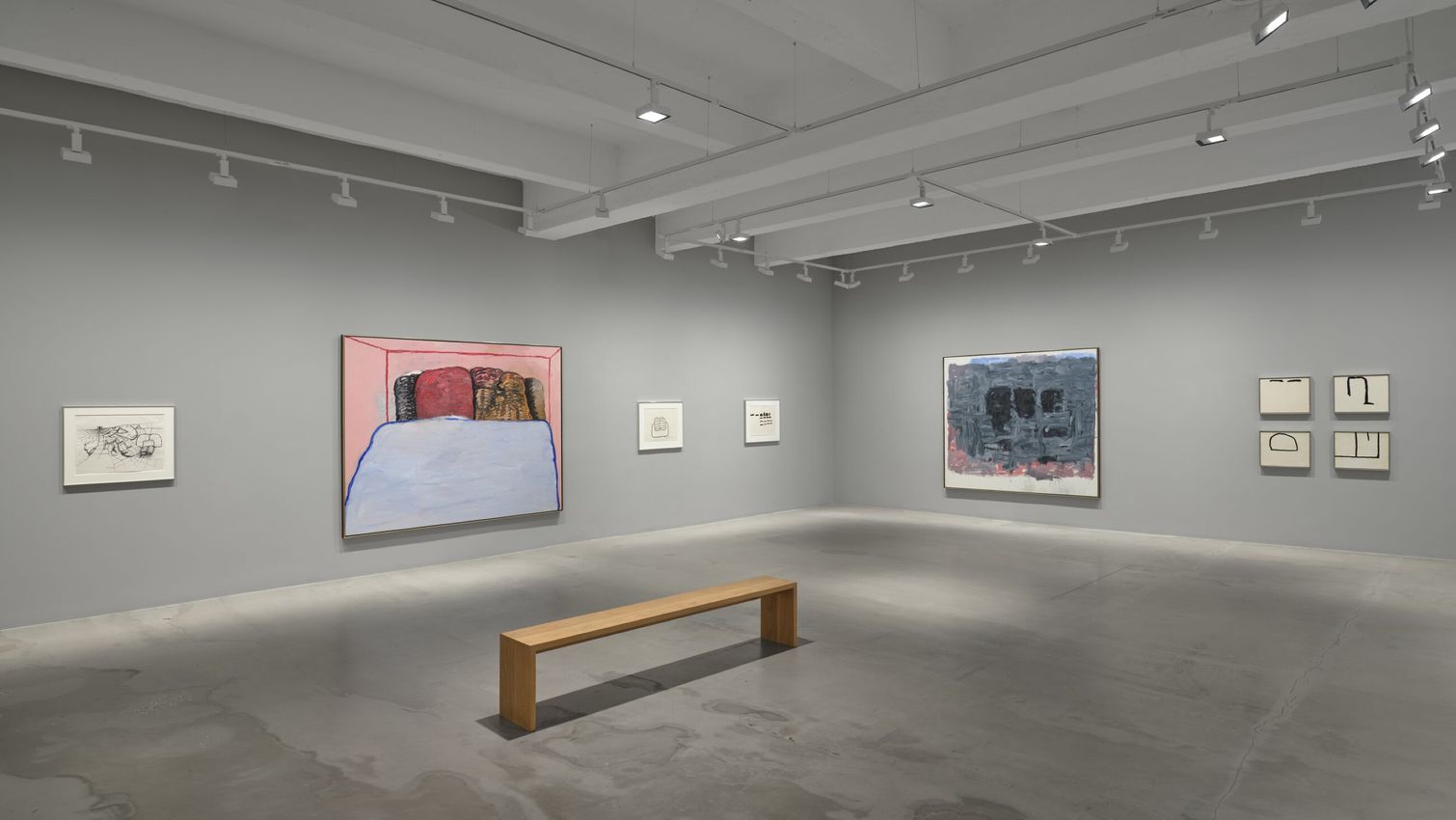
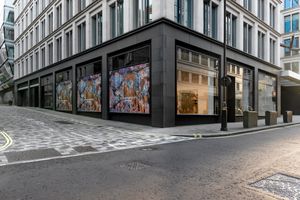
Recent scholarship and exhibitions have brought renewed attention to the intimacy and domesticity at the heart of Guston’s late work. Opening 21 April–10 July 2026 at Hauser & Wirth New York, 18th Street, Life with P. – Philip Guston: Paintings and Drawings 1964–1978 focuses on Guston’s relationship with his wife, the poet Musa McKim, and their life in Woodstock.
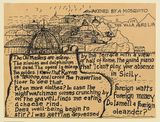
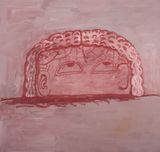
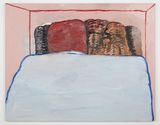
The exhibition presents a group of more personal paintings and works on paper, including Guston’s ‘Poem Pictures’, drawings that directly respond to McKim’s poetry, as well as three large-scale figurative paintings that have never before been shown in a gallery or museum. Among the works highlighted are Awakened by a Mosquito (c. 1972–1975), an ink drawing whose everyday subject echoes McKim’s writing, and Blue Cover (1977), an oil painting in which the couple appear as block-like forms bound together in the intimacy of a shared bed. Also featured is Untitled (1976), an oil on canvas depicting McKim’s distinctive curly hair and large, contemplative eyes, and works related to The Three (1964), an abstract painting that anticipates the family-centered iconography of the Woodstock years.
The show coincides with the publication of Life with P.: Journals, 1966–1976 by Hauser & Wirth Publishers, an illustrated volume of McKim’s previously unpublished journals edited and contextualised by their daughter, Musa Mayer. Spanning a crucial decade that saw Guston’s turn to his iconic late figuration, the book records daily life in Woodstock, trips to New York, travels to Italy and Mexico, and time at artist residencies, offering a candid portrait of McKim’s life as a writer and of the couple’s shared artistic world. Mayer’s notes provide further context and complement her earlier memoir Night Studio (1988), giving readers an intimate window onto Guston’s domestic and creative environment.
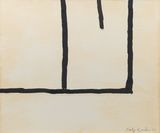
During the mid-1960s, Guston temporarily set painting aside to concentrate on drawing, developing what he called his ‘pure drawings’ between 1966 and 1967. After the couple moved permanently from New York City to Woodstock in 1967, their focus turned increasingly toward the everyday—tables, stoves, books, bricks, furniture, license plates—which took on an intensified symbolic presence in both his images and her texts. These seemingly prosaic objects coalesced into a private lexicon that underpins his late figurative work, transforming the domestic realm into a shared field of perception where ‘looking became a mode of knowing’.
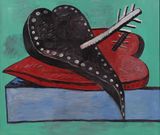
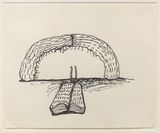
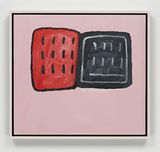
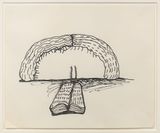
In one 1969 journal entry, McKim notes her habit of scanning the kitchen table, counters, and stove to see ‘what P.‘s been up to’, while he, she says, does the same with her, a mutual attentiveness Guston visualises in a 1975 drawing of McKim’s head looming over an open book. By the early 1970s, his work had become increasingly autobiographical, filled with tender scenes of togetherness with his wife and child alongside images that confront aging, vulnerability, and mortality. In three paintings shown together for the first time in Life with P., he symbolically renders their marriage: two wounded, limp hearts stand in for the couple in Two Hearts (1978); Blue Cover (1977) presents them as block-like bodies bound in bed; and in Untitled (1976), McKim is distilled into those characteristic curls and wide, upward-looking eyes. Reflecting on this period, Guston wrote, ‘There is nothing to do now but paint my life; my dreams, surroundings, predicament, desperation, Musa—love, need’.
Recent and current exhibitions
Guston’s work has been the subject of major institutional attention in the 2020s. The touring retrospective Philip Guston Now—organised by the National Gallery of Art, Tate Modern, the Museum of Fine Arts, Boston, and the Museum of Fine Arts, Houston—was initially postponed in 2020 amid concern that its Klan imagery could be misread during heightened debates about racial justice, a decision that sparked intense criticism and discussion about museums’ responsibilities. When it finally opened, culminating at Tate Modern in 2024, the show placed new emphasis on themes of complicity, racism, and moral reckoning, underscoring Guston’s relevance to contemporary conversations around art and ethics.
In 2024, at Hauser & Wirth in Zurich, Philip Guston: Singularities (7 June–28 September 2024) presented a well-known paintings alongside previously unseen works from 1968 to 1979, highlighting the evolving motifs of his late figuration. In New York, Philip Guston: 1969–1979 at Hauser & Wirth’s 22nd Street gallery focused on the breakthrough decade when he abandoned abstraction for a new figurative language, bringing together eighteen major paintings, many never exhibited, that trace the development of his hooded figures and other emblematic forms.
Beyond gallery shows, Philip Guston: The Panel Paintings, 1968–1972 at The Metropolitan Museum of Art in New York (2024–2026) examines his experimental panel-format works from the period immediately surrounding his shift back to figuration. Additional works continue to feature in broader surveys of modern and postwar art in museums across North America and Europe, reflecting his entrenched position in the canon.
Influence on contemporary painting
Guston’s late, confrontational figuration helped lay the groundwork for movements such as Neo-Expressionism and has deeply influenced painters including Dana Schutz, Nicole Eisenman, Tala Madani, and Kerry James Marshall, among others. His willingness to embrace vulnerability, ambiguity, and moral complexity has reshaped expectations of what politically engaged painting might look like, encouraging artists to mine personal mythology, irony, and critique in tandem. The renewed focus on his domestic and collaborative life with Musa McKim only amplifies his relevance for a generation of artists interested in how private experience and public history collide on the canvas.
Awards, Exhibitions, and Reception
Guston received significant recognition in his lifetime, including a Guggenheim Fellowship (1947), the Prix de Rome (1949), and membership in the American Academy of Arts and Letters (1972). His work has been featured in landmark solo and group exhibitions at institutions such as SFMOMA, The Metropolitan Museum of Art, Tate Modern, the Whitney Museum of American Art, the Royal Academy of Arts, and many others.
Philip Guston FAQs
Who was Philip Guston?
Philip Guston (born Phillip Goldstein, 1913–1980) was a Canadian American painter known for moving from social realist murals to Abstract Expressionism and later to a stark, cartoon-like figurative style.
What is Philip Guston best known for?
Philip Guston is best known for his late figurative paintings featuring cartoonish forms, hooded Ku Klux Klan figures, and everyday objects like shoes, light bulbs, and cigarettes, which explore complicity, power, and the banality of evil.
Why did Philip Guston paint Ku Klux Klan figures?
Philip Guston used Klan imagery as an allegory for racism, political violence, and his own sense of moral complicity, famously describing the hooded figures as self-portraits rather than depictions of others.
Why was the exhibition Philip Guston Now controversial?
The touring retrospective Philip Guston Now was postponed in 2020 over concerns that his Klan imagery might be misinterpreted during racial justice protests, sparking debate about censorship and museums’ responsibilities before it ultimately opened with expanded contextual material.
What is “Life with P.”?
Life with P. – Philip Guston: Paintings and Drawings 1964–1978 is a Hauser & Wirth New York exhibition focusing on Guston’s intimate works about his marriage to poet Musa McKim and their life in Woodstock, including ‘Poem Pictures’ and several never-before-exhibited large paintings.
What is the book Life with P.: Journals, 1966–1976?
Published by Hauser & Wirth Publishers, this illustrated book presents McKim’s previously unpublished journals from 1966–1976, edited by their daughter Musa Mayer, giving an intimate view of the couple’s domestic life and Guston’s pivotal late period.
Who was Musa McKim and how did she influence Guston?
Musa McKim was a poet and Guston’s wife; her writing and their shared domestic life in Woodstock informed his late iconography of beds, books, bricks, and everyday objects, many of which appear in his “Poem Pictures” and autobiographical paintings.
What are Philip Guston’s ‘pure drawings’?
In the mid-1960s, Guston set painting aside to focus on spare, linear works he called ‘pure drawings’, a period that led directly into the development of his late figurative language.
What movements was Philip Guston associated with?
Guston was a key figure in the New York School and Abstract Expressionism, and his later work helped pave the way for Neo-Expressionism and other forms of politically and psychologically charged figurative painting.
Where can I see Philip Guston’s work now?
Philip Guston’s work is held in major museums including the National Gallery of Art, Tate, SFMOMA, the Whitney Museum of American Art, and The Metropolitan Museum of Art, and continues to feature in exhibitions at institutions and galleries such as Hauser & Wirth.
What are Philip Guston’s most famous paintings?
Frequently cited works by Philip Guston include The Studio (1969), Bad Habits (1970), Riding Around (1969), and the late figurative canvases that established his signature lexicon of hoods, shoes, and everyday objects.
How did Philip Guston influence contemporary artists?
Philip Guston’s shift from abstraction to raw figuration and his mix of dark humour, politics, and personal mythology have been influential for artists such as Dana Schutz, Nicole Eisenman, Tala Madani, and Kerry James Marshall.
How much are Philip Guston’s paintings worth?
Philip Guston’s works command high prices at auction; for example, To Fellini set a record in 2013 when it sold for around $25.8 million at Christie’s.
What are some key themes in Philip Guston’s art?
Recurring themes in Philip Guston’s work include racism, antisemitism, fascism, American identity, guilt and complicity, the brutality of the world, and the tensions of domestic and inner life.
Ocula | 2026














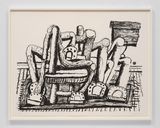


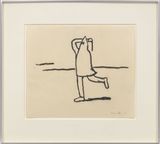


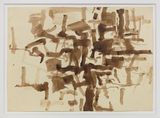

Philip Guston in Ocula Magazine



Explore and Follow Artists Shaping Contemporary Art
A respected voice in contemporary art discourse.
Focusing on ambitious storytelling and insightful art-world commentary. Ocula Magazine publishes in-depth interviews, critical essays and timely analysis on the artists, exhibitions and ideas driving the global art world.
Learn more about Ocula Magazine
Showcasing the best of the art world.
Ocula partners with galleries from around the world to highlight their artists, artworks and exhibitions. Gallery membership is by application and invitation, with each member vetted by an independent panel.
Learn more about Ocula Membership
Specialises in the sale of major artworks.
Led by a team with deep ties to the world’s leading auction houses, galleries and collectors. Ocula’s advisory team offers bespoke services to high-net-worth clients from around the world who are looking to acquire the best of contemporary and modern art.
Learn more about our team and services