



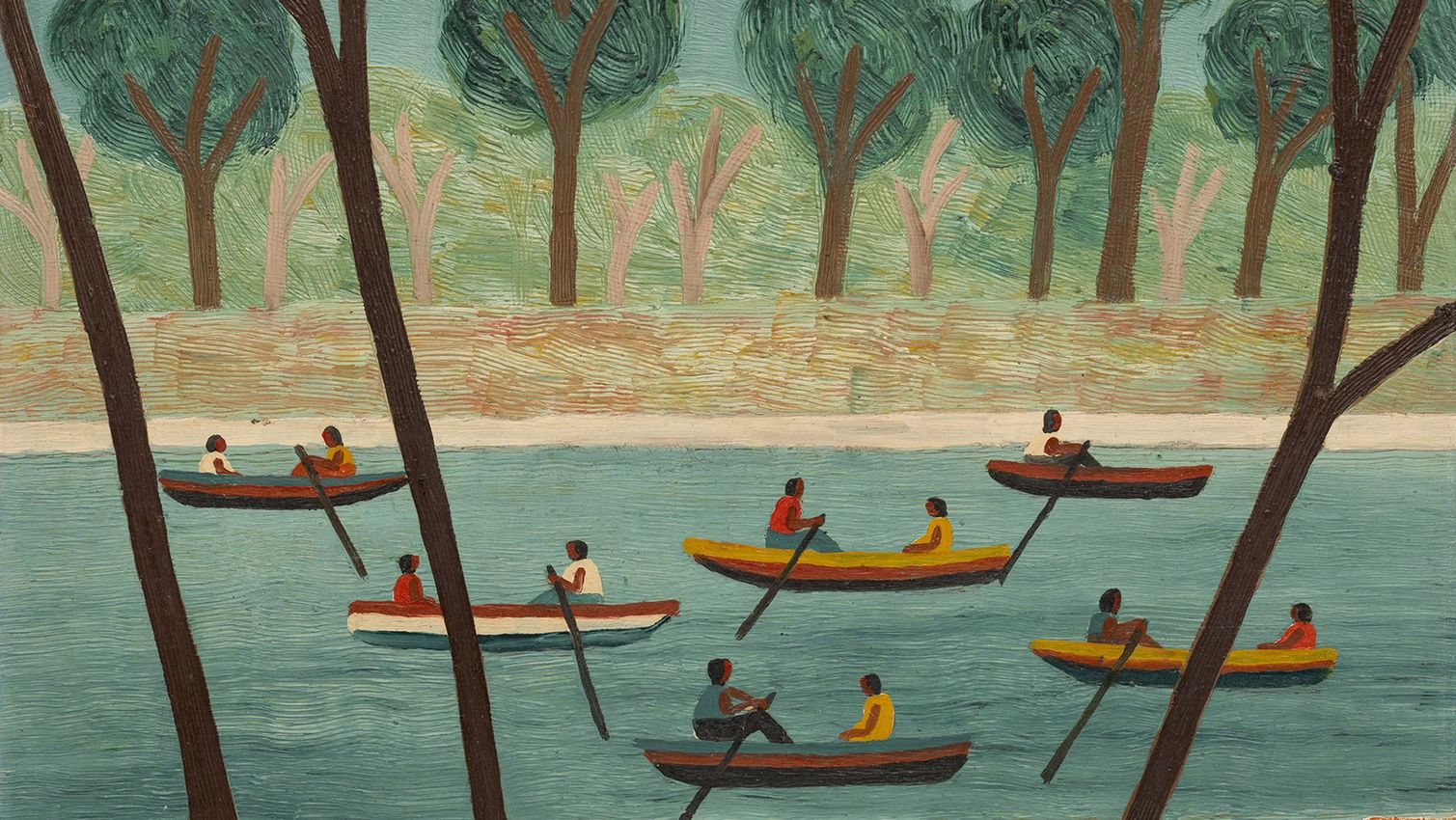
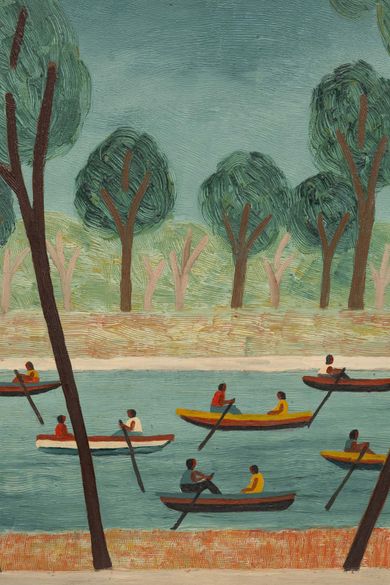
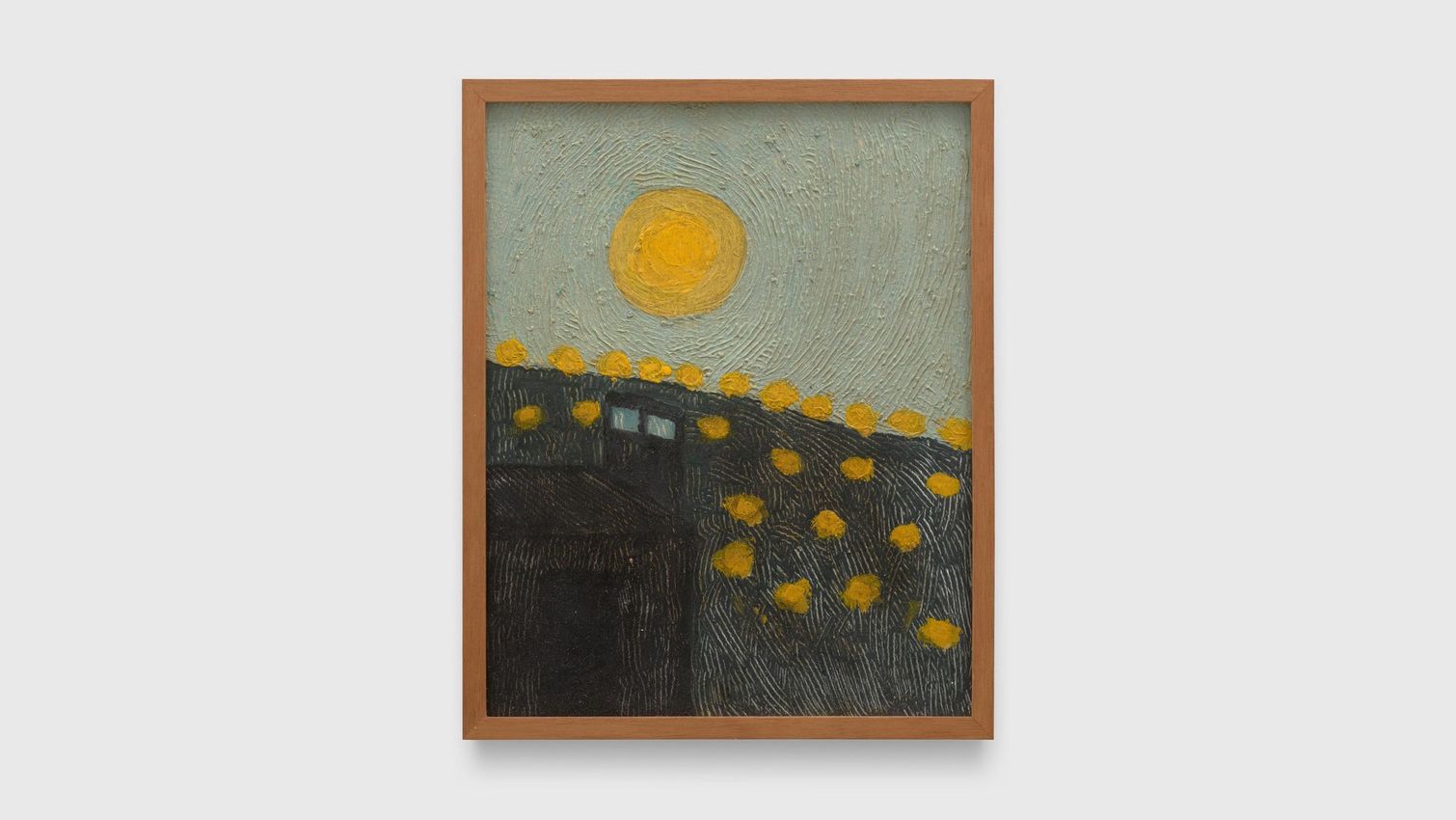
David Zwirner is pleased to present an exhibition of paintings by Brazilian artist Amadeo Luciano Lorenzato (1900–1995), on view at the gallery’s Hong Kong location. Marking the artist’s third solo exhibition with the gallery and the first presentation of his work in Asia, this exhibition coincides with Lorenzato’s inclusion in the 60th Venice Biennale, organized by curator Adriano Pedrosa, on view through November 24, 2024.
Among the foremost Brazilian artists of his generation, Lorenzato developed a singular body of paintings centred on his fastidious observations of everyday subjects in his hometown of Belo Horizonte—including favelas, semi-urban landscapes, and scenes of agriculture and rural industry. Lorenzato’s distinctive compositions are characterised by reduced geometric forms and densely textured surfaces that the artist achieved through the use of richly coloured self-made pigments applied with brushes and enhanced with combs and forks. Imbued with an assured freedom of expression, these canvases masterfully capture the vitality of the artist’s surroundings as well as the colours and textures of the natural world. As Rodrigo Moura, Lorenzato scholar and chief curator at El Museo del Barrio, New York, notes, ‘Lorenzato’s paintings are not only born out of the desire to construct his own reality but also to contain the other dimensions that coexist within it, such as gesture, nature, and silence.’
Spanning the last three decades of Lorenzato’s career, the works in this exhibition embody many of the primary concerns of the artist’s mature oeuvre in both subject matter and form. Paintings on view include depictions of vernacular architecture, pastoral landscapes, and quotidian figurative scenes that call on Lorenzato’s lived experience. Of particular prominence in this presentation are paintings of favelas—working-class shantytowns that have become familiar, even quintessential images of informal urbanity and rural culture in Brazil—which as a whole constitute Lorenzato’s largest body of work and earned the artist early fame, due in part to the commercial popularity of Brazilian modern art focused on the subject. He had personally witnessed the construction of a favela near his home in an area used for the reforestation of eucalyptus trees; the subject, both architectural and personal, provided the artist a generative space for formal experimentation.
Moura elaborates: ‘Lorenzato’s Favelas are the construction site of his ever-developing modernity. In these paintings, we find geometric blocks, flat concrete slabs, parapets or platbands, primary-coloured rectangles, and rhomboid shapes set against red skies. These elements recur on successive planes, all of which ignore the theory and practice of perspective.... The paintings convey an unsystematic body of thought in which the Eurocentric canon, represented by Italian Renaissance painting—Lorenzato’s spiritual matrix—is transfigured by a specific, Global South social experience. Modern architecture appears in a reprocessed form in suburban houses built by suburban contractors, and their styles resonate in Lorenzato’s facades. This marginal modernity, built on social injustice and unplanned urbanisation, is depicted through bold shapes and bright colours.’
Other paintings in the exhibition showcase Lorenzato’s long-standing preoccupation with landscape—ranging from vast rural horizons of sun, sky, and land to close-up nature studies wherein tree branches or a single plant fill the entire picture plane. These works exemplify his restrained formal approach combined with his signature treatment of texture and colour. As art historian Claudia Giannetti Nölle observes, ‘Especially through his ability to represent reality, he is able to transform or metamorphose elements of nature or human figures, conferring upon them a magical quality that can only be achieved through genuine abstraction of real forms and figures. His method of capturing everyday life and expressing it in drawings or oil paintings goes well beyond mere simplification.... The image seems to go through a process of distillation. He eschews finer details and focuses instead on the essential lines which make up the image he observes.’
Seen together, these works express an important crosscurrent between Brazilian art and broader modernist movements of the twentieth century. While he kept on hand a worn copy of painter Giorgio Vasari’s famous sixteenth-century book on artists of the Italian Renaissance and was known to express admiration for painters such as Cézanne, Van Gogh, Monet, and Manet, Lorenzato operated as a singular and distinctly Brazilian artist—albeit with European roots. Often using geometric shapes to suggest objects in real space, his paintings show a visual parallel to the work of Italian-born Brazilian modernist painter Alfredo Volpi (1896–1988), who similarly painted everyday subjects in São Paulo. Lorenzato’s position as a working-class artist—an atypical identity in Brazilian cultural circles until the later decades of the twentieth century—set him apart, both for his perspective on the rural vernacular and for his influence on local contemporaries. Legendary in his hometown, Lorenzato created work that was collected by fellow artists in Belo Horizonte, who introduced it to new audiences in São Paulo when they moved to the urban center in the 1990s, bringing wider awareness to the artist’s oeuvre.
Recent critical and institutional attention to Lorenzato’s work has expanded the appreciation of his art far beyond the regional recognition it received during his lifetime. This exhibition celebrates Lorenzato’s contribution to a global modernist canon, in which the nuances and textures of the artist’s intimate compositions can be considered alongside the universality of his colourful language.

Amadeo Luciano Lorenzato (1900–1995) was a Brazilian modernist painter whose works vividly portray everyday life in Belo Horizonte—Brazil’s first planned city—and its surroundings. Lorenzato’s paintings capture an essence of Brazilian culture and landscapes, reflecting a deep connection to his environment.


A respected voice in contemporary art discourse.
Focusing on ambitious storytelling and insightful art-world commentary. Ocula Magazine publishes in-depth interviews, critical essays and timely analysis on the artists, exhibitions and ideas driving the global art world.
Learn more about Ocula Magazine
Showcasing the best of the art world.
Ocula partners with galleries from around the world to highlight their artists, artworks and exhibitions. Gallery membership is by application and invitation, with each member vetted by an independent panel.
Learn more about Ocula Membership

Specialises in the sale of major artworks.
Led by a team with deep ties to the world’s leading auction houses, galleries and collectors. Ocula’s advisory team offers bespoke services to high-net-worth clients from around the world who are looking to acquire the best of contemporary and modern art.
Learn more about our team and services