David Zwirner New York is pleased to present an exhibition of work by Dan Flavin (1933–1996), Donald Judd (1928–1994), John McCracken (1934–2011), and Fred Sandback (1943–2003), four of the most innovative American artists of the twentieth century. Each artist will be represented by a focused presentation of his work in a single room, allowing visitors to experience both the commonalities and distinctions in the individual approaches to reductive form, material, colour, and space.
Included in the exhibition will be a series of twelve works by Dan Flavin from 1995, each consisting of two four-foot lamps positioned horizontally on a wall with a single two-foot lamp centred between them, in various colour combinations. Made just a year before Flavin’s death, these works were first shown as a group in 1996. Installed together for the first time since their initial presentation, they underscore the artist’s innate facility with serial permutations.
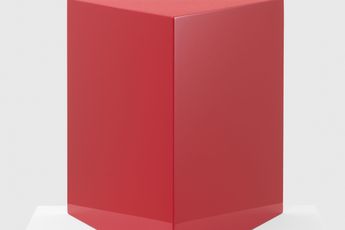
Likewise, a grouping of wall-mounted boxes by Donald Judd explores the primary preoccupations of the artist’s body of work, such as the relationships between surface and volume and interior and exterior space, thus demonstrating his visionary approach to using industrial material as well as his considered attitude toward proportion and installation.
An installation by John McCracken features six individual columns of similar but slightly differing sizes and tones of black installed in two rows of three. The notion of grouping columns in a grid was first formulated by McCracken in a sketchbook from the early 1970s, but was not realized until 2006 on the occasion of this work’s inclusion in the artist’s solo exhibition at David Zwirner New York.
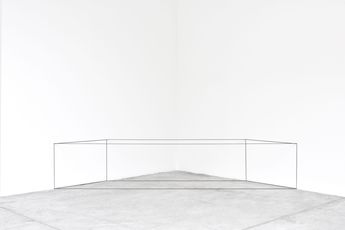
Fred Sandback‘s multipart vertical sculptures originated at the beginning of his artistic career with works installed in his studio at Yale School of Art in 1967. On view will be an eighteen-part vertical construction in blue, black, and yellow yarn conceived in 1987—the year of his important midcareer solo presentation at the Westfälischer Kunstverein, Münster, that featured his vertically oriented works. The artist remarked on his focus on verticality in the exhibition’s catalogue, ‘Isn’t it quite natural to create vertical things, since this corresponds to the human body carriage?’1 The axes of the individual yarn lines permit the viewer to discern multiple parallel and intersecting planes.
1 Fred Sandback, quoted in Marianne Stockebrand, Fred Sandback: Vertical Constructions. Exh cat. (Münster: Westfälischer Kunstverein, 1987), p. 9.


A respected voice in contemporary art discourse.
Focusing on ambitious storytelling and insightful art-world commentary. Ocula Magazine publishes in-depth interviews, critical essays and timely analysis on the artists, exhibitions and ideas driving the global art world.
Learn more about Ocula Magazine
Showcasing the best of the art world.
Ocula partners with galleries from around the world to highlight their artists, artworks and exhibitions. Gallery membership is by application and invitation, with each member vetted by an independent panel.
Learn more about Ocula Membership

Specialises in the sale of major artworks.
Led by a team with deep ties to the world’s leading auction houses, galleries and collectors. Ocula’s advisory team offers bespoke services to high-net-worth clients from around the world who are looking to acquire the best of contemporary and modern art.
Learn more about our team and services