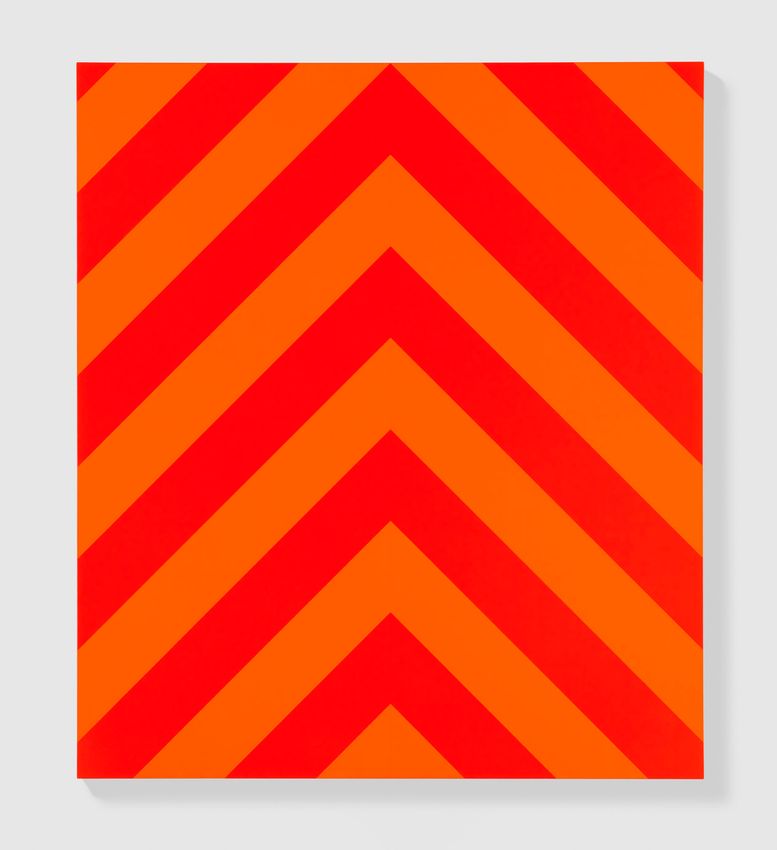
‘It’s about violence and danger and escapism and death and warning signs and being safe or getting caught.’ —Damien Hirst
Gagosian is pleased to present Emergency Paintings, Danger Paintings, Hazard Pictures and Seizures, the third phase of Damien Hirst‘s yearlong takeover of the Britannia Street gallery. The exhibition features paintings, photographs, and sculptures that address the experiences and emotions of warning, danger, crime, rescue, and death. The works take their inspiration from a variety of sources, including the bold designs on emergency vehicles, the skins of dangerous animals, and media images of police activity. The exhibition follows the inaugural installment in the takeover sequence, Fact Paintings and Fact Sculptures, and the second, Relics and Fly Paintings.
The ‘Emergency Paintings’ series (2014–16) was born from long car journeys during which Hirst was struck by the graphics emblazoned on emergency vehicles and their use of colour as a warning. He took photos of these disturbing and beautiful designs with his phone and incorporated their high-visibility stripes and chevrons into his paintings. Powerfully conveying a sense of real-world crisis, these works also evoke the hard-edge abstractions of such painters as Ellsworth Kelly, Kenneth Noland, and Frank Stella. Featured alongside the paintings is a framed selection of Hirst’s original source photos, which the artist values for their raw documentary quality: ‘They aren’t careful or considered. . . . They are quick and easy snaps taken as the world was flying by,’ he remarks, ‘and all the better for it.’
Also on view at Britannia Street are several smaller oil-on-canvas compositions from the related series ‘Danger Paintings’ (2016). These show close-up views of the skin of dangerous animals including poisonous frogs, snakes, insects, and sea creatures—living things that employ colour and pattern to signal their danger to potential predators. As Hirst notes, this colouration represents ‘a thing that nature does that’s similar to what we do on emergency vehicles. We stole the idea from nature, of course, and hid it in geometry.’
Finally, the exhibition includes several sculptures based on media photographs of police drug seizures, in which large quantities of illegal substances are displayed to promote the authorities’ success. The ‘Seizures’ series (2021) represents a continuation of Hirst’s long-standing fascination with drugs and medicine—which has also resulted in such iconic series as ‘Instrument Cabinets’, ‘Medicine Cabinets’, and ‘Pill Cabinets’—and reflects his interest in and use of systems of taxonomy and display.
Damien Hirst first rose to public recognition in 1988 during his time studying at Goldsmiths College in London, when he conceived and curated Freeze, a group exhibition of his work and that of his contemporaries at Goldsmiths. In the near quarter century since that pivotal show, Hirst has become one of the most prominent artists of his generation. Through work that includes the iconic shark suspended in formeldahyde, The Physical Impossibility of Death in the Mind of Someone Living (1991), to the platinum cast of a human skull set with 8,601 flawless diamonds, For the Love of God (2007), Hirst takes a direct and challenging approach to ideas about existence. Of the latter, art historian Rudi Fuchs has said, ‘The skull is out of this world, celestial almost. At the same time, it represents death as something infinitely more relentless. Compared to the tearful sadness of a vanitas scene, the diamond skull is glory itself.’ His work calls into question our awareness and convictions about the boundaries that separate desire and fear, life and death, reason and faith, love and hate. Hirst uses the tools and iconography of science and religion, creating sculptures and paintings whose beauty and intensity offer the viewer insight into art that transcends our familiar understanding of those domains. ‘There [are] four important things in life: religion, love, art and science,’ the artist has said. ‘At their best, they’re all just tools to help you find a path through the darkness. None of them really work that well, but they help. Of them all, science seems to be the one right now. Like religion, it provides the glimmer of hope that maybe it will be all right in the end…’


A respected voice in contemporary art discourse.
Focusing on ambitious storytelling and insightful art-world commentary. Ocula Magazine publishes in-depth interviews, critical essays and timely analysis on the artists, exhibitions and ideas driving the global art world.
Learn more about Ocula Magazine
Showcasing the best of the art world.
Ocula partners with galleries from around the world to highlight their artists, artworks and exhibitions. Gallery membership is by application and invitation, with each member vetted by an independent panel.
Learn more about Ocula Membership

Specialises in the sale of major artworks.
Led by a team with deep ties to the world’s leading auction houses, galleries and collectors. Ocula’s advisory team offers bespoke services to high-net-worth clients from around the world who are looking to acquire the best of contemporary and modern art.
Learn more about our team and services