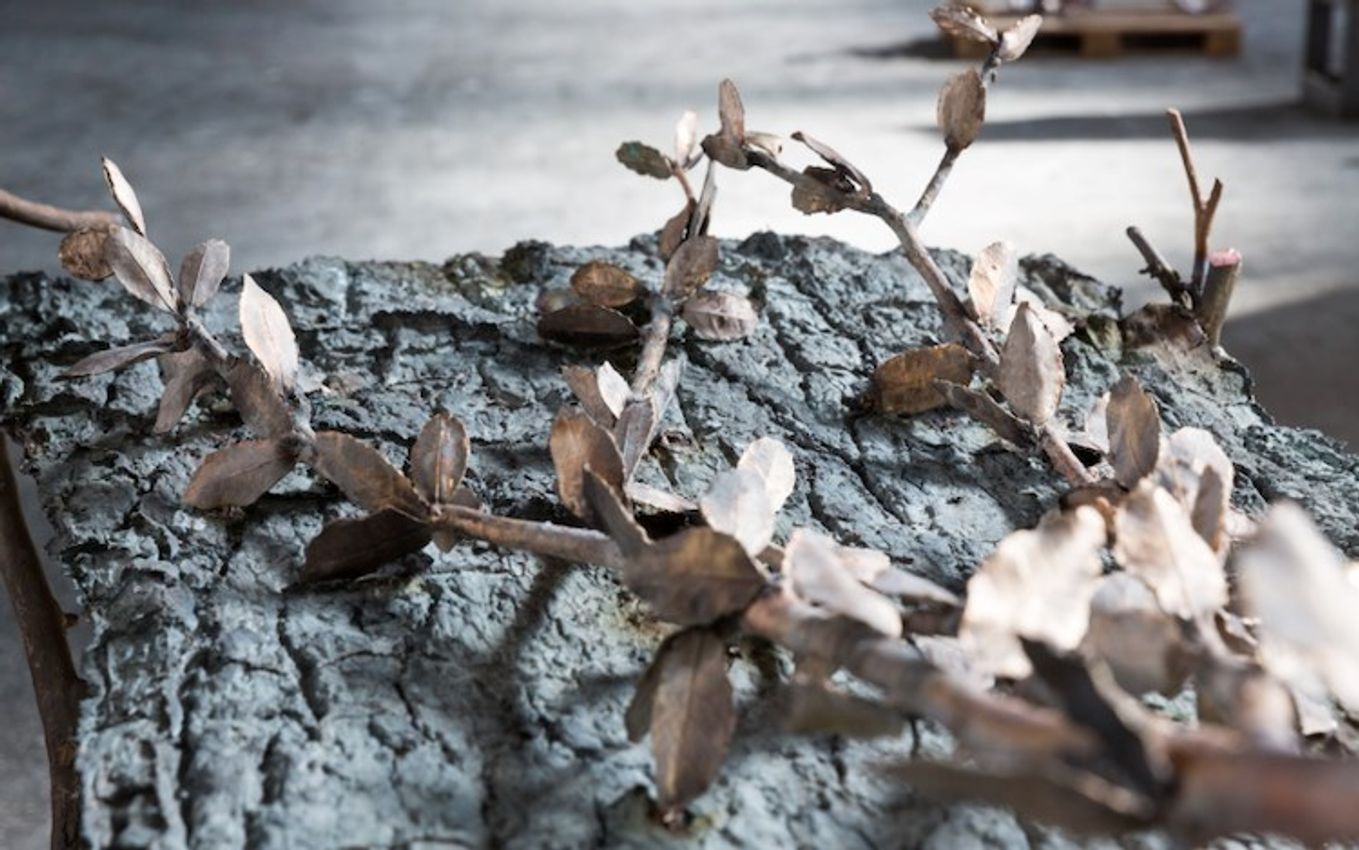
The bifurcations of the trees that appear so intimately human to us...The bifurcations of the fingers, by their movement through space, form the branches, the roots, and by the succession of actions in the same points, construct the branches and trunk of the plant. The woodland landscape is the action of sculpture.’
-Giuseppe Penone
Gagosian is pleased to present an exhibition of sculptures and drawings by Giuseppe Penone, his first in San Francisco.
Penone uses objects from the natural world to document the intertwined relationship between humans and nature in evolution over a macroscopic, geological timeline. He was a proponent of the radical Arte Povera movement, beginning in Italy in the 1960s, which used ‘poor’ and unconventional materials such as soil or plant matter to evoke a preindustrial age and subtly critique systems of industrialisation, mechanisation, and art. Penone’s earliest works included site-specific sculptures situated in the woods around his Piedmont hometown-the start of a decades-long fascination with the arboreal that is still prevalent in his work today.
This exhibition will feature a selection of works in bronze, stone, and marble illustrating Penone’s ability to seamlessly transpose human-made and naturally occurring patterns. In Respirare l’ombra - foglie di tè (To Breathe the Shadow - Leaves of Tea) (2008), a branch-like pair of bronze lungs emerges from a metal-gridded wall of tea leaves, creating a direct link between plant respiration and the inhalation and exhalation of human breath. Freestanding sculptures such as the cast bronze foliage of Pensieri di foglie (Thoughts of Leaves) (2014-2017) compare traces made by the artist’s hand to the weathering and degenerative marks made on plants and minerals as they are left to the elements.
In a group of works on paper from 2015-2016 in watercolour, coffee, and pencil, Penone further explores the points of simultaneous connection and separation posited in the organic geometries of Pensieri di foglie. The wall-hung marble slabs of Corpo di pietra - rami (Body of Stone - Branches) (2016), in which bronze twigs extend from veined white stone, suggest the slow outgrowth of one element from the other. Penone positions time as a transformative agent, using poetic, indexical mark making to minutely track involuntary processes such as respiration, growth, and ageing. He blurs the distinction between human, botanical, and mineral life, giving form to their coexistence.
‘The veins of water that pour from the earth flow in trickles that merge, like the branches in the trunk, like the fingers in the palm of a hand, like the bronze in the matrix of a tree.’—Giuseppe Penone


A respected voice in contemporary art discourse.
Focusing on ambitious storytelling and insightful art-world commentary. Ocula Magazine publishes in-depth interviews, critical essays and timely analysis on the artists, exhibitions and ideas driving the global art world.
Learn more about Ocula Magazine
Showcasing the best of the art world.
Ocula partners with galleries from around the world to highlight their artists, artworks and exhibitions. Gallery membership is by application and invitation, with each member vetted by an independent panel.
Learn more about Ocula Membership

Specialises in the sale of major artworks.
Led by a team with deep ties to the world’s leading auction houses, galleries and collectors. Ocula’s advisory team offers bespoke services to high-net-worth clients from around the world who are looking to acquire the best of contemporary and modern art.
Learn more about our team and services